For decades, oceanographer Jon Zehr was chasing a ghost. He knew a specific nitrogen-fixing bacteria existed in the ocean — a tiny, glow-orange unicellular cyanobacteria crucial for life on Earth. He had its genetic signature, a tell-tale gene for an enzyme called nitrogenase. He found that signature everywhere from Hawaii to the Arctic. But when he looked through his microscope, the bacteria was always, stubbornly, invisible.
It was like finding footprints without the animal. And this wasn't just any animal; it was one that defied a fundamental biological rule. All living things need nitrogen for DNA and proteins. Our atmosphere is full of it. But nitrogen gas can't be used by plants or animals because the enzyme required to pull it from the air, nitrogenase, falls apart in oxygen. Only simple organisms like bacteria and archaea can do this trick, and they do it in oxygen-free environments.

Zehr's mystery bacteria, however, seemed to have lost 80% of its genome, including genes vital for survival. And it was photosynthetic, which means it should produce oxygen. How could it be alive, let alone fix nitrogen?
We're a new kind of news feed.
Regular news is designed to drain you. We're a non-profit built to restore you. Every story we publish is scored for impact, progress, and hope.
Start Your News DetoxThen he noticed a pattern: every time the bacteria's DNA showed up, so did the DNA of a specific type of algae. He wondered if his invisible bacteria was hiding inside the algae, using it as a biological oxygen-free apartment. He just didn't know that half a world away, someone else was already working on the other side of this very specific, very tiny puzzle.
The Algae Whisperer
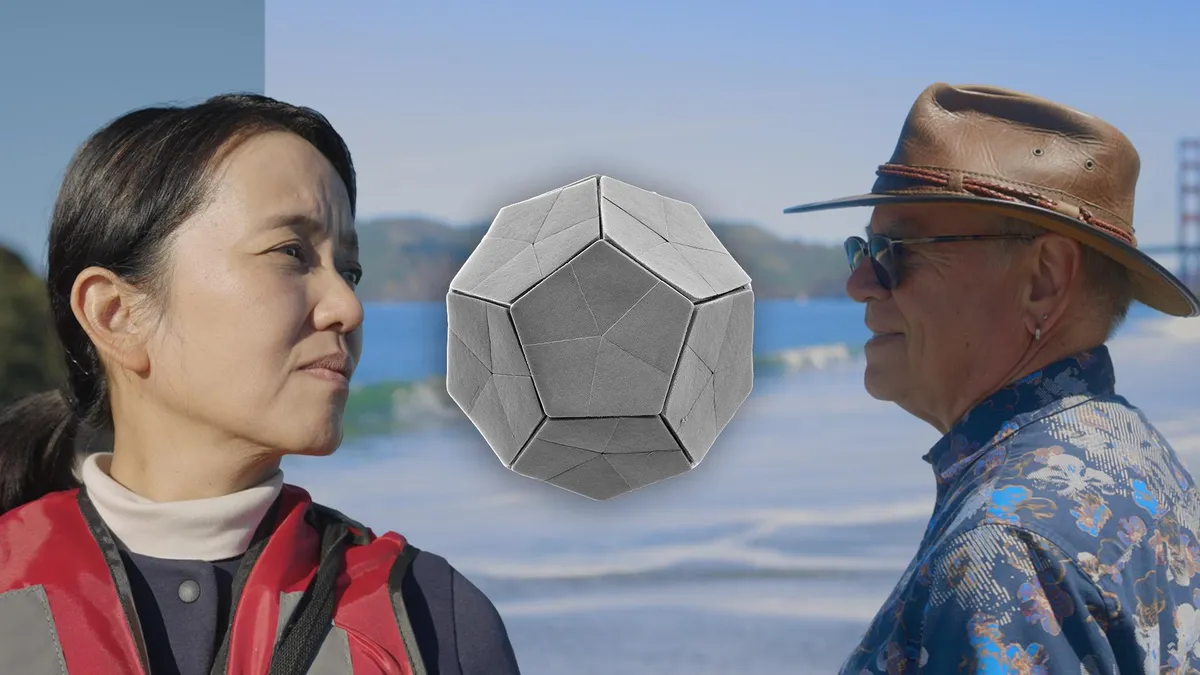
Kyoko Hagino, an algae scientist in Kochi, Japan, had her own obsession. In the late 1990s, she became captivated by a particular algae called Braarudosphaera bigelowii, or Bigelowii for short. It formed beautiful geometric shells, and Hagino wanted to study the living algae inside. Her boss thought it was a career dead end, especially as Hagino was struggling to find a university job and raising young children. But she couldn't give up on Bigelowii.
With her daughter in tow, Hagino collected seawater samples, picking out Bigelowii cells under a microscope for hours. They wouldn't grow in a test tube. Then, a colleague suggested adding tokoroten, a Japanese jelly noodle made from seaweed, to her culture. To everyone's surprise, the noodles worked. Bigelowii cells started swimming and multiplying, and Hagino noticed a strange black dot in the center of each cell — something she'd never seen in textbooks.
Then, as she prepared to publish her findings, Hagino stumbled upon an article in Science. It was Jon Zehr's paper, theorizing his invisible nitrogen-fixing bacteria lived inside Braarudosphaera bigelowii. The pieces clicked. She ran a genetic test. Positive. She had found Zehr's missing bacteria. Both scientists, working on different continents, had solved half of the same biological riddle.
A New Organelle is Born
Zehr and Hagino teamed up, because their discovery wasn't just a cool find; it was about to rewrite a basic rule of biology. Nature is full of symbiosis, where organisms help each other. Sometimes, these relationships get so cozy that one organism moves in permanently. In rare cases, they merge, becoming one, like mitochondria and chloroplasts, which started as independent cells but evolved into tiny organs, or organelles, inside other cells.
The question was: how close were Bigelowii and its internal bacteria? Hagino sent a culture to Zehr's lab. Then COVID-19 hit, stalling collaboration, but Zehr's team pressed on. They quickly saw clues that this was more than just a typical roommate situation. Bigelowii and the bacteria divided and grew at the same rate, just like mitochondria or chloroplasts.
Then Tyler Coale, a postdoc in Zehr's lab, found the smoking gun. The bacteria had proteins they didn't have the genes to make. Bigelowii, however, had extra genes that produced these proteins, each tagged with a tiny DNA sequence — molecular delivery instructions to send the protein right to the bacteria. Bigelowii had evolved an extra copy for almost every gene the bacteria had lost, each tagged with this sequence. This kind of system had only ever been seen in mitochondria and chloroplasts.
That tiny black dot inside Bigelowii? It was no longer just a bacteria. It had become a part of Bigelowii, an independent microorganism turned organelle. They named it the Nitroplast. This meant Bigelowii had broken a fundamental rule: it was the first known complex organism that could pull nitrogen from the air. The decades-long dream of self-fertilizing plants suddenly felt a little less impossible.
Coale believes this discovery could greatly impact agriculture, noting, "This organism has done what decades of biotech couldn't do... It's natural to think that there might be lessons here that we could learn." Zehr is cautiously optimistic, believing self-fertilizing plants are still far off, but as he points out, "if you don't take one step, you're not going to make 100 steps."
For Hagino, the journey itself is the lesson: "This experience has shown that we don't know which research will be useful and when." Zehr adds, "Some of the biggest, biggest advances might come from things that you didn't expect." Sometimes, you just have to chase the ghost.