Imagine a world where the laws of physics suddenly decide they're more of a 'suggestion' than a rule. Well, welcome to the quantum realm, where scientists just deliberately created a new phase of matter that completely defies our current understanding.
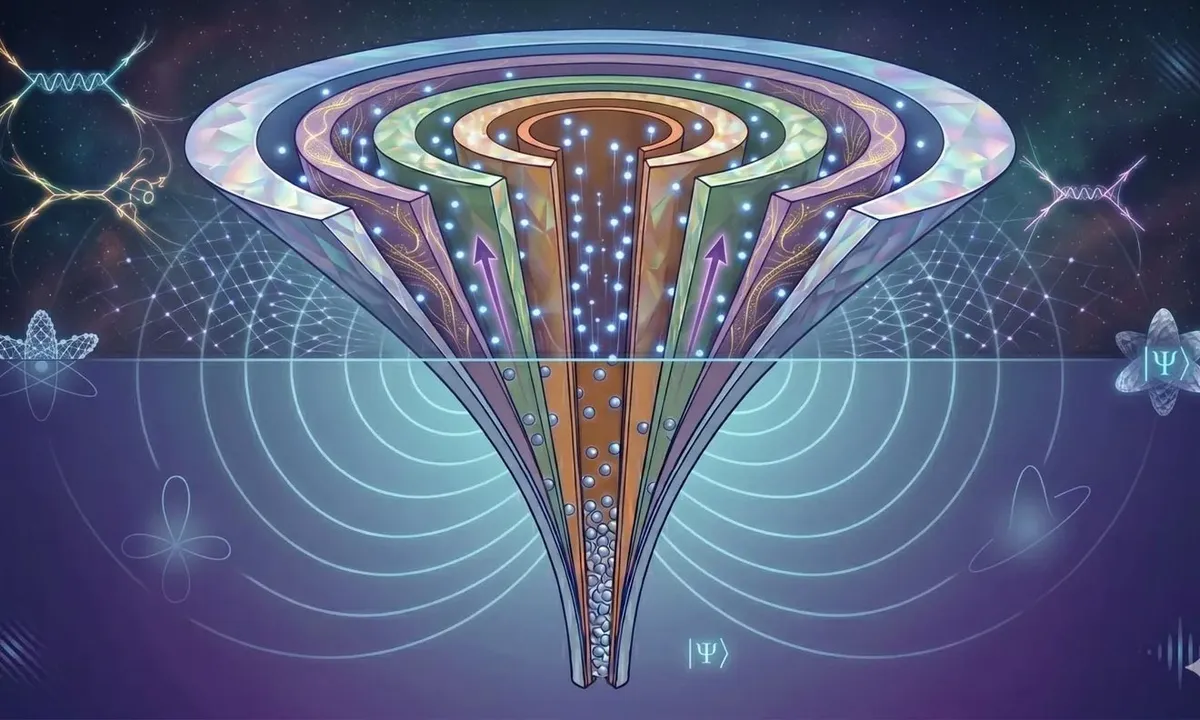
Researchers, led by the Nägerl group and theorist Alvise Bastianello, have intentionally conjured something called a "fractional Fermi sea." It's not just a fancy name; it's a previously unknown state that pushes the boundaries of established theory. Their work, detailed in Physical Review Letters, basically confirms that yes, we can now engineer quantum matter that doesn't occur naturally. Because apparently that's where we are now.
The Recipe for the Unthinkable
To pull this off, the team took ultracold Cesium atoms, confined them to a single dimension (because, you know, easy), and then started messing with their interactions. They cycled these atoms between strong repulsion and strong attraction, repeatedly, like a tiny, very precise quantum disco ball. This pushed the system so far out of its comfort zone, it decided to evolve.
We're a new kind of news feed.
Regular news is designed to drain you. We're a non-profit built to restore you. Every story we publish is scored for impact, progress, and hope.
Start Your News DetoxInstead of settling into a known state, the atoms entered a new critical phase. This wasn't an accident; it was a deliberate act of "quantum engineering." It's proof that by carefully cycling interactions, you can create quantum states that nature simply hasn't gotten around to yet.
What Even Is a Fractional Fermi Sea?
Normally, at super low temperatures, quantum particles called fermions are incredibly tidy. They stack up neatly into energy states, forming what's known as a "Fermi sea." Think of it as a perfectly organized, subatomic filing cabinet. But theorist Alvise Bastianello wondered what would happen if you forced these interacting atoms to go through extreme, cyclical conditions – smoothly shifting them from repelling each other to attracting each other.
The answer? Pure, organized chaos. The atoms were driven from their ground state into a highly excited, yet surprisingly organized, non-equilibrium state. They dubbed it a "fractional" Fermi sea because the particles appear to follow a reduced occupancy rule. It's like the filing cabinet suddenly decided to only use half its drawers, but still knows exactly where everything is.
"Instead of just heating the system, the interaction cycle reorganizes the atoms into a new many-body state," explained lead author Yi Zeng. Which is a very polite way of saying, "We broke it, and it became something better."
Hidden Order and Super-Fermions
This fractional Fermi sea isn't just a hot mess. It has unique, hidden features. There are mathematical relationships between particles that create subtle ripples, and specific decay patterns that differ from anything seen in standard one-dimensional quantum systems, known as Tomonaga-Luttinger liquids. So, not just new, but distinctly new.
"This state is highly excited, but it is not random," said Hanns-Christoph Nägerl, the group's leader. "It has a hidden order that becomes visible in its correlations." He even mused about calling the new quasiparticles "super-Fermions." Which, if you think about it, is both impressive and slightly terrifying.
This discovery isn't just a win for bragging rights; it opens up a whole new frontier for quantum simulation. It proves that our ability to manipulate quantum systems can go beyond mimicking known models. We can now create and test states that exist purely in the realm of theoretical possibility. And if that's not a reason to raise an eyebrow, what is?