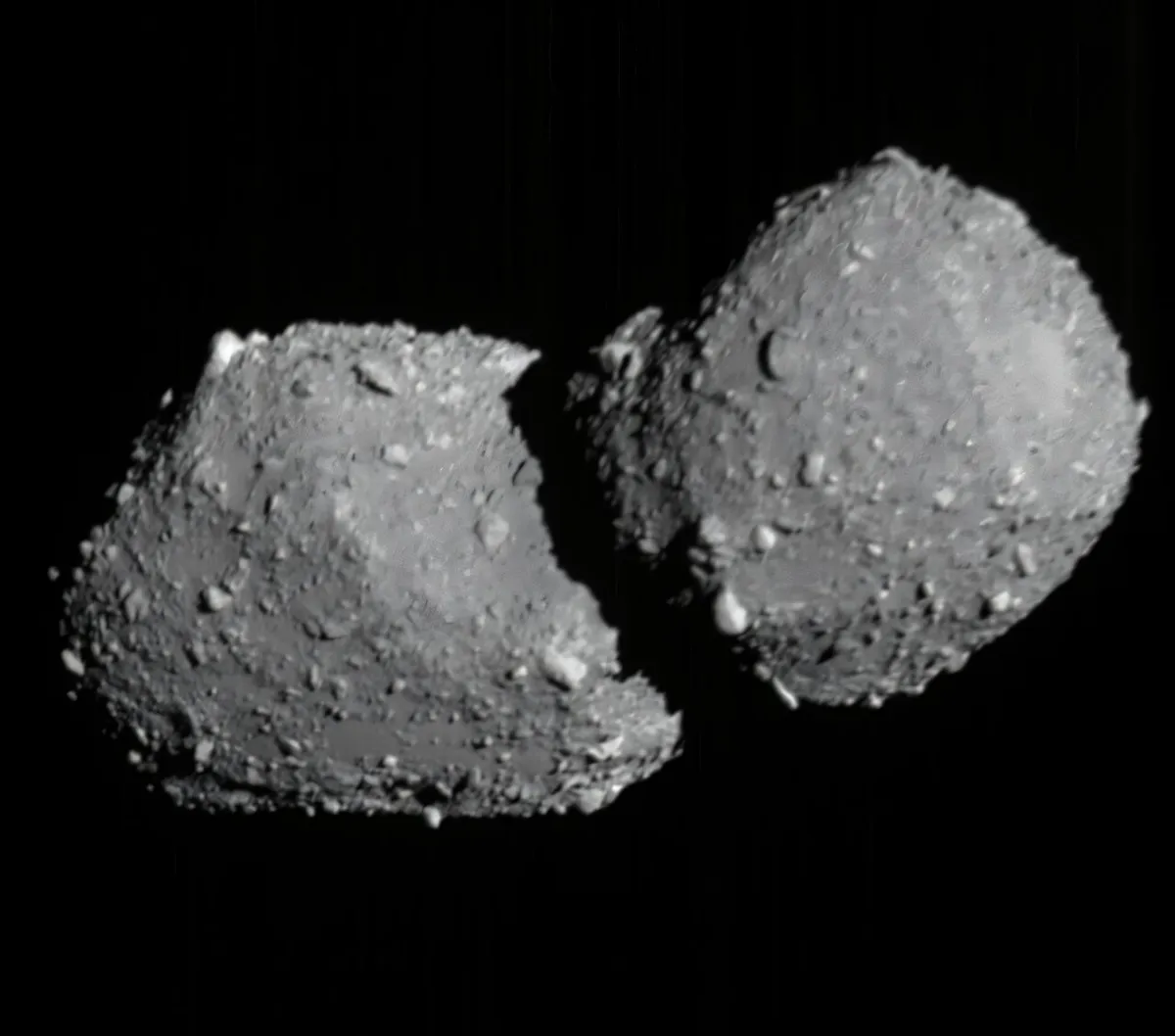
JAXA's Hayabusa 2 spacecraft successfully flew past asteroid Torifune. The mission captured the first close-up images of the asteroid. These images show Torifune is a "contact binary," meaning it formed from two separate asteroids that joined together.
Hayabusa 2's main mission was to asteroid Ryugu. It collected a sample that returned to Earth in December 2020. Now, the spacecraft is on an extended journey to visit other asteroids.
Exploring Asteroid Torifune
Torifune is a near-Earth asteroid, about 450 meters (1,476 feet) wide. It is an S-type asteroid, which means it is stony or siliceous. These are dense objects, making up about 17% of all asteroids.
We're a new kind of news feed.
Regular news is designed to drain you. We're a non-profit built to restore you. Every story we publish is scored for impact, progress, and hope.
Start Your News DetoxHayabusa 2 started observing Torifune in June using its Optical Navigation Camera—Telescopic (ONC-T). On July 5, the spacecraft came within about 800 meters (2,625 feet) of the asteroid. The ONC-T captured detailed images of Torifune's surface.
Ground observations had suggested Torifune was elongated. The new images confirmed it is a contact binary. This happens when two asteroids orbit each other, then spiral inward and merge.
During the flyby, Hayabusa 2 also used its Near-Infrared Spectrometer (NIRS3), Thermal InfraRed Imager (TIR), and Light Detection and Ranging (LIDAR) instruments.
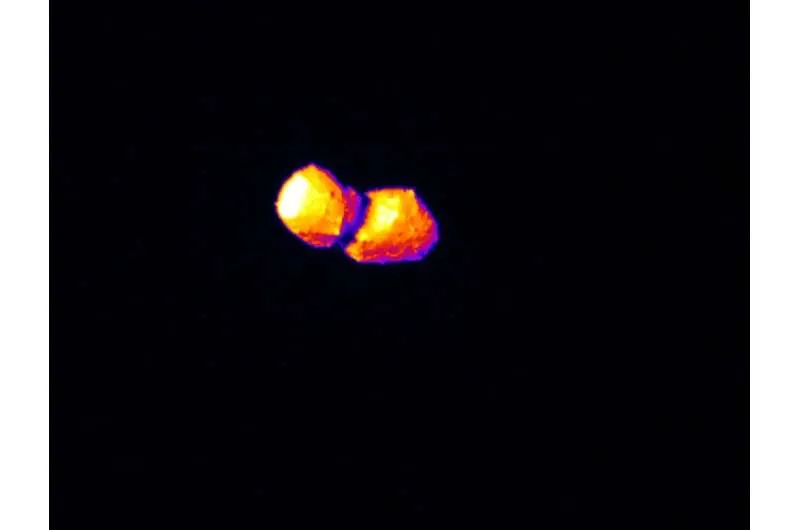
The spacecraft was moving very fast, at 5 km/s (3.1 mi/s), which made navigation and image capture difficult. Hayabusa 2 has less than half of its fuel left. This is enough to reach Torifune and its next target, but not for extra maneuvers.
What's Next for Hayabusa 2
Hayabusa 2 will swing past Earth in December 2027 and again in June 2028. These flybys will help set it on course for its rendezvous with asteroid 1998 KY26 in July 2031.
Asteroid 1998 KY26 is a tiny object, only about 11 meters (36 feet) across. Scientists believe it is rich in water and is likely a single chunk of rock, not a pile of rubble. It might also be an X-type asteroid, a category for objects that look similar through a telescope but have different compositions.
JAXA will release more data from the Torifune flyby soon. The current results are preliminary.