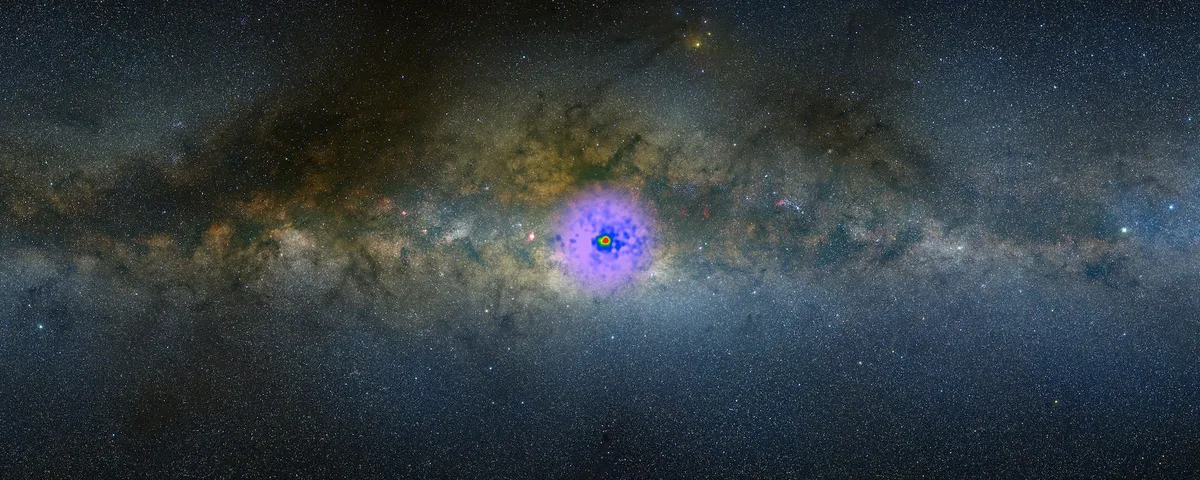
For years, astronomers have been staring at a faint, unsettling glow at the Milky Way's heart, wondering if it's the universe's most elusive ingredient: dark matter. Then, a few years ago, the smart money started betting against it. Now, thanks to some clever machine learning, dark matter is officially back in the running.
An international team, spearheaded by brainiacs from the University of Vienna and Lawrence Berkeley National Laboratory, decided to throw every piece of data they had at the problem. Their conclusion, published in Physical Review Letters, is that we may have been too quick to dismiss the invisible stuff.
The Milky Way's Lingering Question Mark
This cosmic whodunit revolves around something called the Galactic Center Excess (GCE) — a gamma-ray glow stretching thousands of light-years around our galaxy's core. Think of it as a ghostly halo, silently radiating energy, and nobody's quite sure why.
We're a new kind of news feed.
Regular news is designed to drain you. We're a non-profit built to restore you. Every story we publish is scored for impact, progress, and hope.
Start Your News DetoxThe two main suspects? Either dark matter particles, predicted by some theories to annihilate each other in spectacular fashion, or an army of super-fast spinning neutron stars called millisecond pulsars. For a while, the pulsars were winning the popularity contest. After all, they're actual, observable things. Dark matter? Still just a theoretical party guest that never shows up.
As Florian List, one of the study's authors, dryly observed, "understanding the signal is hard" because the Galactic Center is basically a mosh pit of gamma-ray sources. Good luck getting a clean signal there.
When AI Gets Curious
Previous studies, the ones that leaned towards pulsars, had a bit of an oversight: they weren't using all the data. Specifically, they ignored the energy signature of each individual gamma-ray particle. Which, if you think about it, is a bit like trying to identify a criminal just by their height, ignoring their fingerprints.
So, the researchers built a machine-learning system. They fed it over a million simulated gamma-ray observations, training it to look at both where the photons were coming from and how much energy they carried. For the first time, the model could compare the two main theories on a much more granular level.
And that's when things got interesting.
Dark Matter: Still a Strong Contender
Suddenly, the pulsar explanation didn't look so hot. Earlier analyses suggested the glow came from relatively bright, but unseen, point sources. But with the energy data factored in, the new analysis showed that if pulsars were the culprits, they'd have to be incredibly, almost impossibly, faint.
Nick Rodd, another author from Berkeley Lab, put it best: these pulsar sources would be so dim they'd be "almost identical to the emission expected from dark matter." Which is just a wonderfully ironic twist.
In fact, for pulsars to be responsible, we'd need at least 35,000 of them packed into the Milky Way's center. That's a whole lot more than the few hundred or few thousand some earlier research assumed. Imagine trying to park that many tiny, rapidly spinning stars.
So, while this study doesn't definitively point to dark matter as the answer, it certainly yanks the rug out from under the pulsar-only theory. As List noted, the origin of the GCE is one of astrophysics' oldest debates, and it's far too soon to close the case. Looks like the universe still enjoys a good mystery, and dark matter isn't going anywhere just yet.