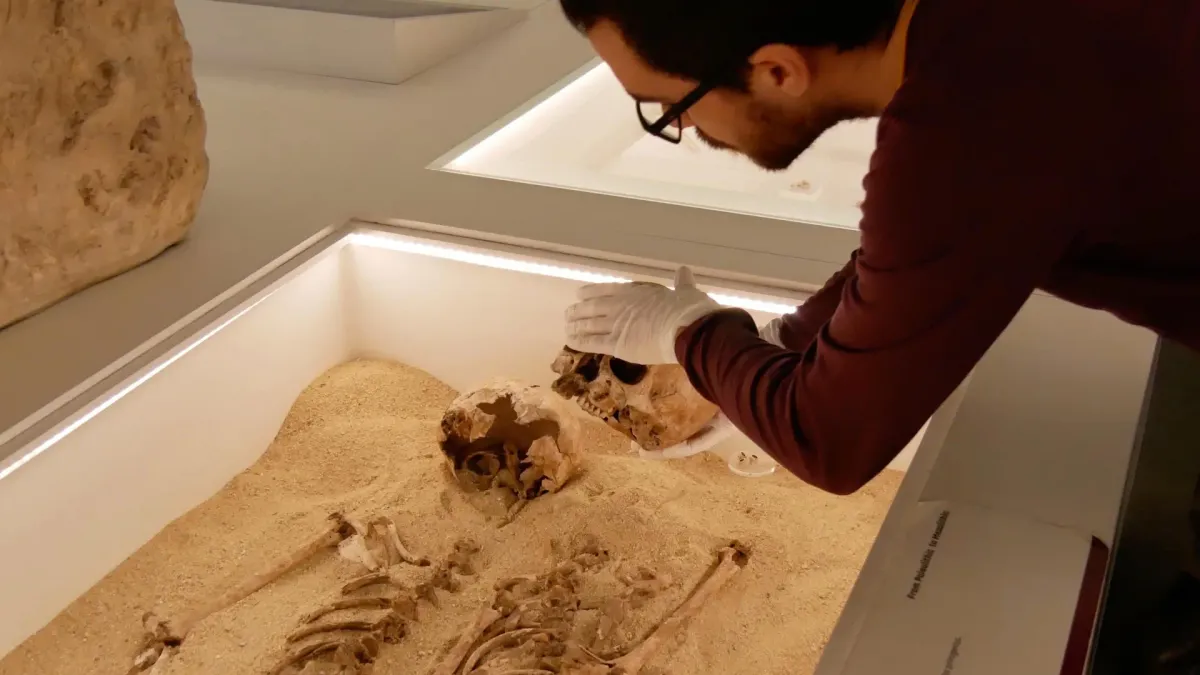
Two skeletons buried in an embrace in southern Italy 12,000 years ago have finally revealed their secret. Scientists extracted ancient DNA from the remains and discovered that a mother and daughter carried mutations in the NPR2 gene — the earliest known genetic diagnosis of a rare inherited growth disorder in human history.
The younger woman, known as Romito 2, stood about 110 cm (3'7") tall. The older woman, Romito 1, measured roughly 145 cm (4'9"). For decades, researchers at the Grotta del Romito burial site in southern Italy puzzled over their unusually short stature and the tenderness of their burial — the two were laid to rest together, suggesting a close bond that transcended their physical differences.
When geneticists analyzed DNA from the skeletons, the picture became clear. Romito 2 had two copies of a mutated NPR2 gene, a condition called acromesomelic dysplasia, Maroteaux type. This rare disorder causes severe short stature and significant limb shortening. Romito 1 carried just one altered copy of the same gene, which explained her milder short stature. They were first-degree relatives — almost certainly mother and daughter.
We're a new kind of news feed.
Regular news is designed to drain you. We're a non-profit built to restore you. Every story we publish is scored for impact, progress, and hope.
Start Your News Detox"By applying ancient DNA analysis, we can now identify specific mutations in prehistoric individuals," says Ron Pinhasi of the University of Vienna, who co-led the study. "This helps establish how far back rare genetic conditions existed."
But the genetics tell only part of the story. What strikes researchers most is that Romito 2 survived into adolescence or adulthood despite a serious physical condition that would have made survival in an Ice Age environment extraordinarily difficult. She couldn't have done it alone. Her community — her mother, her family, her group — must have provided sustained support: help finding food, assistance with movement, care through illness.
This isn't just a genetic puzzle solved. It's evidence of something quieter and more profound: that humans have always cared for their vulnerable members, even when survival itself was precarious. Rare genetic diseases aren't a modern invention, as Adrian Daly of Liège University Hospital Centre notes. They've threaded through human history. Understanding that history — seeing these conditions in our ancestors — might help us recognize and support people living with them today.
The findings appear in the New England Journal of Medicine.