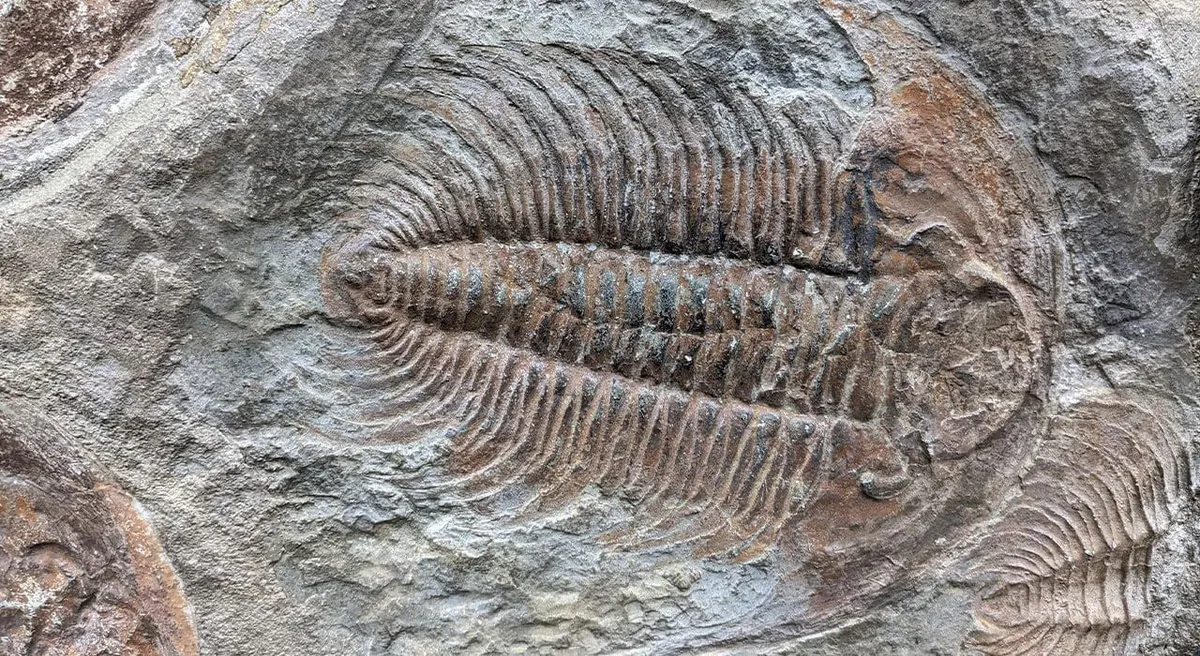
Trilobites have always been fossils that look like fossils — beautiful mineral imprints of creatures that vanished half a billion years ago. But researchers at the University of Texas at San Antonio just found something that changes that: actual organic chemistry preserved inside them, trapped in the rock for more than 500 million years.
The molecule is chitin, the same tough material that makes up crab shells and insect exoskeletons today. It's the first time scientists have confirmed it survived in trilobites, and it shouldn't have lasted this long.
Why This Matters More Than It Sounds
For decades, researchers assumed chitin would break down quickly after an organism died. Microbes and chemical decay are relentless. Complex organic molecules don't usually make it through deep time intact. But a growing body of evidence suggests that under the right conditions — the right burial environment, the right mineral shield — some biological polymers can persist for hundreds of millions of years.
We're a new kind of news feed.
Regular news is designed to drain you. We're a non-profit built to restore you. Every story we publish is scored for impact, progress, and hope.
Start Your News Detox"This study adds to growing evidence that chitin survives far longer in the geologic record than originally realized," says Elizabeth Bailey, the assistant professor who led the work. "Beyond paleontology, this has significant implications for understanding how organic carbon is stored in Earth's crust over geologic time."
That last part is the real story. Chitin is the second most abundant organic polymer on Earth, after cellulose. It's everywhere — in the shells of countless marine creatures, in insect cuticles, in fungi. And if chitin can survive for half a billion years, that means the limestone formations that built up from all these organisms over geological time are doing something unexpected: storing carbon for incomprehensibly long stretches.
When climate discussions turn to carbon sequestration, the conversation usually centers on forests and trees. But Bailey points out that limestones — those familiar pale rocks formed from accumulated shells and skeletons — are part of Earth's long-term carbon storage system too. "Evidence that chitin can survive for hundreds of millions of years shows that limestones are part of long-term carbon sequestration and relevant to understanding Earth's carbon dioxide levels," she explains.
The study examined a limited number of fossils from the Carrara Formation in Western North America, so this isn't a complete picture yet. But it opens a door. Bailey's Early Earth Lab at UTSA is already planning to use these findings as a launchpad for student-led research into how organic molecules persist in geological materials. The work was published in PALAIOS, a journal focused on how life has shaped Earth's history.
The next phase is mapping exactly which conditions allow chitin to survive, and what that tells us about carbon cycles — both ancient and present.