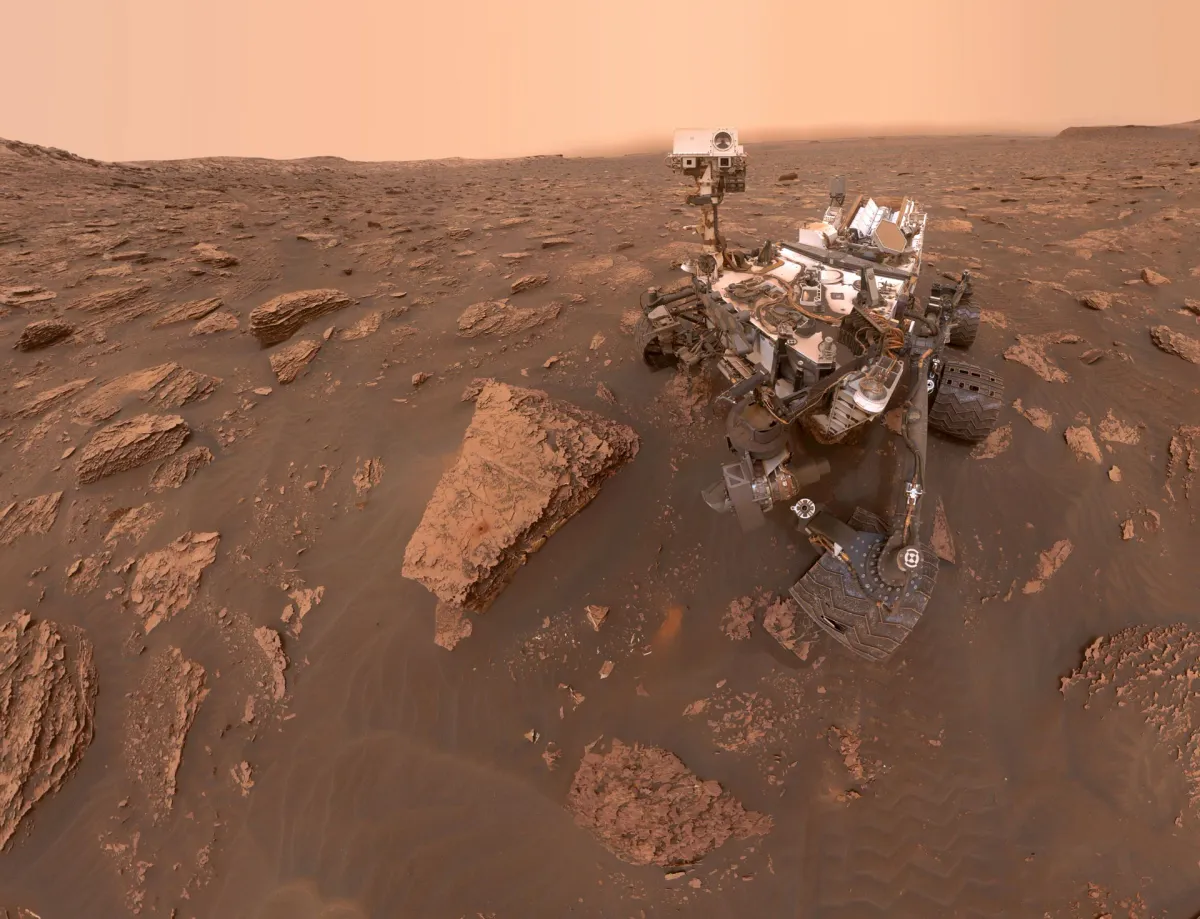
NASA's Curiosity rover has detected something unexpected in a 3.7-billion-year-old Martian rock: organic molecules in quantities that known non-biological processes struggle to account for.
The rover's onboard laboratory, called SAM (Sample Analysis at Mars), heated and analyzed rock powder from Gale Crater and identified three hydrocarbons—decane, undecane, and dodecane—the largest organic molecules ever found on Mars. These carbon-and-hydrogen compounds are thought to be fragments of fatty acids preserved in ancient mudstone, rock that formed from sediment once settled in water. On Earth, fatty acids are the building blocks of cell membranes and are typically made by living things, though certain geological processes can produce them too.
The discovery itself wasn't shocking. Finding organic material on Mars isn't new—Curiosity has been detecting it since 2012. What caught scientists' attention was the amount. So they did something methodical: they tested whether meteorites and other known non-biological sources could explain the abundance they measured.
We're a new kind of news feed.
Regular news is designed to drain you. We're a non-profit built to restore you. Every story we publish is scored for impact, progress, and hope.
Start Your News DetoxThe Case Non-Biology Can't Close
Meteorites regularly bombard Mars and carry carbon-rich materials. Scientists modeled whether this cosmic delivery, combined with standard chemical reactions, could produce the observed levels. The math didn't work. In a February 2025 Astrobiology paper, the team reported that non-biological explanations alone fell short of matching what they found in the rock.
To reach this conclusion, they had to account for something Mars does extremely well: destroying organic material. Without Earth's thick atmosphere or magnetic field, Mars' surface gets hammered by cosmic radiation. Over time, this radiation breaks down complex molecules. The researchers essentially rewound 80 million years—the time this particular rock has been exposed on the surface—using laboratory experiments and computer models to estimate how much organic material would have degraded. Their calculations suggest the original quantity was substantially larger than non-living chemistry typically produces.
This doesn't mean life existed on Mars. The team is careful about that. What it does mean is that the chemical story locked in Martian rocks is more complicated than previously thought, and that the simplest explanations may not be sufficient.
More work is coming. Researchers need better laboratory simulations of how organic molecules actually decay in Mars-like conditions. The mystery isn't solved—but it's gotten more interesting.