Imagine your doctor hands you a Lyme disease test result, but then whispers, "Just between us, I'm only 88.2% sure about this." Not exactly confidence-inspiring, is it?
That's the silent problem with many quick medical tests that use AI. They're fast, they're convenient, but sometimes their machine learning models get a bit… overconfident. Or just plain wrong. And in healthcare, "oops" isn't a great outcome. So, UCLA researchers decided to teach the AI a little humility.
They built a new system that essentially gives AI a self-doubt mechanism, allowing it to flag its own unreliable predictions and yank them from the results pile. They put it to the test with a rapid Lyme disease diagnostic, which, if you've ever had a tick, you know is a pretty big deal.
We're a new kind of news feed.
Regular news is designed to drain you. We're a non-profit built to restore you. Every story we publish is scored for impact, progress, and hope.
Start Your News DetoxThe Test That Knows Itself
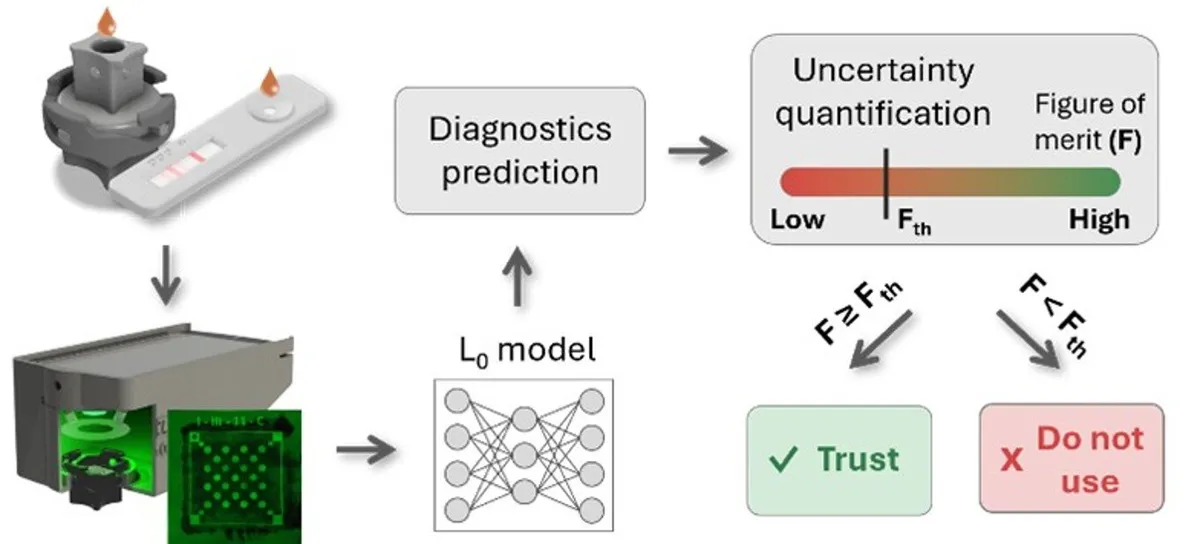
This isn't your grandma's litmus paper. The Lyme test uses a paper strip, your smartphone camera, and an AI program to deliver results in under 20 minutes from a single drop of blood. Instead of a simple "yes/no" line, it has 25 spots that light up based on antibodies to Lyme exposure, creating a unique pattern.
That pattern then gets fed to a neural network, which makes the diagnosis. Pretty slick. But here's where the new system, dubbed Monte Carlo dropout (MCDO), steps in. Instead of just one AI model making a call, each sample is processed by the main model and then 1,000 additional, slightly different models.
Think of it like getting 1,000 second opinions from tiny, slightly tipsy experts. Each of these extra models has a random part of its "brain" temporarily switched off, creating a thousand subtly different predictions. By comparing all these results, the system generates an "uncertainty figure of merit" score.
Low score? That result gets a big fat "Do not use" stamp and is binned. High score? "Trust it," says the AI. Because apparently that's where we are now: A computer telling us which other computers to trust.
What This Means for Your Health
The real win here is reducing false negatives. That's when you have Lyme disease, but the test says you don't. Missing a Lyme infection early can lead to some seriously unpleasant, long-term health issues. The new AI system boosted the test's sensitivity from that initial 88.2% to a much more reassuring 95.7%. And it kept 100% specificity, meaning it didn't accidentally tell healthy people they had Lyme.
Professor Aydogan Ozcan, who led the research, noted that the system is completely autonomous. It doesn't need a human to tell it what's reliable. It just… knows. And the best part? It doesn't need any extra computing power, making it perfect for those quick, on-the-go tests.
While this was tested with Lyme disease, the implications are huge. This self-aware AI can be integrated into any rapid diagnostic test that uses a neural network – from other infections to heart conditions. So, soon, your diagnostic tests might not just give you an answer, but also tell you exactly how confident it is in that answer. Which, if you think about it, is both impressive and slightly terrifying.