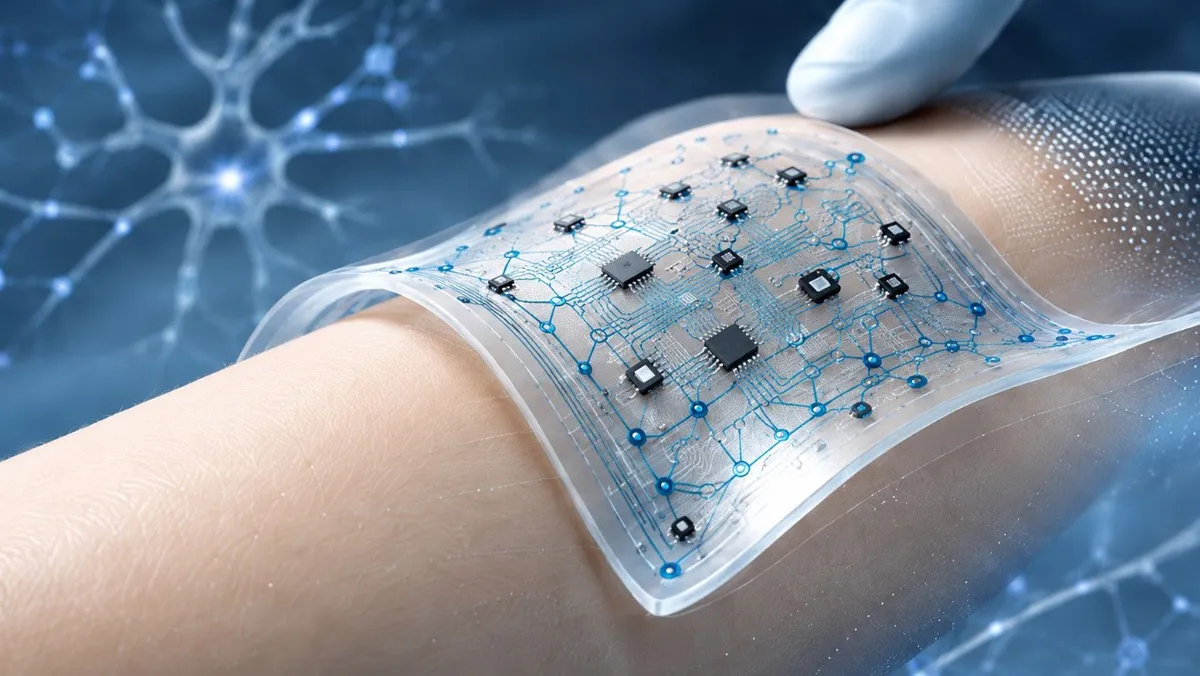
Imagine a world where your smart device isn't a rigid rectangle, but a second skin that literally thinks with you. Scientists are making that less sci-fi fantasy and more imminent reality, developing electronics that can stretch like human skin and learn like a brain. Because apparently, our tech needs to get a lot more squishy.
Traditional AI hardware, all those silicon chips, are fantastic at crunching numbers but terrible at cuddling. They're rigid, unyielding, and generally uncomfortable inside a body that's anything but. Trying to attach one to, say, a beating heart or a flexing knee? That's a recipe for irritation, rejection, and eventual failure. The body, it turns out, prefers its internal components to be a bit more... organic.
Enter the new era of soft neuromorphic electronics. These aren't just bendy circuits; they're an entirely new class of device that combines sensing, memory, and computing into materials that can conform to living tissue. Think of them as the ultimate mimic, inspired by the brain's own elegant dance of information processing.
We're a new kind of news feed.
Regular news is designed to drain you. We're a non-profit built to restore you. Every story we publish is scored for impact, progress, and hope.
Start Your News DetoxMore Brain, Less Brawn
Unlike the electron-slinging circuits we're used to, these systems use flexible polymers and ionogels. These materials have a party trick: they transport both electrons and ions. Which, if you think about it, is exactly how your nervous system transmits its electrochemical signals. It’s like they’re speaking the body’s native language.
These active materials can absorb and release ions, subtly shifting their electrical state. This allows a single, soft transistor to mimic synaptic plasticity—that biological magic where brain cells strengthen or weaken connections. In plain English? The hardware can learn, just like your brain does when you finally remember where you put your keys.
And these things are flexible. Some components can stretch up to 140% of their original length. That's more elastic than human skin, making them perfect for those highly mobile, twisty-turny parts of the body. They also sip power, operating at less than 0.5 volts. This keeps things cool and calm, which is crucial when you're literally touching living tissue.
This isn't just about internal implants. Imagine wearable tech that's not a bulky watch, but a virtually invisible, stretchable network printed directly onto your skin. It could combine sensing, memory, and processing in one seamless, smart layer. Hello, electronic skin. Goodbye, charging cable for your clunky fitness tracker.
Of course, there are still a few kinks to iron out. Memory retention is a big one—some soft devices forget things faster than we forget what we had for breakfast. But researchers are tackling this with "island-bridge" designs, protecting the crucial memory bits on tiny, rigid islands while keeping the connections flexible. Because even in the softest tech, some things just need to stay firm.
Combine these clever designs with stable, non-toxic materials, and we're looking at durable, brain-inspired devices that could integrate with the human body for the long haul. Which, if you think about it, is both impressive and slightly terrifying.