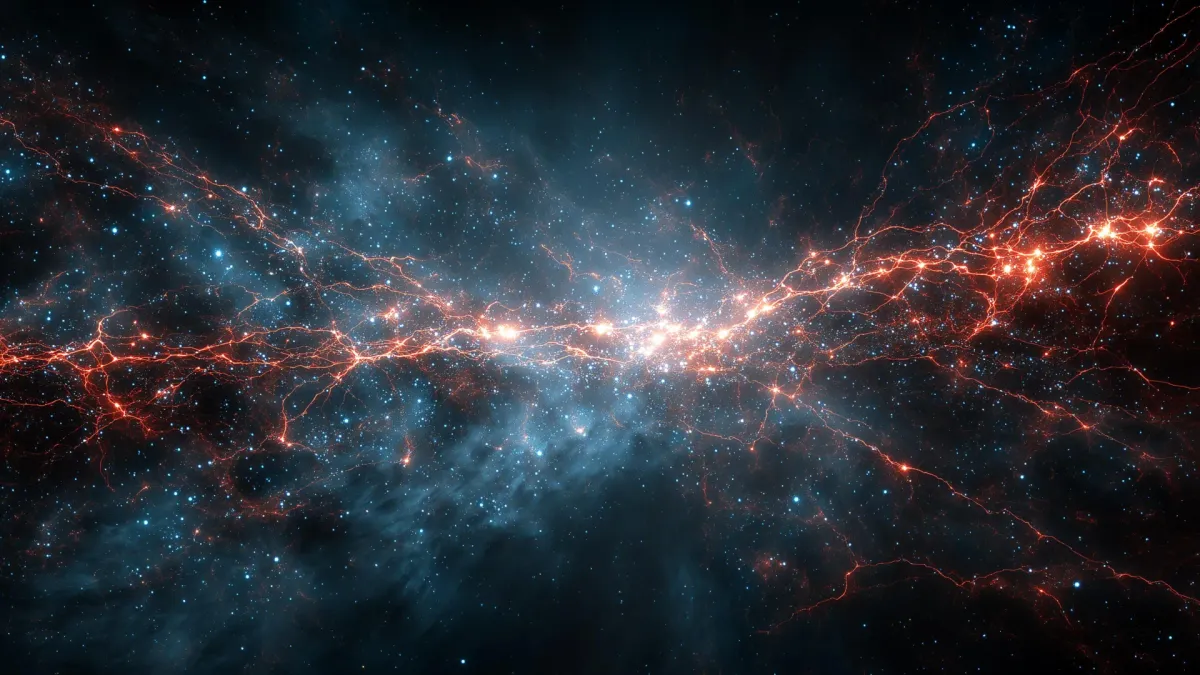
Dark matter: the universe's invisible, gravitational strongman. Or so we thought. Turns out, this elusive substance might have its own internal drama, interacting with itself through a mysterious 'dark force' that does the exact opposite of what you’d expect.
Scientists, always digging into the universe's secrets, just published a study in the Journal of Cosmology and Astroparticle Physics suggesting that if dark matter particles were extra attractive to each other, it wouldn't make cosmic structures grow faster. Nope. It would actually slow them down. Because apparently that’s where we are now: the universe is a contrarian.
The Universe Isn't Adding Up (Again)
Why look for a dark force at all? Because the universe, when you look at it really closely, isn't quite following the script. Precise observations of how the cosmos expands and how galaxies clump together sometimes tell slightly different stories.
We're a new kind of news feed.
Regular news is designed to drain you. We're a non-profit built to restore you. Every story we publish is scored for impact, progress, and hope.
Start Your News DetoxSome distant universe measurements hint that expansion might have been a tad slower than our standard model predicts. Meanwhile, the cosmic microwave background (the universe's baby picture) suggests matter is more tightly packed than it should be. These are tiny discrepancies, but in science, tiny discrepancies are like a dropped stitch in the fabric of reality. You have to fix it.
Enter the 'dark force' idea. What if dark matter particles feel an extra pull that regular matter simply can't detect? It's like a secret handshake only they understand. This interaction could tweak both the universe's expansion and the formation of those massive cosmic structures.
As Zachary Weiner, a lead author from the Perimeter Institute, points out, everything we know about dark matter so far comes from its gravitational effects. This leaves plenty of room for a hidden social life among dark matter particles.
The Gravity of the Situation (and Beyond)
The research team dove into theoretical models where dark matter isn't just a gravitational wallflower. It’s also got this long-range attractive force. Intuitively, you'd think more attraction equals more clumping, right? Faster structure growth. Maybe even explain those denser structures we're seeing.
Weiner himself noted that an extra attractive force should, by all logic, make structures grow faster. But logic, much like a cat, often has other plans.
The Cosmic Counter-Intuition
Here’s the twist: while this extra force does make dark matter cluster more effectively, it also makes the dark matter particles effectively lose mass over time as the universe expands. Think of it as a cosmic diet plan.
This mass reduction weakens their gravitational pull, which then — poof! — cancels out the stronger attraction from the hidden force. The net effect? Instead of speeding things up, the combined forces actually slow down the growth of cosmic structure. It’s like putting your foot on the gas and the brake at the same time, only to find you're just... coasting.
This unexpected mechanism will likely influence a whole host of more complex models, especially those trying to explain recent measurements from the Dark Energy Spectroscopic Instrument (DESI). Any theory involving a hidden attractive force might now have to contend with the idea that dark matter gets lighter as the universe ages. Which, if you think about it, is both impressive and slightly terrifying.
Future observatories and cosmic surveys will provide even more precise measurements, helping scientists sort out which of dark matter's potential hidden interactions are real and which are just theoretical whims. Because, as Weiner succinctly puts it, "the Universe is often more subtle than our intuition, which is why we must keep testing these ideas." And sometimes, those tests reveal the universe is just doing its own thing, completely unbothered by our expectations.