Between ages 50 and 75, the human brain may enter a new biological phase. Scientists found unexpected changes in brain cells, including shifts in inflammation and how genes are regulated. This suggests that brain aging is an active process of remodeling, not just a slow decline.
These findings come from a study of individual cells in the human hippocampus, a brain area vital for learning and memory. Researchers used advanced methods to map gene regulation and the 3D structure of the genome. This offers a detailed look at how these features change as the brain ages.
Major Immune Shifts in Midlife
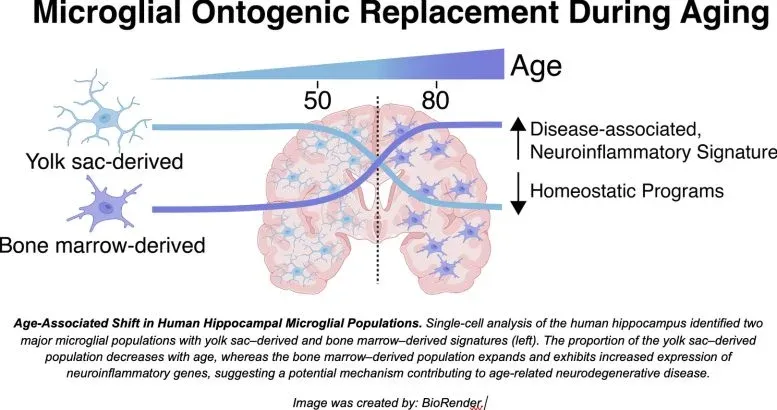
The most notable changes were seen in microglia. These are immune cells that protect and maintain the brain. Between about 50 and 75 years old, microglia formed during early development sharply decreased. In their place, new cells appeared that looked like immune cells found in the blood.
We're a new kind of news feed.
Regular news is designed to drain you. We're a non-profit built to restore you. Every story we publish is scored for impact, progress, and hope.
Start Your News DetoxThis discovery challenges the idea that microglia stay in the brain for a person's entire life. The new microglia-like cells also showed stronger signs of inflammation. This might explain the ongoing brain inflammation linked to aging.
The study also found a significant loss of cells that maintain the blood-brain barrier. This barrier prevents harmful substances from entering the brain from the bloodstream.
Bing Ren, a lead author of the study, explained that microglia are crucial for brain health. When they don't work properly, toxic materials can build up. This can trigger inflammation, which may lead to neurodegenerative diseases.
Genome Organization Weakens with Age
Changes weren't limited to immune and vascular cells. Across several types of brain cells, the 3D structure of the genome became less organized.
DNA is not a loose strand in the cell nucleus. It folds into a specific structure that controls which genes a cell can use. The widespread breakdown of this structure suggests that declining genome organization is a basic part of brain aging.
Nathan Zemke, Director of Single-cell Genomics at UC San Diego, noted that this work greatly improves our understanding of how aging changes the human genome in brain cells. He emphasized the need to study gene regulation and genome organization to understand the aging process.
The results show that brain aging is more than just damage accumulating over time. Instead, immune, vascular, and nerve systems seem to change together as people get older.
Xiangmin Xu, a co-corresponding author, highlighted that aging involves a coordinated and dynamic remodeling of these systems. These findings could help identify new ways to protect brain function throughout life.
A Broader Map of Genome Change
This research is part of six studies published in Science through the National Institutes of Health’s 4D Nucleome (4DN) Common Fund program. This program aims to map how the genome's structure changes over time and space.
The initiative brought together researchers from across the U.S. to study how the genome's spatial arrangement affects biological activity. Bing Ren also contributed to three other Science papers on genome architecture in different cell types and timescales.
Together, these studies provide a valuable resource for researchers. They can use this information to investigate how problems in genome organization relate to development, aging, and diseases like Alzheimer's.
Deep Dive & References
Epigenetic and 3D genome reprogramming during the aging of the human hippocampus - Science, 2026