A native Australian millet might hold genetic clues about thousands of years of Aboriginal harvesting and plant management. This plant is called channel millet.
Channel Country in outback Australia is a vast area with many waterways. The Mithaka people have lived there for at least 3,000 years. They were important in developing a trade system across the continent. Plants were central to their way of life, with about 200 species used for food, medicine, and other purposes.
New research in Nature Communications shares important information about channel millet (Echinochloa turneriana). Scientists found traits in this plant that are often linked to domestication.
We're a new kind of news feed.
Regular news is designed to drain you. We're a non-profit built to restore you. Every story we publish is scored for impact, progress, and hope.
Start Your News DetoxGenomics Reveals Aboriginal Plant Management
Understanding how people managed plants is a growing area in Australian archaeology. Genomics, the study of an organism's genes, has helped explain the relationship between people and plants in other parts of the world, like the Americas and Asia. It can also show how humans influenced plant communities in Australia.
Some genetic studies in Australia, done with Aboriginal people, have already shown new insights. For example, Aboriginal people in New South Wales and Queensland intentionally spread the black bean (Castanospermum australe), a valuable native food.
A Landscape Built Around Native Foods
The Mithaka people have a rich archaeological history that shows how important plants were in their daily lives. Earlier research found hundreds of grinding stone quarries. These were used to process seeds from native grasses, herbs, and trees. This shows a deep knowledge of local ecosystems and food.
These sites together form a significant cultural landscape. It was recently added to Australia's National Heritage List. The new study builds on this previous work.
Millet Fields Across the Floodplains
Channel millet can grow over a meter tall. It's a strong grass that thrives after floods, creating large fields of brown seedheads. In the past, it was a key food source for Aboriginal people.
In 1884, explorer Augustus Gregory saw "fields of 1,000 acres of millet" on the Cooper Creek floodplain. He described people cutting the stalks. Early writer Alice Duncan-Kemp also described Aboriginal women processing "ugar" or "egar" (grass seeds) on the Diamantina River.
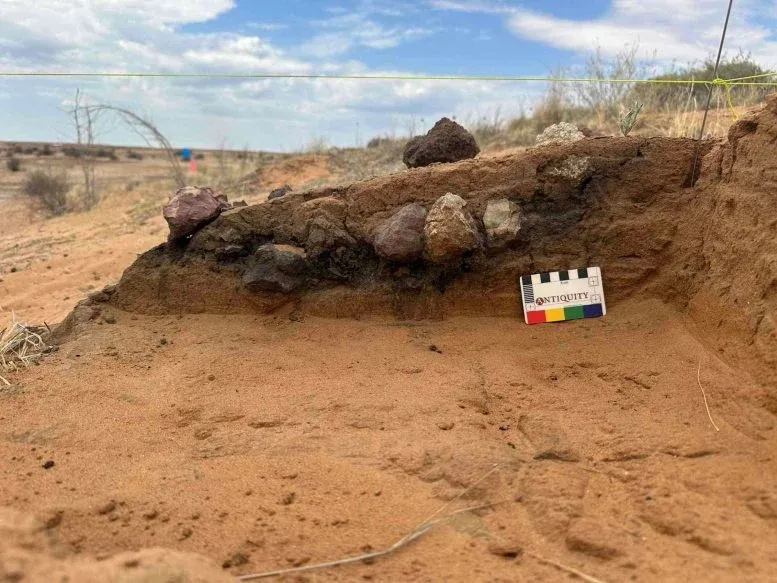
 An Aboriginal hearth from Mithaka country. Hearths burn plant seeds, making them resilient to erosion, and when analyzed by archaeobotanists, reveal important information about ancient Mithaka food production systems. Credit: Michael Westaway
A Genome With 12 Chromosome Copies
Scientists sequenced the DNA of channel millet. They found its genome to be very complex. Humans and many plants have two copies of each chromosome. But channel millet has 12 copies of each chromosome.
This is called polyploidy. It means an organism has multiple sets of chromosomes. This can happen through reproduction accidents or hybridization.
Many domesticated crops like wheat, rice, and sugarcane also have many copies of each chromosome. While natural polyploidy has happened for millions of years, people have sped up this process. They sometimes accidentally, and later deliberately, caused chromosome doubling. This created crops with larger fruits, more vigor, and better resilience.
Genetics Built for Flood and Drought
This unique genetic pattern might explain how channel millet survives in its environment, which has periods of flood and drought. During long dry spells, channel millet populations shrink. But they survive as underground seeds that quickly sprout when floodwaters cover the region.
Having multiple copies of each chromosome may help these plants survive the big changes in Channel Country. Like hybrid crops that farmers value, plants with extra chromosome sets can be very strong. This gives them a genetic advantage to thrive in an unpredictable environment.
Signs of Human Selection
Natural selection might not be the only thing that shaped these unusual genetics.
Channel millet has large seeds, making it an appealing food source. Like other domesticated grasses such as wheat, rice, and corn, it also doesn't shatter much. This means its mature seeds stay attached to the plant, making harvesting efficient.
Human harvesting, storage, and eating may have helped this unique plant evolve. Harvesting would have favored large seeds that didn't shatter.
Human consumption might have caused population reductions in the ancestors of modern channel millet. Storage may have helped some seeds survive during long dry periods. More studies on population changes and other species in the area are needed to understand these impacts better.
Reconstructing Thousands of Years of Cultivation
Today, the Mithaka people want to learn more about plants like channel millet. They are interested in how past human interactions with these species can inform future food knowledge.
Future research will connect plant genetics with evidence from ancient fireplaces, shell midden sites, plant remains from grinding stones, and pollen from waterholes. This work will focus on specific areas in Mithaka country.
Combined with Indigenous knowledge, this research will create a clearer picture of how the Mithaka people actively shaped, and were shaped by, the plant communities around them over thousands of years.
Deep Dive & References
Genome analysis of Channel millet reveals a wild dodecaploid shaped by environmental variability - Nature Communications, 2026