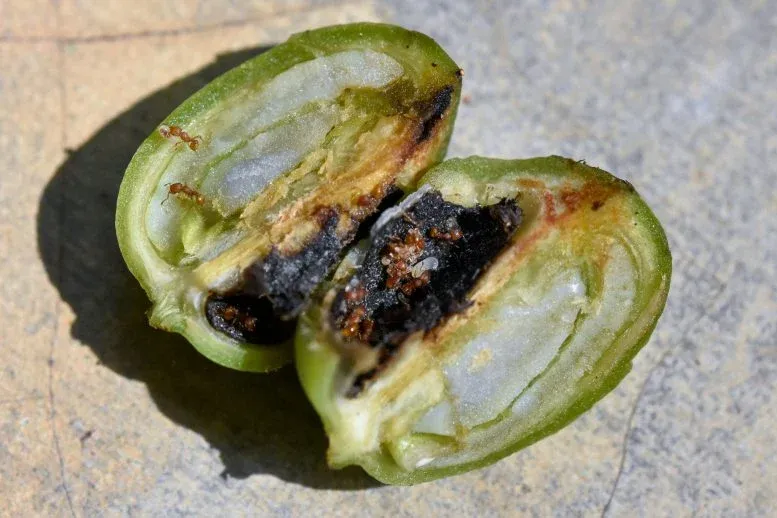
A tiny coffee pest might be creating the perfect home for the ants that hunt it. Coffee berry borers dig deep into coffee fruit to feed and reproduce, safe from many predators. But after small ants push these beetles out, some ant species seem to use these empty tunnels as nurseries for their young.
Jonathan "Jonno" Morris first saw this behavior while studying coffee plants in Chiapas, Mexico. His observations are the first to show that small ants can reproduce inside spaces made by coffee berry borers. This discovery reveals an unexpected link: the pest creates shelter that could actually help the ant populations that attack it.
How Ants Use Borer Tunnels
Coffee berry borers spend most of their lives inside coffee fruit. Female borers drill into the fruit and create tunnels where they lay eggs. Their young then eat the coffee bean itself. This damage happens mostly inside the fruit, making the pests hard to control.
We're a new kind of news feed.
Regular news is designed to drain you. We're a non-profit built to restore you. Every story we publish is scored for impact, progress, and hope.
Start Your News DetoxLarger ants can catch adult borers before they enter the fruit. Smaller ants can squeeze into the beetles' tunnels and eat adults, eggs, larvae, and pupae. Morris found that the story doesn't end once the pest is gone.
Some ants cleaned out the damaged tunnels, made the entrances wider, and moved their own young inside. Morris recorded seven ant species living in previously infested fruit, with five showing signs of reproduction. These included the electric ant, Wasmannia auropunctata, and species like Pseudomyrmex, Nesomyrmex, and Procryptocerus.
Morris explained that this is mostly good for pest control. It helps the ant populations grow and stay healthy. The ants get a place to reproduce, thanks to the coffee pest. This could help keep more diverse ant communities on coffee plants.
By nesting inside coffee fruit, the ants stay close to where new infestations might start. This closeness could mean they find more borers moving into nearby fruit, making them better at controlling pests naturally. The study doesn't say how much this behavior reduces crop damage, but it shows a possible way to support helpful ant populations on coffee plants.
An Accidental Discovery
The discovery happened almost by chance in 2016. Morris was working on another project at a research station in Chiapas, Mexico. This station was set up by University of Michigan ecologists Ivette Perfecto and John Vandermeer on an organic coffee farm. While opening green coffee fruit attacked by borers, he kept finding ants living inside.
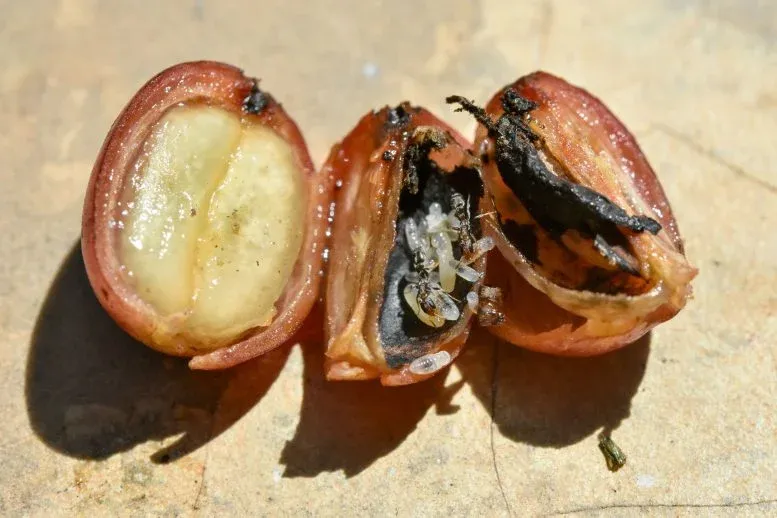
Morris kept the ants he found nesting in the fruit, thinking he might study them later. Years later, he realized that no one had ever reported ants using these borer-made spaces to reproduce.
Morris returned to the farm with technicians in 2025 to gather more evidence and take the first photos of this behavior. The findings were published in the journal Ecology.
When One Species Builds for Another
Ecologists call this an indirect niche construction. One organism changes its environment, and another species later benefits from that changed habitat. Here, the borer creates a protected tunnel, the ants remove or eat the beetle, and then the tunnel becomes a nesting site for the pest's natural enemies.
This finding also challenges the idea that all pests must be completely removed for an ecosystem to work well. Very small borer populations might provide both food and nesting spots for ants, which then help control larger outbreaks.
Morris noted that this discovery reminds us that important scientific insights can come from simple observations in nature. He believes that funding for basic science and field observations is crucial for these kinds of discoveries.
Deep Dive & References
Indirect niche construction: A coffee pest facilitates its own ant natural enemies - Ecology, 2026