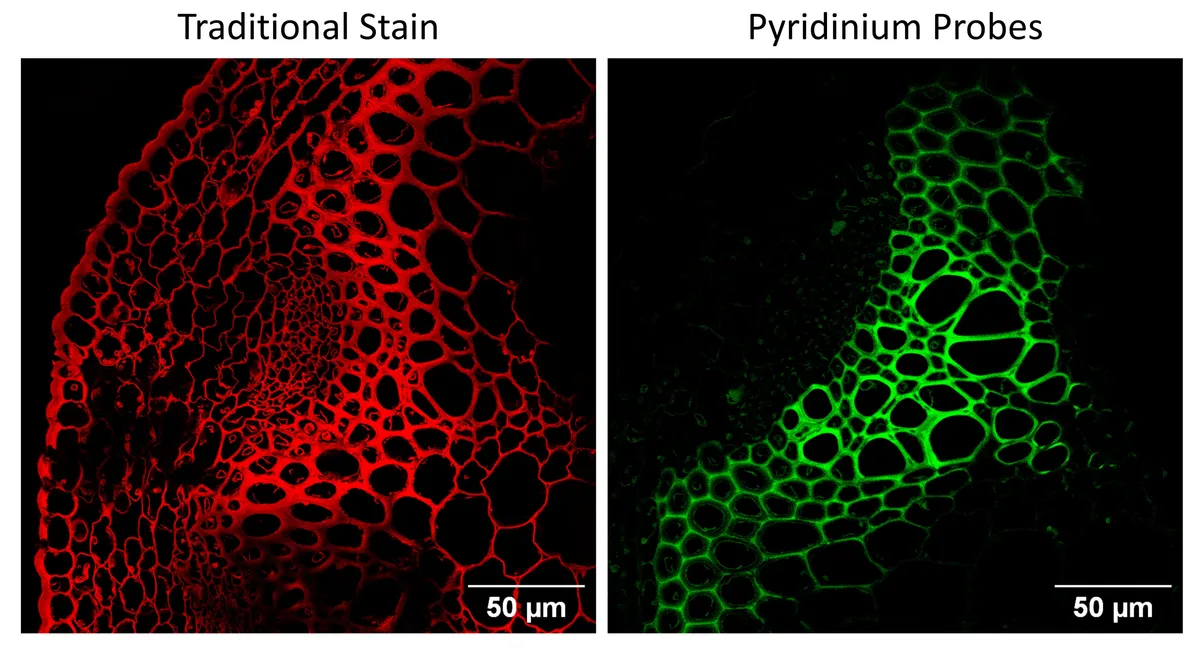
Researchers have created new fluorescent probes that give scientists a much clearer look at xylem. Xylem is the special tissue that moves water and minerals through plants. This new method is faster and more precise than older staining techniques.
This breakthrough could help improve research on how plants grow, their internal systems, and how well crops handle tough conditions.
A Better Way to See Plant Plumbing
Plants have two main "pipe" systems. Phloem moves sugars from leaves. Xylem carries water and minerals up from the roots. This tissue helps support the plant and affects how it deals with stress like drought or heat.
We're a new kind of news feed.
Regular news is designed to drain you. We're a non-profit built to restore you. Every story we publish is scored for impact, progress, and hope.
Start Your News DetoxTo study xylem, scientists usually slice plant tissue and use dyes. But these dyes often stain many parts of the plant, not just the xylem. This makes it hard to tell which parts are which. Dr. Subramanian Sankaranarayanan from IITGN explained that researchers often see xylem, phloem, and cambium all lit up. They then have to guess which glow belongs to the xylem.
In 2023, a team from IITGN developed fluorescent molecules for animal cells. These molecules were designed to detect a chemical linked to inflammation. They used a special design that makes them sensitive to their chemical surroundings.
The researchers realized this sensitivity could help them distinguish between different plant tissues. The inside of a xylem wall is chemically very different from a phloem cell. Professor Sriram Kanvah, who led the team, said they used this difference to their advantage.
The team created positively charged pyridinium dyes. Two of these, C1 and C3, stained only the xylem, providing much clearer images.
Sharper Images with Less Dye
The researchers tested the probes on Arabidopsis thaliana, a common plant used in studies. They also tested them on Nicotiana benthamiana (a tobacco relative) and Allium fistulosum (Welsh onion).
The new probes not only improved image quality but also worked at much lower concentrations. For example, they needed about 15 times less dye than propidium iodide, a common dye. This means less dye is used and less laser power is needed, which helps prevent the dyes from losing their brightness during imaging.
The team also tested the probes on damaged plants. They looked at Arabidopsis eskimo1 mutants, which have faulty xylem vessels. The C1 and C3 probes gave a clearer view of these damaged vessels than older dyes.
Dr. Sankaranarayanan noted that this work aims to improve the tools available to plant scientists. He hopes these probes will make it easier to study plant growth, problems with their vascular system, and how they react to environmental changes.
More research is needed to understand exactly how these dyes bind to cell walls. Scientists also want to adapt them for use in living tissue. This would allow researchers to watch water-conducting vessels form and respond in real time.
Deep Dive & References
Pyridinium derivatives as novel fluorescent probes for xylem staining in plant tissues - Plant and Cell Physiology, 2026