For creatures that can grow longer than a school bus, whale sharks have been surprisingly good at keeping secrets. Turns out, the ocean's largest fish aren't just surface-level diners; they're deep-diving, multi-course connoisseurs with a surprisingly diverse menu of moves.
Until recently, most of what we knew about whale sharks came from watching them casually cruise near the surface. Which, if you think about it, is like trying to understand a human's entire life by observing them at a buffet line. Once they dipped below the waves, it was anyone's guess what they were up to.
These gentle giants inhabit tropical waters, where a good meal isn't always easy to come by. Understanding their foraging habits is more important than ever, especially as climate change starts messing with their already unreliable food sources.
We're a new kind of news feed.
Regular news is designed to drain you. We're a non-profit built to restore you. Every story we publish is scored for impact, progress, and hope.
Start Your News DetoxThe Shark-Cam Diaries
Enter the intrepid researchers who decided to slap tiny cameras onto these magnificent beasts. Attached to juvenile whale sharks gathering at a coastal site, these devices offered a first-person, shark-eye view of their underwater world, complete with high-res movement data. The cameras would stay on for a solid 24 hours, then detach themselves like good little spies, ready for retrieval without disturbing the sharks.
The footage that came back was nothing short of a deep-sea exposé. It revealed behaviors no one had ever witnessed, painting the most complete picture yet of how whale sharks go from finding a snack at the surface to hunting dinner near the seafloor.
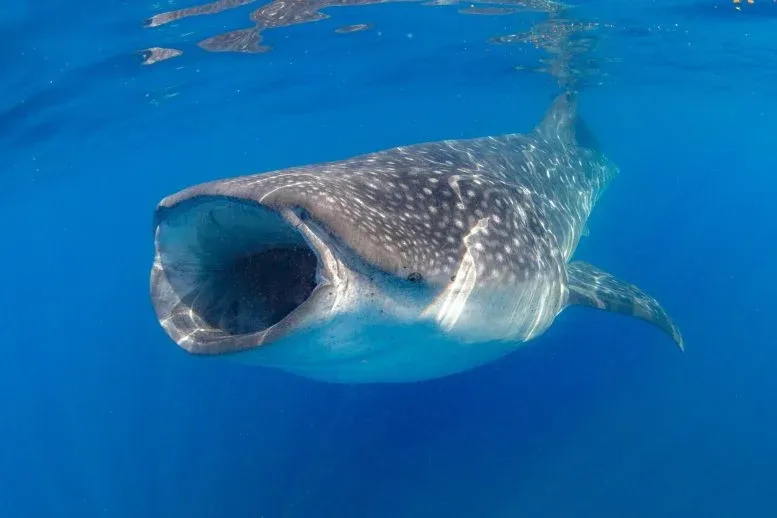
Previously, the consensus was that these filter feeders mostly grazed up top. But the cameras showed them noshing up to 70 meters (that's over 200 feet) deep. Their methods? Everything from languidly gliding with an open mouth near the bottom, probably just hoovering up whatever's around, to actively chasing down swarms of krill at the surface. Because apparently, even the biggest fish needs to switch things up to avoid food boredom.
The study cataloged a whopping 36 distinct whale shark behaviors. Most of the time, they stuck to six low-effort feeding styles, suggesting they often just 'snack' in leaner patches until they stumble upon a dense, delicious krill swarm. Then, it's game on for more active hunting.
This impressive range of feeding strategies likely explains how whale sharks manage to thrive in tropical waters where prey can be scarce. Compare that to other massive filter feeders, like basking sharks and whales, which seem to have far fewer tricks up their fins. Which, if you think about it, is both impressive and slightly terrifying. Imagine having 36 ways to eat.
This initial dive into their secret lives focused on the Ningaloo Reef in Western Australia. The next step? More cameras, more locations, and even more secrets from these iconic, and still very much endangered, fish. Because who doesn't love a good mystery, especially when it involves giant sharks and tiny cameras?