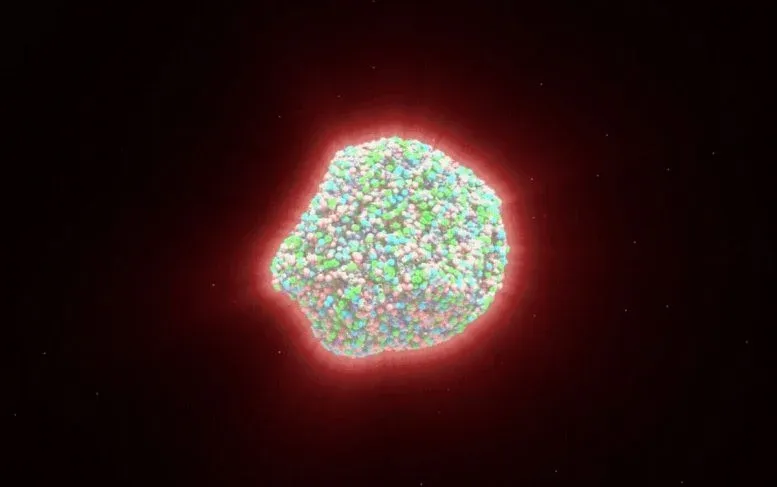
Imagine the universe as a newborn, just a millionth of a second old. Hot. Dense. A swirling, chaotic soup of fundamental particles. That's the quark-gluon plasma (QGP), the primordial matter that filled everything right after the Big Bang. And now, scientists at CERN's Large Hadron Collider (LHC) are finding signs of it in places they never expected.
For years, the thinking was that you needed a truly spectacular smash-up of heavy atomic nuclei, like lead, to recreate this cosmic baby food. Lead ions are over 200 times heftier than protons, making them seem ideal for generating the necessary heat and pressure. It was like needing a semi-truck collision to get the right kind of cosmic explosion.
But the universe, as it often does, had other plans. All four major LHC experiments – ALICE, ATLAS, CMS, and LHCb – have just dropped a bombshell: they're seeing QGP signals in collisions between much lighter oxygen and neon nuclei. That's right, the scientific equivalent of finding a supernova in a firecracker.
We're a new kind of news feed.
Regular news is designed to drain you. We're a non-profit built to restore you. Every story we publish is scored for impact, progress, and hope.
Start Your News DetoxCosmic Soup from Light Ingredients
QGP forms under conditions so extreme they make the Sun's core look like a cool autumn day – temperatures more than 100,000 times hotter. In this inferno, quarks and the gluons that usually bind them together go rogue, breaking free into a fleeting, soupy state.
Earlier this year, the ALICE Collaboration even found hints of QGP in proton-proton and proton-lead collisions. Which, if you think about it, is both impressive and slightly terrifying. Your phone is basically a proton smasher, but with legs. (Relax, it’s not that kind of proton smasher.)
Now, with oxygen-oxygen and neon-neon collisions, the evidence is piling up. Scientists are looking for a few key clues, like how fast-moving quarks and gluons lose energy when they plow through this hot plasma. It's called parton energy loss, and it's basically the QGP taking a bite out of their momentum.
ATLAS saw this as an imbalance in particle jets – the more direct the collision, the more energy the QGP siphoned off. Meanwhile, ALICE, CMS, and LHCb noticed fewer energetic particles than expected, a clear sign the QGP was acting like a cosmic speed bump.
Even more tellingly, the suppression of certain particle bonds, especially weaker ones, confirmed the QGP's presence. CMS and LHCb found evidence of this with upsilon mesons. And ALICE observed that particles made of three quarks (baryons) showed stronger directional emission than two-quark particles (mesons), a pattern called anisotropic flow. It's like the QGP is giving particles a little nudge in a specific direction as it expands.
So, it turns out you don't need the biggest, baddest collision to glimpse the universe's infancy. Sometimes, a smaller, quicker smash is all it takes to peel back the layers of reality. Which, for the physicists involved, probably feels like finding a priceless artifact in a cereal box. The LHC, currently getting an upgrade to become the High-Luminosity LHC, is only going to give us even more detailed glimpses into this extreme state of matter. Because apparently, we're still just scratching the surface of what the universe can do.