Astronomers have found a new planet, Beta Pictoris d, orbiting a young star 63 light-years from Earth. This gas giant is the faintest exoplanet ever directly photographed from the ground. Researchers later realized it had been in telescope images for 11 years without being noticed.
Ben Sutlieff, an astronomer at the University of Edinburgh, called it a "serendipitous discovery." He and his team initially wanted to study Beta Pictoris b, a known planet in the system, to see how it changed over time.
An Unexpected Discovery
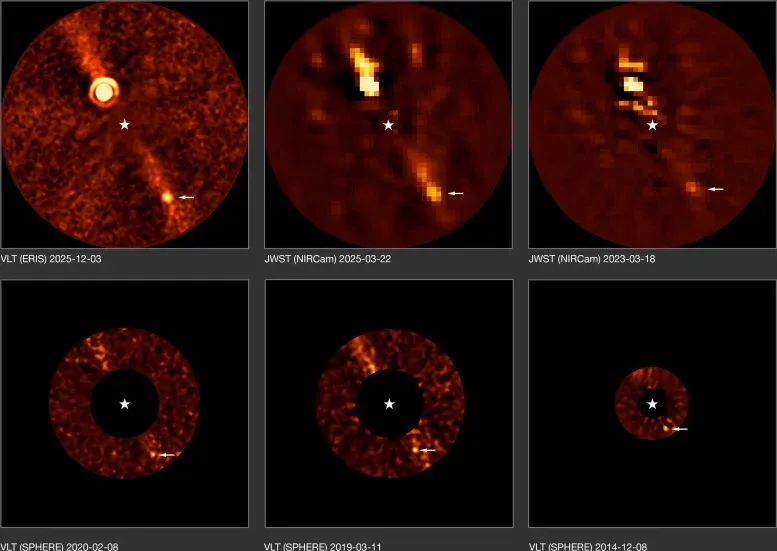
Instead, images from the ERIS instrument on the European Southern Observatory’s Very Large Telescope (ESO’s VLT) showed an unexpected point of light. This light was separate from Beta Pictoris b.
We're a new kind of news feed.
Regular news is designed to drain you. We're a non-profit built to restore you. Every story we publish is scored for impact, progress, and hope.
Start Your News DetoxMarkus Bonse, an ESO astronomer and co-lead of the study, remembered saying, "There’s something else there; did you see it?" This faint object turned out to be the previously unknown planet.
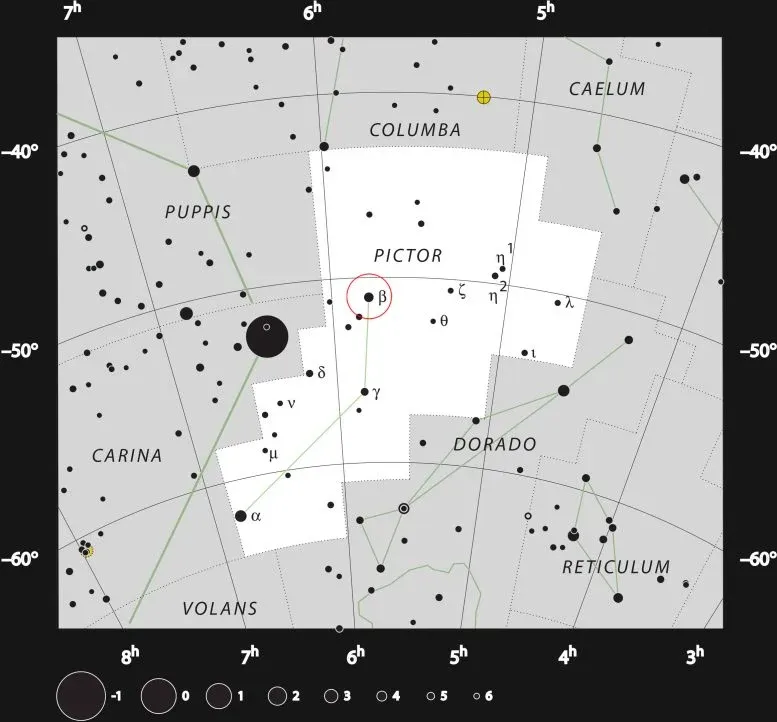
Beta Pictoris is a very young star, only about 20 million years old. Our Sun, by comparison, is about 4.6 billion years old. This young age makes the system important for astronomers. They can watch giant planets and a surrounding disk of debris as the system is still forming. Smaller rocky planets might even still be developing from collisions between asteroids and comets.
A Decade of Hiding
The researchers looked through the ESO archive to see if the planet had appeared in older observations. They found it in many images taken over an 11-year period, including data from SPHERE, another VLT instrument. In one image, Beta Pictoris d was barely visible next to the much brighter Beta Pictoris b.
Jayne Birkby, a study co-author and astronomer at the University of Oxford, said, "Planet d, it seems, has been playing a game of hide-and-seek with us for over a decade, and only now can we say ‘found you!’"
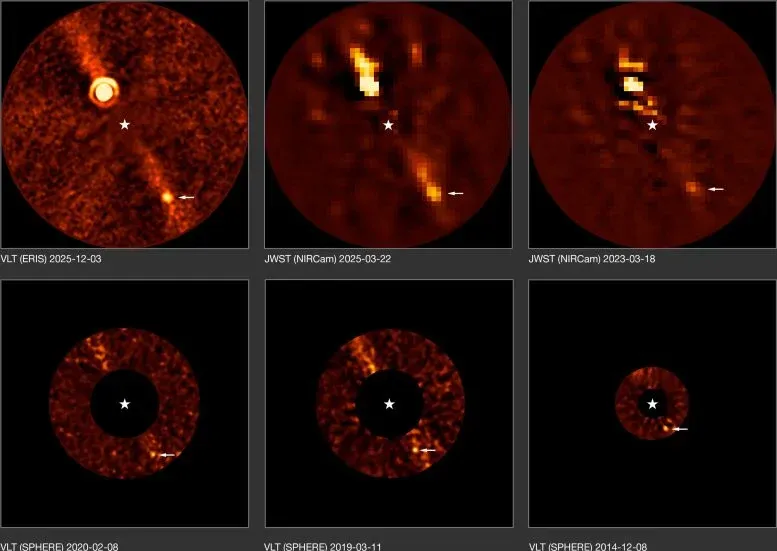
Tracking the object in these old images showed it was moving with the system in an orbit. This proved it was a planet, not just a background star. Beta Pictoris d orbits its star at an average distance of about 26 astronomical units. One astronomical unit is the average distance between Earth and the Sun. The planet might take about 91 years to complete one orbit.
A Fainter, Lighter Gas Giant
Like its neighbors, Beta Pictoris b and c, the new world is a gas giant. However, it is much less massive. Planets b and c are each about 10 times the mass of Jupiter. Beta Pictoris d is estimated to be about 2.4 times Jupiter's mass, possibly ranging from two to four Jupiter masses. It is also relatively cool, so it gives off much less infrared light than the system's brighter planets.
Finding such a faint world through direct imaging is very hard. Most exoplanets are found indirectly, for example, when they pass in front of their stars. Direct imaging tries to capture light from the planet itself. The star can be millions or billions of times brighter, so instruments must block its glare and separate the planet from surrounding dust.
Bonse explained that the new planet is 100 times fainter than Beta Pictoris b. This makes it the faintest exoplanet ever directly imaged from Earth.
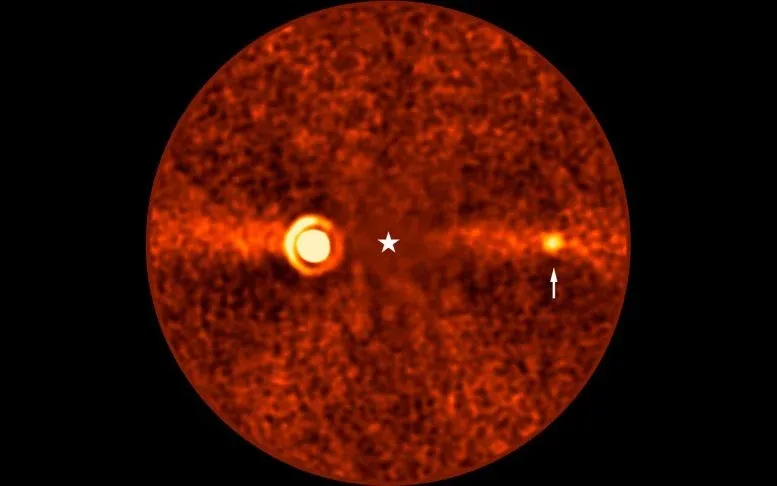
An independent team led by Aidan Gibbs at the University of California, San Diego, also found the same planet using the James Webb Space Telescope (JWST). Both groups found it separately using different tools and methods. This provides strong proof that the discovery is real.
The JWST team found Beta Pictoris d using the telescope’s NIRSpec instrument. They later confirmed it with more NIRSpec and MIRI data. Instead of just using a regular image, they looked for the unique molecular "fingerprints" of a planetary atmosphere. The planet's light spectrum showed signs of methane, carbon monoxide, and water vapor.
This method helped the team tell the planet apart from the bright debris disk around Beta Pictoris. Dust can scatter starlight and look like faint companions, but molecules in a planet's atmosphere leave specific patterns in the light that dust cannot easily copy. The ground-based researchers also found Beta Pictoris d in old observations from NIRCam, another JWST instrument.
A Rare Three-Planet Laboratory
Beta Pictoris is now only the second planetary system, after HR 8799, where astronomers have directly imaged more than two planets. Such systems are rare because direct imaging usually finds young, massive planets far from their stars.
Sutlieff noted that systems with multiple directly imaged exoplanets are like "holy grails" for discoveries. They can teach us a lot about different exoplanets that formed in the same environment.
Because all three planets formed around the same star from the same gas and dust disk, astronomers can compare them. This helps avoid many uncertainties that come from studying unrelated planetary systems. Differences in their masses, temperatures, atmospheres, and orbits could show how giant planets develop and affect each other.
Beta Pictoris d might also solve a mystery about the system’s debris disk. The disk has a sharp inner edge and other unusual features. These suggested an unseen planet was shaping the material with its gravity. The newly found world seems to have the right mass and location to help clear that region and sculpt the disk.
The Search for More Hidden Worlds
ESO’s Extremely Large Telescope (ELT), which is currently being built, should allow direct imaging of even fainter and less massive planets. Researchers believe that several famous systems with directly imaged giants might also have smaller worlds still hidden in the glare.
Beth Biller, an astronomer at the University of Edinburgh and a co-author, said, "Planets seem to have friends." She added that many famous directly imaged exoplanet systems have multiple giant planets. There are likely even more lower-mass planets hiding in these systems that the ELT might reveal.
Deep Dive & References
Direct Imaging Discovery of Giant Exoplanet β Pictoris d: A Decade-long Game of Hide-and-seek - The Astrophysical Journal Letters, 2026