Underwater robots often lose touch with the surface as soon as they dive. This makes it hard for them to talk to each other or to us. Now, a new antenna technology, inspired by medical implants, is changing how these machines communicate.
Radio waves don't work well in saltwater. Regular signals weaken quickly, limiting their range to only a few feet. Acoustic systems work over longer distances but can have issues like echoes and noise that might harm marine life. Optical systems are fast but need a clear view and fail in cloudy water. Because of these problems, most underwater robots either send short updates or have to surface to send data. This limits how much they can do on their own in real-time.
BlueME: A New Way to Communicate Underwater
A new antenna called BlueME aims to solve these communication problems. Developed by a team at the University of Florida, this system lets autonomous underwater vehicles (AUVs) share data reliably. It works up to 730 meters (2,395 feet) away and uses about 10 watts of power, which is less than a household LED light bulb.
We're a new kind of news feed.
Regular news is designed to drain you. We're a non-profit built to restore you. Every story we publish is scored for impact, progress, and hope.
Start Your News DetoxThis research, published in the IEEE Journal of Oceanic Engineering, came from an unexpected place. Project co-lead Adam Khalifa used to design tiny wireless implants. He realized that the challenges inside the human body are similar to those underwater. Our bodies are mostly saltwater, just like the ocean. This insight led to a new approach for ocean communication.
How Magnetoelectric Antennas Work
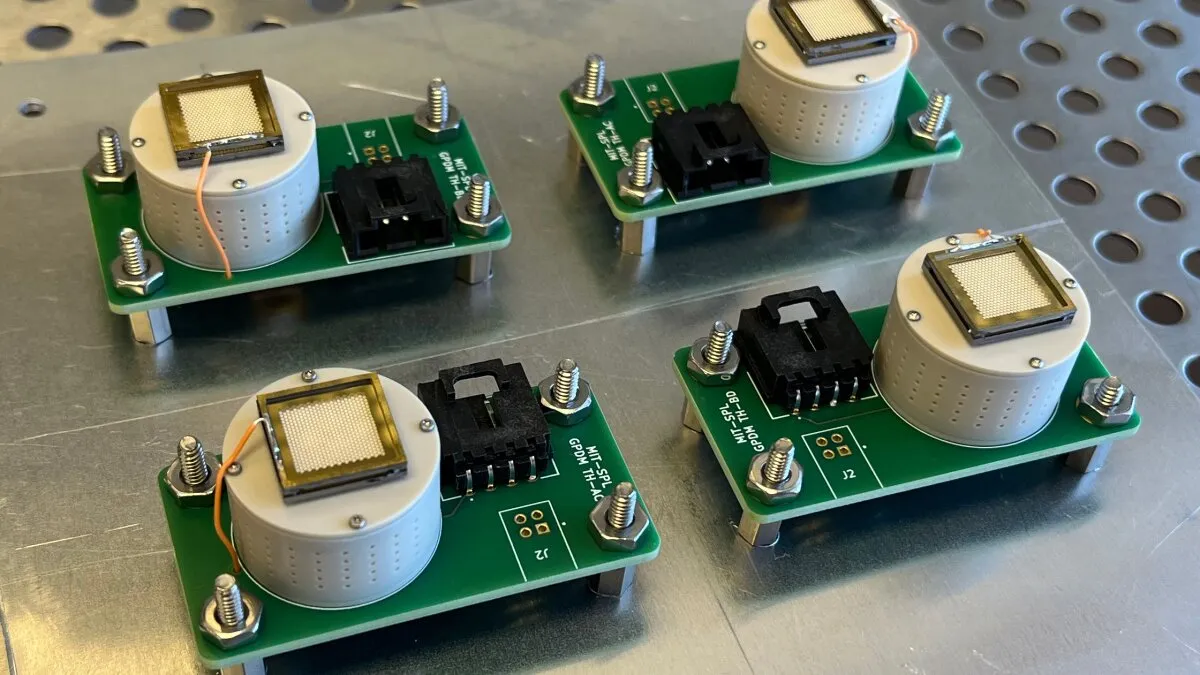
BlueME's main feature is its magnetoelectric (ME) antenna. This device combines two physical effects. A magnetic field changes a layer of Metglas, a magnetostrictive material. This change then creates a voltage in a nearby piezoelectric layer (PZT), a ceramic used in sensors.
The process can also run in reverse to transmit signals. This antenna works at very low frequencies, around 35–36 kHz. It is much smaller than traditional electrical antennas that work at the same frequencies.
The full system uses 15 such antennas in a 3x5 arrangement. These are housed in waterproof cases filled with oil to handle the intense pressure deep underwater. Interestingly, ME antennas work better when submerged. At 36 kHz, the wavelength shrinks from about 8,327 meters (27,320 feet) in air to just 170 meters (558 feet) in freshwater. This compression greatly improves how efficiently small antennas radiate signals.
Using 15 antennas together boosts the radiated power by 225 times compared to a single antenna. When combined with a matching receiver array, the total signal improvement can reach about 119 dB.
Testing and Future Potential
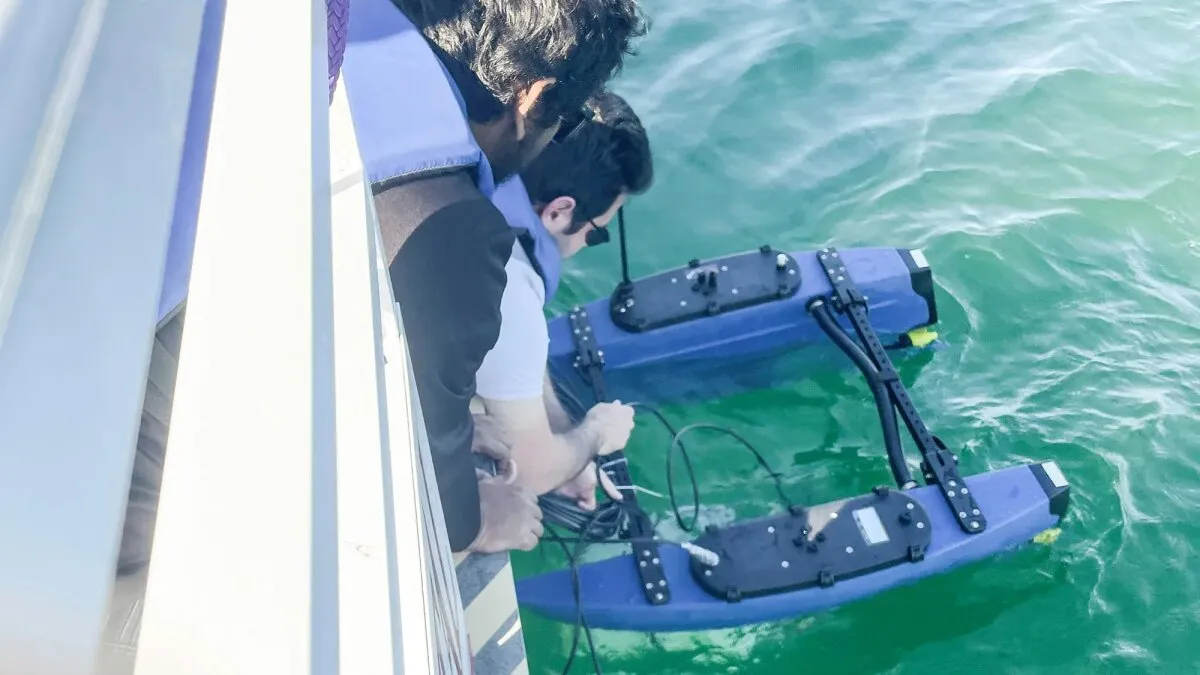
The team tested BlueME in open water at two locations: Lake Wauburg in Florida (freshwater) and the Florida Gulf Coast (saltwater). In freshwater, BlueME kept reliable communication at 200 meters (656 feet) using just 1 watt of power. In saltwater, the system detected signals at 730 meters (2,395 feet) using less than 10 watts. Its performance remained steady even with murky water, obstacles, or echoes.
The data rates are between 1 Kb/s and 100 Kb/s. While this is slower than optical systems in perfect conditions, speed was not the main goal. Co-lead Md Jahidul Islam explained that a robot could send updates every 10 minutes. This would allow an operator to make real-time decisions and adjust the mission.
The researchers say this paper describes the first practical outdoor use of ME antennas. It also represents the largest Very Low Frequency/Low Frequency array of its kind ever built. The team has applied for a patent and is looking for funding to improve the hardware. They also plan to conduct trials on full-sized AUVs. This technology could be used for things like guiding fleets of robots, mapping the seafloor, and tracking locations in real-time.
Khalifa noted that these results were achieved with limited resources. He believes that with more development, the possibilities will grow much wider. Islam added that this is just the beginning of a very powerful product.
Deep Dive & References
Magnetoelectric Antennas for Underwater Communication - IEEE Journal of Oceanic Engineering