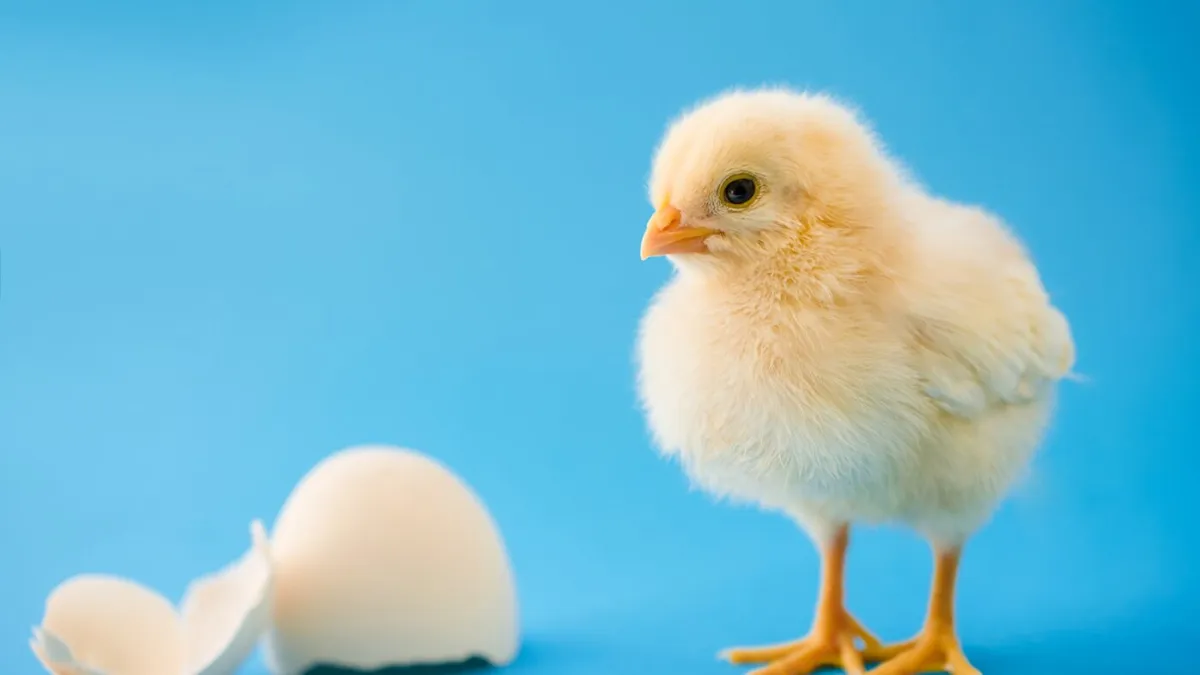
Three-day-old chickens prefer rounded shapes when they hear "bouba" and spiky ones when they hear "kiki." So do humans. So do four-month-old infants. The pattern is so consistent across cultures that researchers have spent decades trying to understand why.
Now, a team at the University of Padova in Italy has found the same effect in birds — and that discovery is reshaping how scientists think about where this ability comes from.
The Bouba-Kiki Effect
The experiment is deceptively simple. Show someone a rounded blob and a jagged shape. Ask which one is "bouba" and which is "kiki." Across every culture tested, from the US to Japan to rural communities in Namibia, people overwhelmingly match "bouba" with the soft shape and "kiki" with the spiky one. Even infants four months old make the same association, before language has properly taken hold.
We're a new kind of news feed.
Regular news is designed to drain you. We're a non-profit built to restore you. Every story we publish is scored for impact, progress, and hope.
Start Your News DetoxFor decades, this suggested something fundamental about human perception — that our brains are wired to link certain sounds with certain visual qualities, perhaps laying the groundwork for how language itself emerged. But when researchers tested great apes, chimpanzees and gorillas showed no such preference. The effect seemed oddly specific to humans.
Then Maria Loconsole and her colleagues wondered: what if they tested animals at the absolute earliest stage of life, before experience could shape their preferences?
What the Chicks Revealed
In the first experiment, three-day-old chickens were trained to peck behind a panel decorated with both blobby and spiky shapes to find food. Once they learned the task, researchers presented them with two separate panels — one rounded, one jagged — and played either "bouba" or "kiki" through a speaker.
The chicks moved significantly more often toward the rounded shape when they heard "bouba," and toward the spiky shape when they heard "kiki." A second experiment with one-day-old chicks, shown video screens with moving objects, produced the same result.
Marcus Perlman, a linguistics researcher at the University of Birmingham who wasn't involved in the work, found the results startling. "If I had to guess whether baby chickens would exhibit the bouba-kiki effect, I would have guessed no," he says. But the data was clear.
Loconsole emphasizes she's not suggesting chickens have language. Instead, the findings point to something older and broader: vertebrate sensory systems appear to be primed by evolution to expect certain regularities in the world. High-pitched sounds tend to match smaller, lighter objects. Low-pitched sounds align with larger, darker shapes. These associations likely stretch back to a common ancestor of birds and mammals — millions of years before human speech existed.
What This Changes
The bouba-kiki effect isn't unique. Animals across species link pitch to size, sound to visual weight. What makes humans different isn't that we have these basic sensory associations — we share them with chickens. What differentiates us is our ability to take those hard-wired connections and build something unprecedented: a creative capacity to generate novel symbols through sounds, gestures, and drawings, each carrying meaning we collectively agree on.
The chickens have shown us that the foundation is ancient. What humans built on top of it is what's genuinely new.