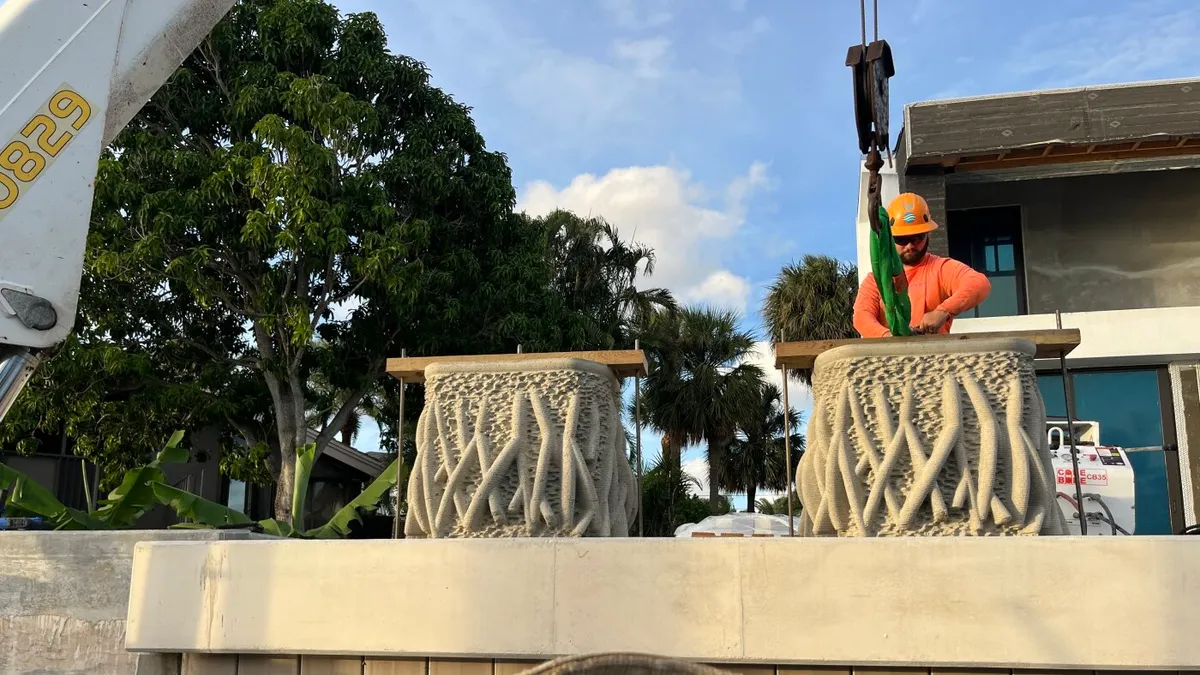
In a South Florida canal, Arthur Tiedeman's marine construction company is installing a new kind of seawall. This seawall is designed to protect property. However, it also aims to bring marine life back to areas often overlooked.
Tiedeman is drilling holes into a new seawall in Pompano Beach, Florida. The seawall is made of reinforced concrete encased in vinyl. This smooth, hard surface protects land but offers little habitat for marine life.
"It's not a natural shoreline like mangroves and sand," Tiedeman said. "It's just a straight giant wall."
We're a new kind of news feed.
Regular news is designed to drain you. We're a non-profit built to restore you. Every story we publish is scored for impact, progress, and hope.
Start Your News DetoxCreating New Habitats
To solve this, Tiedeman and his team are installing special planters. These planters will hold living mangrove trees on the otherwise plain wall. The planters are rough and grooved, mimicking oyster reefs and mangrove roots. They are part of a growing trend to make marine infrastructure more friendly to wildlife.
Keith Van de Riet, a professor at the University of Kansas, designed these new mangrove planters. He is helping with the installation. Van de Riet, an architect and angler, wants to improve coastal infrastructure for both people and nature. He calls seawalls "a forgotten edge."
He explained that these areas were once natural mangrove creeks. People dredged the waterways and built walls, turning a rich intertidal zone into a simple vertical wall. Marine life thrives on texture and hiding spots, not smooth surfaces.
"The more texture the better," Van de Riet said.
Older concrete seawalls offered some texture for oysters, a key species. However, many of these post-World War II seawalls are now being replaced with smooth steel or vinyl. This removes the last bit of habitat for these creatures.
Van de Riet hopes his mangrove planters will help oysters and other marine life survive this change.
A New Era for Coastal Design
Rachel Gittman, a coastal ecologist at East Carolina University, noted that many new products are emerging globally. These include artificial reef balls and vertical oyster gardens. Miami Beach recently installed a "living seawall" designed to provide habitat and protect against storms.
Gittman believes these new products are a better option where natural habitats are already lost or where regular seawalls would be built. Even a small oyster reef can support many organisms.
The biggest challenge is creating enough of these new habitats. Only about 15% of the world's coastal regions remain ecologically intact. Restoring these areas will need major policy changes and support from homeowners, especially in places like South Florida.
"We are in this critical period where we could make huge leaps in terms of how our infrastructure is designed," Gittman said. She hopes thoughtful investments will lead to better, more environmentally friendly designs.
Deep Dive & References
South Florida's coral reef is being overfished, nearly a dozen species are nearing unsustainable numbers - WLRN, 2022 New report shows Biscayne Bay water quality worsened - WLRN, 2025 Plan to foster sea life gets to root of problem - University of Kansas News, 2016 Artificial Reef Balls - Reef Innovations Vertical Oyster Gardens - Gulf Shellfish Institute Miami Beach installs its first 'living seawall' to protect against storm surge and provide marine habitat - WLRN, 2025 Global analysis of coastal habitat integrity - Conservation Biology, 2021