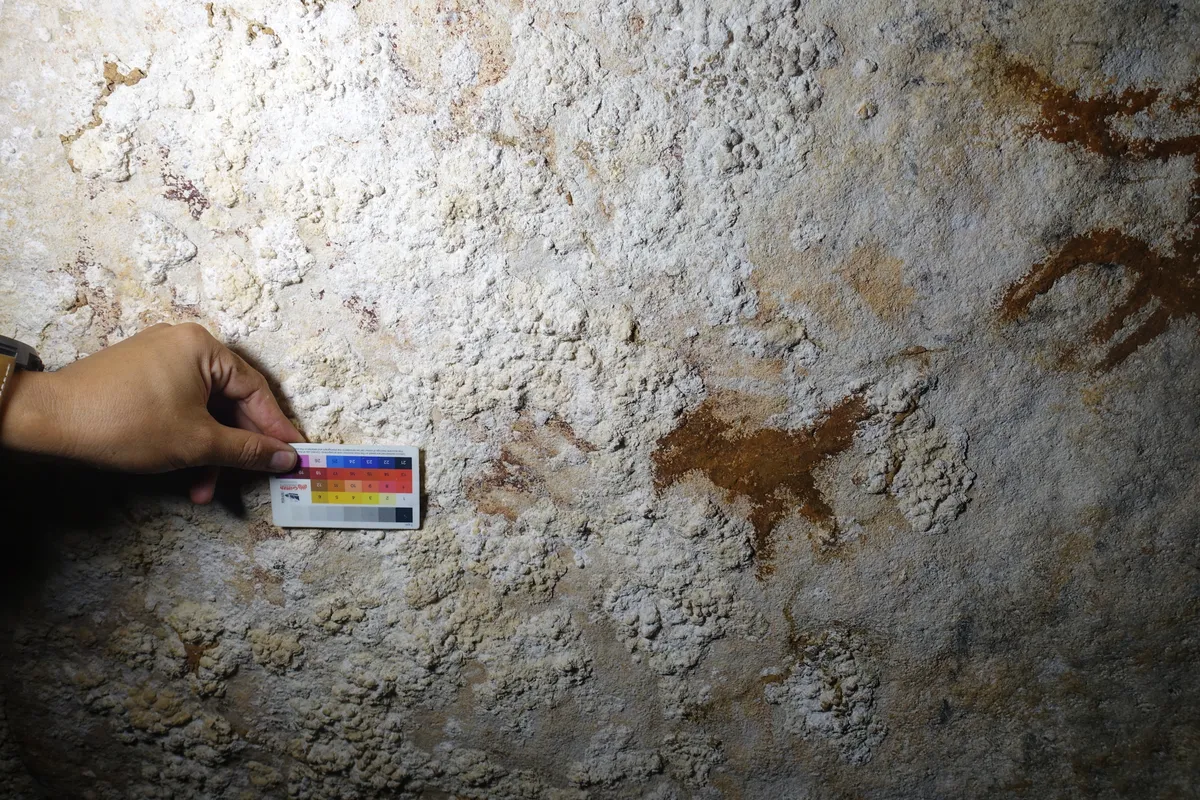
Someone pressed their palm against limestone in an Indonesian cave tens of thousands of years before writing was invented, before agriculture, before anything we'd recognize as civilization. They used reddish-brown pigment to trace the outline. Then they did something stranger: they deliberately made the fingers look more claw-like, more exaggerated, more intentional.
That handprint—found on Muna Island in Sulawesi, Indonesia—is now the oldest known rock art in the world. Researchers used laser-ablation uranium-series dating to analyze the mineral crust that formed over the pigment, pinpointing the age to at least 67,800 years ago. It beats the previous record holder, a Neanderthal hand stencil in northern Spain, by roughly 1,100 years.
What makes this discovery quietly profound is what it suggests about the artist's mind. The deliberate alteration of the fingers—making them pointy, claw-like—suggests creative imagination and abstract thinking. Researchers believe this points to Homo sapiens, though they're careful not to rule out other possibilities. "To call this complex is rather over-interpreting the hand stencil," cautions archaeologist Paul Pettitt, a note of scholarly restraint that's worth respecting.
We're a new kind of news feed.
Regular news is designed to drain you. We're a non-profit built to restore you. Every story we publish is scored for impact, progress, and hope.
Start Your News DetoxBut the hand stencil doesn't stand alone. In the same region, archaeologists have found a 51,200-year-old cave painting of a pig that may be the oldest known visual storytelling ever created. Evidence suggests humans were painting in the Liang Metanduno cave repeatedly for at least 35,000 years—not a one-off moment, but a sustained cultural practice.
"What we are seeing in Indonesia is probably not a series of isolated surprises, but the gradual revealing of a much deeper and older cultural tradition that has simply been invisible to us until recently," says Maxime Aubert, an archaeologist and geochemist at Griffith University who co-authored the study.
This matters because it shifts where we think human creativity began. For decades, European cave art—Chaucer's hand stencils, Lascaux's animals—felt like the birthplace of human expression. These Indonesian findings suggest the story is older, more geographically dispersed, and more complex than we realized. The hand on that cave wall wasn't a first attempt. It was part of a tradition already thousands of years old.