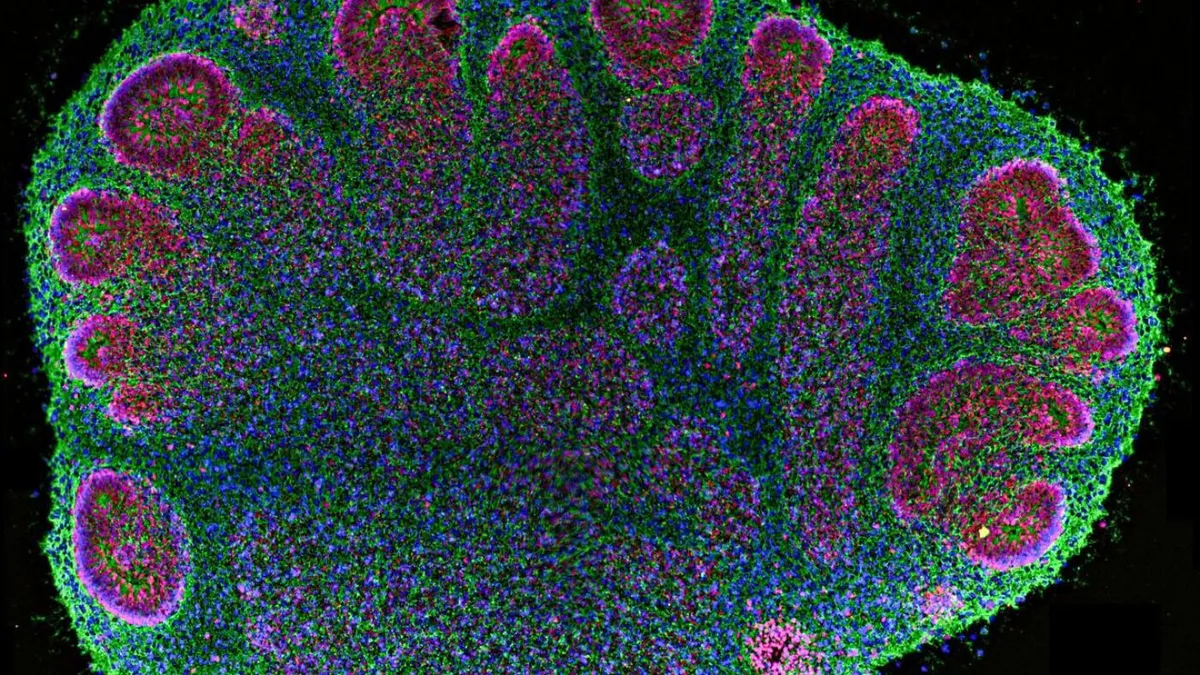
Scientists can now grow pea-size clusters of human brain tissue in the lab—and they're already finding treatments for conditions like autism and epilepsy. But this same technology is forcing us to ask questions we've never had to ask before: Can these organoids feel pain? Could they become conscious? Who decides what's acceptable to do with them?
Brain organoids are essentially miniature models of human brain development. Researchers grow them from human cells over months or years, watching how neural circuits form in ways that animal brains simply don't replicate. This matters because some brain conditions—rare genetic forms of autism, certain epilepsies, even some cancers—can't be properly studied in mice or rats. The human organoid fills that gap.
Dr. Sergiu Pașca at Stanford has used organoids to develop a potential treatment for a rare cause of autism and epilepsy. His lab has also recreated human pain pathways and transplanted human organoids into rat brains to test how they integrate. The science works. The results are promising. And yet, the moment you say "human brain tissue in an animal's brain," something in most people hesitates.
We're a new kind of news feed.
Regular news is designed to drain you. We're a non-profit built to restore you. Every story we publish is scored for impact, progress, and hope.
Start Your News Detox"We are talking about an organ that is at the seat of human consciousness," says Insoo Hyun, a bioethicist at the Museum of Science in Boston. "It's the seat of personality and who we are. So it's reasonable to be especially careful."
Recently, a group of scientists, ethicists, patient advocates and journalists gathered to think through what comes next. The questions on the table were blunt: Is it okay to place human organoids in an animal brain? Can organoids feel pain? Can they become conscious? Who should regulate this work, if anyone?
There's a real tension here. Patient advocates and researchers want to move quickly—these organoids could unlock treatments for life-threatening diseases. Bioethicists push back, arguing for guardrails: clear consent from the people whose cells are being used, oversight to prevent enhancement experiments, transparency so the public understands what's actually happening versus what science fiction suggests.
What emerged from the meeting wasn't conflict so much as recognition. Most scientists understand they're working in territory that needs more than just lab protocols. They need public trust, which means being honest about what organoids can and can't do, and accepting that some experiments might need to wait until we've thought them through more carefully.
The conversation is just beginning. But the fact that it's happening—that researchers and regulators are asking these questions before there's a crisis—suggests the field is trying to get ahead of the ethics rather than chase them.