

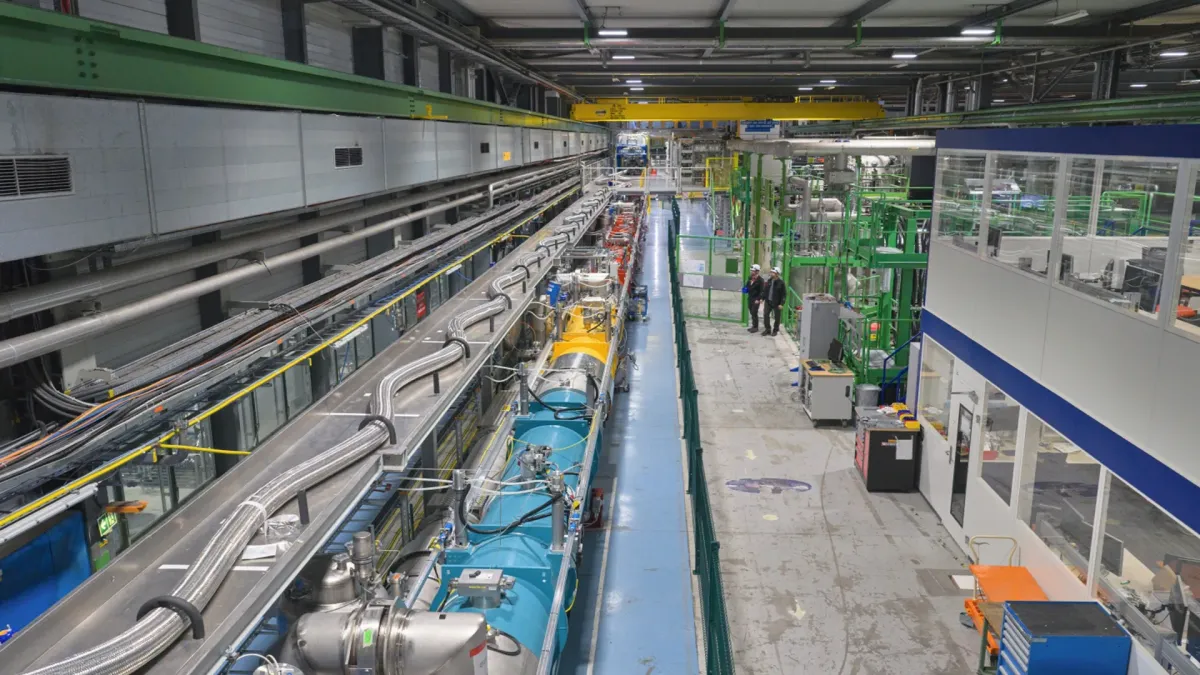
Deep beneath the French-Swiss border, scientists are about to freeze a 312-foot magnet system to minus 456 degrees Fahrenheit—colder than outer space. It's a test run for the High-Luminosity Large Hadron Collider (HL-LHC), CERN's most ambitious upgrade in two decades.
The cooldown of the Inner Triplet String (IT String) marks the beginning of the end for the current LHC as we know it. In just a few months, engineers will shut down the world's largest particle collider for four years of overhaul. When it restarts in 2030, it won't just be faster—it'll be fundamentally transformed.
Why This Matters Now
The current LHC has already made history. It discovered the Higgs boson, confirmed decades of theoretical physics, and opened windows into the nature of matter itself. But it's reaching the limits of what it can do. The upgraded version will smash protons together 10 times more frequently, creating collisions rare enough to reveal physics we've never seen before.
We're a new kind of news feed.
Regular news is designed to drain you. We're a non-profit built to restore you. Every story we publish is scored for impact, progress, and hope.
Start Your News DetoxTo make that happen, CERN needed to invent new magnets. The niobium-tin inner triplet magnets being tested can produce stronger magnetic fields than anything currently in the tunnel, allowing researchers to focus proton beams with unprecedented precision. The catch: they only work when chilled to 1.9 Kelvin, requiring an elaborate liquid-helium refrigeration system that's never been deployed at this scale before.
That's why the IT String exists. It's a full-scale replica of the upgraded hardware, built above ground where engineers can watch every detail. Over the coming weeks, as liquid helium flows through kilometers of piping, the team will validate that the new magnets, cryogenics, protection systems, and power infrastructure can work together seamlessly. If something fails, they'll catch it now—not buried 100 meters underground during the actual installation.
"The connection and operation of all the equipment in the IT String give us a chance to optimize our procedures before the actual installation in the tunnel," said Oliver Brüning, CERN's Director for accelerators and technology. "So that we will be prepared and ready for an efficient and smooth installation."
The project involves nearly 50 institutes across more than 20 countries—a truly global effort spanning Europe, Asia, and North America. It's a reminder that the biggest scientific questions require the biggest collaborations.
When the HL-LHC turns on in 2030, it won't just be hunting for the next Higgs. It'll be exploring genuinely uncharted territory, looking for particles and interactions that might overturn our current understanding of physics entirely. As Mark Thomson, CERN's Director-General, put it: "That's the whole point of exploring the unknown: you don't know what's out there." The cooldown happening right now is the first real test of whether we're ready to find out.





