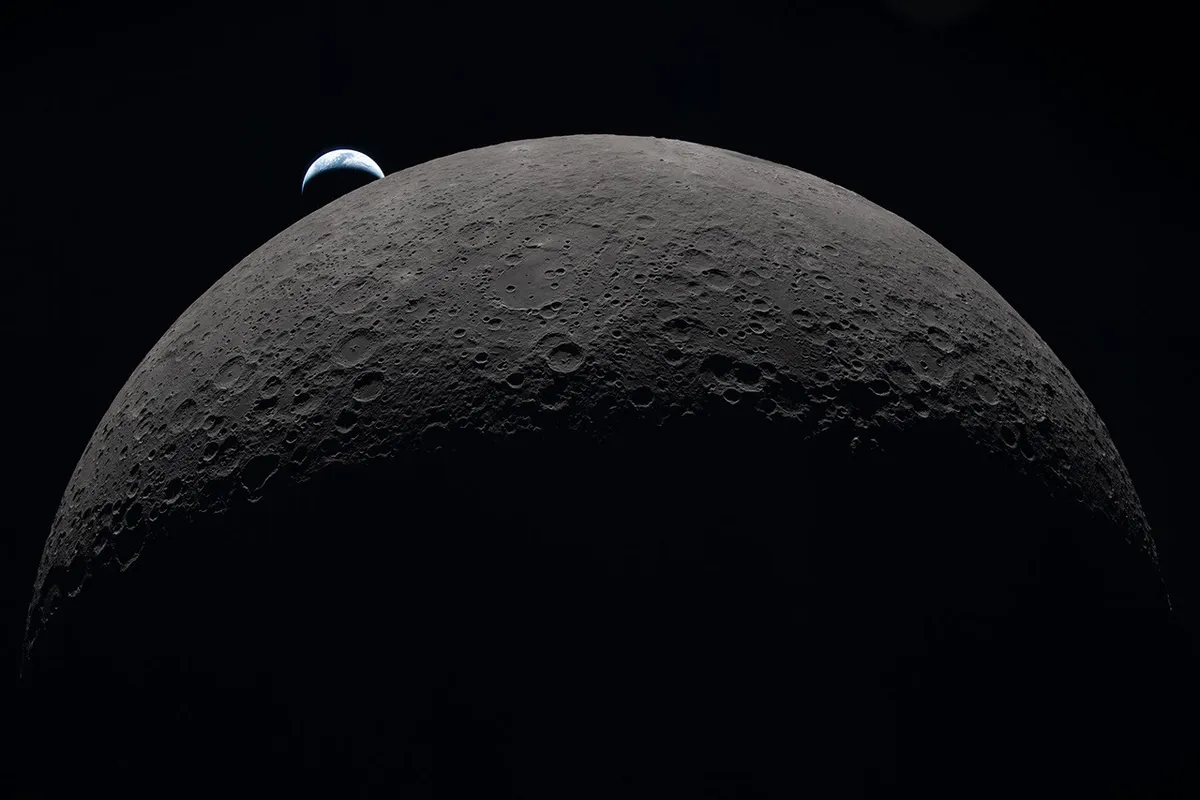
Most of us have seen the iconic "Earthrise" photos from Apollo 8 — our blue marble peeking over the lunar horizon. Now, the crew of NASA’s Artemis II mission has flipped the script, capturing what they're calling an "Earthset." Because apparently, that's where we are now: watching our home planet disappear behind the Moon.
Imagine you’re on the far side of the Moon, an inhospitable, crater-pocked landscape that humanity rarely gets to see. As your spacecraft, Orion, zips along, Earth — a beautiful, partly lit crescent — slowly dips out of view, like a giant, cosmic coin slot machine. That's the view the Artemis II astronauts got on April 6, 2026, at 6:41 p.m. EDT.
From their vantage point, the sunlit portion of our planet showed off bright white clouds swirling over the cerulean waters of Oceania. The darker areas, naturally, were experiencing their own quiet nighttime. All of this played out against the stark, heavily cratered surface of the Moon, a stark reminder of just how much cosmic abuse our celestial neighbor has endured.
We're a new kind of news feed.
Regular news is designed to drain you. We're a non-profit built to restore you. Every story we publish is scored for impact, progress, and hope.
Start Your News DetoxThis stunning image was just one highlight from their seven-hour flyby behind the Moon's far side. The mission, set to wrap up its 10-day journey on April 10, 2026, with a splashdown off the California coast, has already delivered a trove of incredible visuals. Other snapshots include a total solar eclipse (from space, no less), the faint light of distant planets, and those dramatic, long shadows where lunar day meets night.
It’s a powerful reminder that while we’re busy down here, a few lucky humans are getting a perspective on Earth that most of us can only dream of. And occasionally, they send back a photo that makes you stop scrolling and just… look.