New Nanosensor Detects Key Gut Health Marker
Researchers have created a new fluorescent nanosensor that can quickly find a key marker for gut health. This sensor uses carbon nanotubes and could make gut health testing faster and easier to access.
The marker is called Indole-3-propionic acid (IPA). It's a substance made by gut bacteria when they break down tryptophan, an important amino acid. IPA helps control inflammation and stress in the body. It's also linked to conditions like inflammatory bowel disease (IBD), Type 2 diabetes, and liver disease.
Current ways to detect IPA are expensive and take a long time, making them hard to use for regular checks. The new sensor changes this by giving a fast result in minutes using fluorescence. It can also tell IPA apart from similar substances in the gut, even in complex samples like blood.
We're a new kind of news feed.
Regular news is designed to drain you. We're a non-profit built to restore you. Every story we publish is scored for impact, progress, and hope.
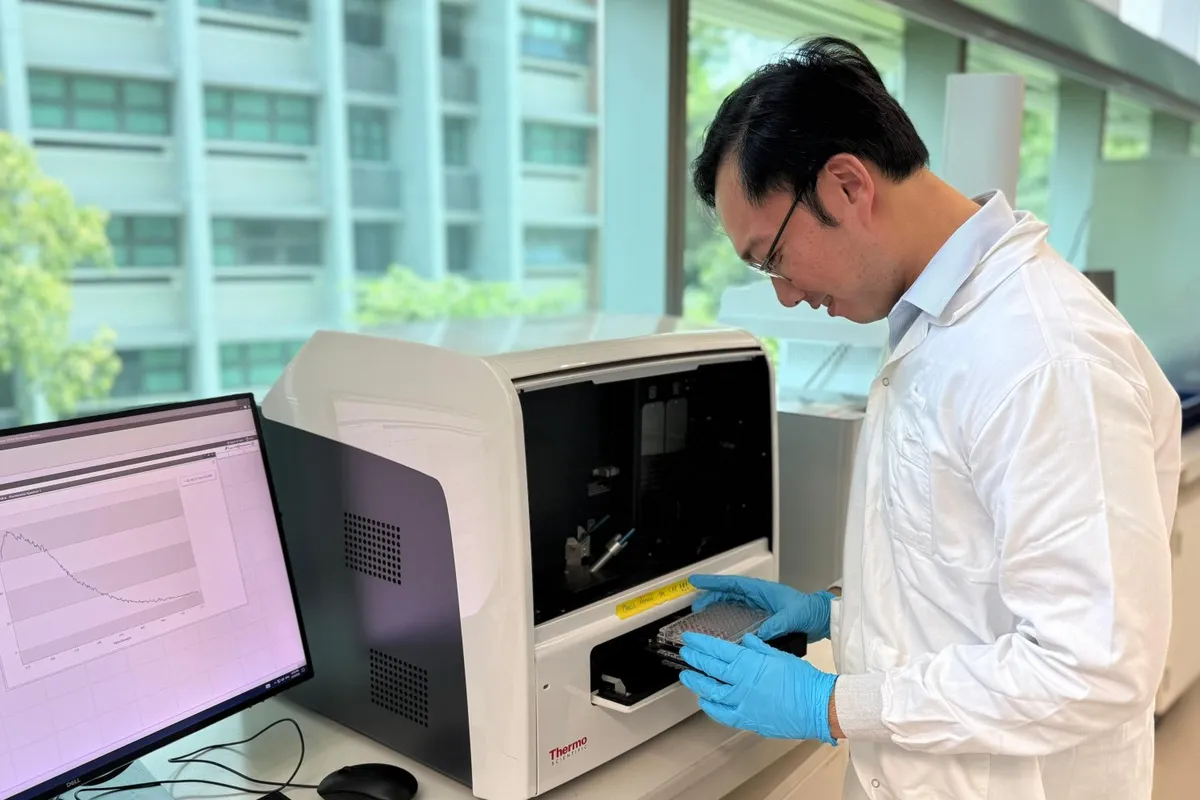
Start Your News DetoxMervin Ang, a co-first author and assistant professor at Nanyang Technological University, said this is the first time IPA levels can be measured directly and quickly in biological samples using an optical nanosensor. He believes this new method could lead to faster and more accessible ways to check gut health.
The team published their findings in Advanced Healthcare Materials in a paper called "Fluorescent Nanosensor for Indole-3-Propionic Acid Detection in Gut Health Monitoring." The work involved researchers from NIE, MIT, SMART, and clinicians from the National University Hospital (NUH) and NUS Medicine.
From Plants to People: A Versatile Technology
This new nanosensor builds on earlier research from SMART DiSTAP. The technology was first used to monitor plant health, looking at growth signals and stress. Now, it has been adapted to human health to detect IPA.
Michael Strano, a lead investigator at SMART DiSTAP and professor at MIT, explained that they've used similar techniques to measure hormones and other substances in plants for agriculture. Now, they've applied it to a long-standing challenge in human gut health. He noted that this new tool could offer quick insights into gut wellness and chronic diseases like IBD.
The sensor has a special "dual-mode" capability. It can work in a visible fluorescence mode for quick, low-cost testing of many samples. It also has a near-infrared mode, which uses wavelengths that can go deeper into tissues. This near-infrared feature, made possible by carbon nanotubes, means the technology could be used inside the body or integrated into wearable devices. These devices could allow for home testing or continuous monitoring, helping patients with conditions like IBD detect flare-ups sooner.
Validated in Patient Samples
To see how well it worked in real-world situations, the research team tested the nanosensor on 125 human plasma samples. These samples came from healthy people and those with gut diseases.
The study showed clear differences in IPA levels. Healthy people had higher IPA levels than patients with inflammatory bowel diseases like Crohn’s disease and ulcerative colitis. Patients with active gut inflammation had lower IPA levels, which matches what doctors already know.
Jonathan Lee, a senior consultant at NUH and co-first author, said that a fast and simple way to check metabolite levels like IPA could be very useful clinically. He believes it could add to existing diagnostic tools and give more information about patients with inflammatory bowel diseases.
This research could lead to faster and more accessible gut health testing outside of labs. Instead of complex lab methods, the nanosensor could allow for quick checks in clinics or even at home. This could help detect gut diseases earlier and make it easier to track treatment progress.
Unlike other tests that just identify which bacteria are present, this nanosensor measures what those bacteria are actually producing. This gives a more direct look at gut health. Measuring the output of these substances, rather than just the types of bacteria, could offer more useful insights and lead to more personalized healthcare.
The technology could also track how well dietary changes work. Users could quickly see if certain foods or probiotics are helping their gut bacteria make anti-inflammatory molecules like IPA. The sensor also worked well in complex body fluids like serum and plasma, which is important for its use in real medical settings. For drug research, the nanosensor could quickly test how effective new treatments or probiotics are by giving instant IPA level readings.
The Path to Point-of-Care Diagnostics
Ang stated that the move from lab discovery to a clinical tool is already happening. With more development, the platform could be used in clinics and eventually adapted into portable devices for regular health monitoring.
The research team has received a grant to start a company in Singapore. This company will work on further testing and developing the sensor. Their goal is to turn it into a clinical diagnostic tool that can be used at the point of care. They also plan to expand the platform to detect many gut metabolites at once and use AI to analyze signals, leading to more accurate and personalized gut health monitoring. Future plans include integrating the sensor into wearable devices or other systems for continuous, real-time sensing.
Deep Dive & References: Fluorescent Nanosensor for Indole-3-Propionic Acid Detection in Gut Health Monitoring - Advanced Healthcare Materials, 2024