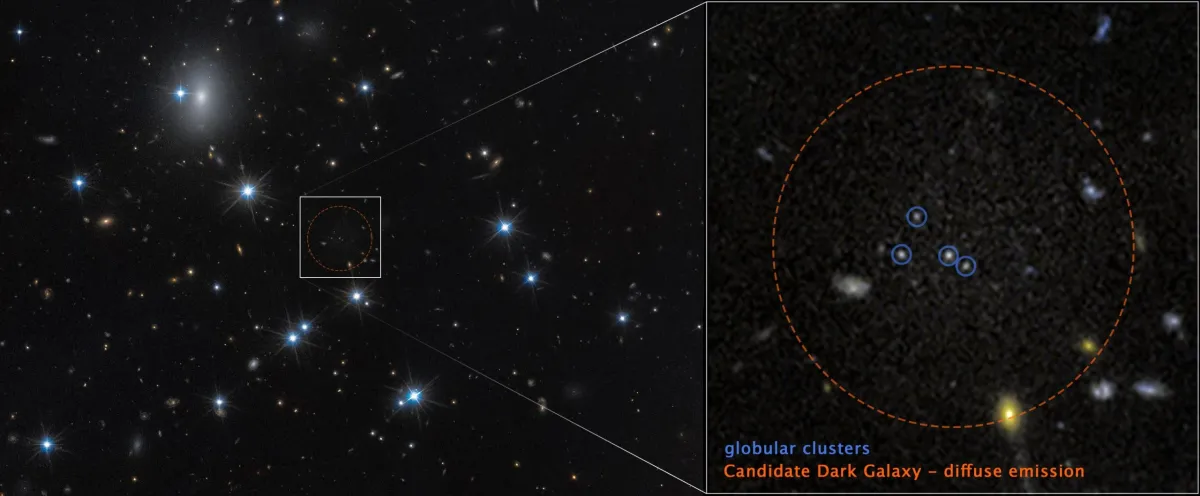
Astronomers just detected something that shouldn't be easy to find: a galaxy so faint and dark that it's barely there at all. CDG-2, discovered 300 million light-years away in the Perseus cluster, is 99% dark matter—the invisible stuff that makes up most of the universe but refuses to show itself through light. The catch is that this ghost galaxy gave itself away through just four globular clusters, those tight knots of ancient stars that orbit its edges like breadcrumbs leading to an invisible loaf.
Most galaxies announce themselves with billions of stars blazing across space. But a rare few are so dim, so starved of light, that they hide in plain sight. These low-surface-brightness galaxies contain barely any visible matter—mostly just dark matter and the gravitational signature it leaves behind. For decades, astronomers suspected they existed. Finding one was another matter entirely.
The Invisible Made Visible
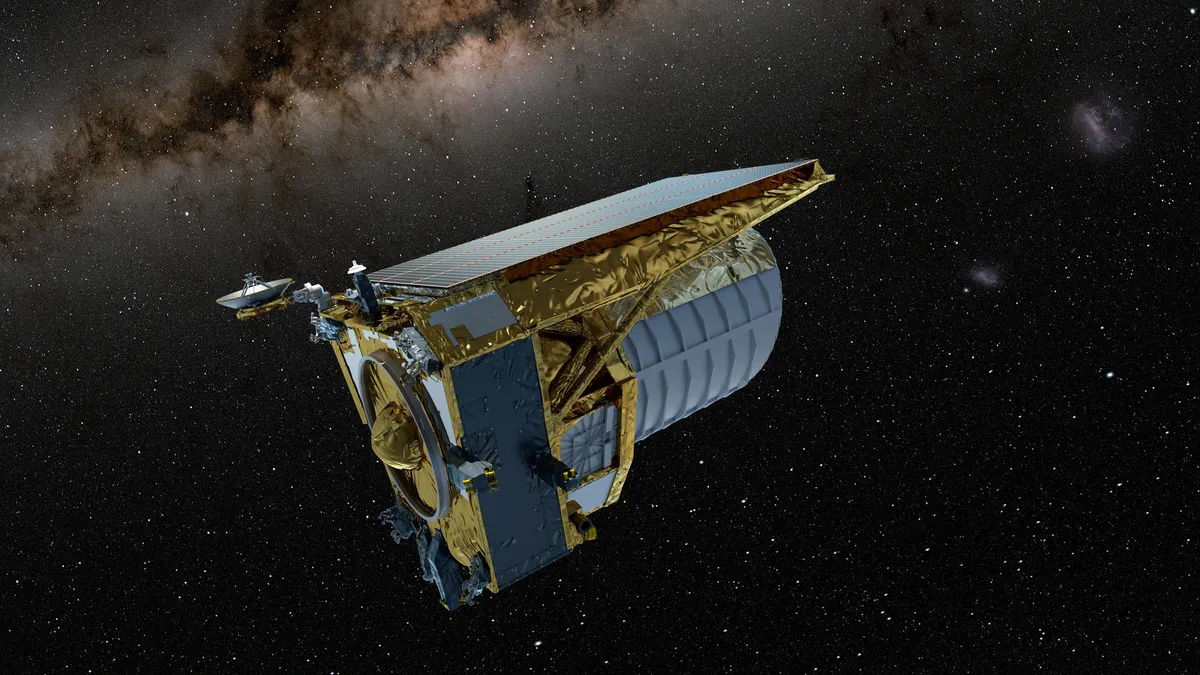
David Li at the University of Toronto approached the problem sideways. Instead of hunting for light, his team searched for patterns—specifically, the tight clustering of globular clusters in space. Think of it like finding a house by spotting its mailbox and fence posts. Using statistical methods on data from NASA's Hubble Space Telescope, the European Space Agency's Euclid observatory, and Hawaii's Subaru Telescope, they detected four globular clusters in close formation. Then they looked deeper. The three telescopes working together revealed something faint but unmistakable: a dim halo of light surrounding those clusters. That glow was the galaxy itself—the first one ever identified purely through its globular cluster population.
We're a new kind of news feed.
Regular news is designed to drain you. We're a non-profit built to restore you. Every story we publish is scored for impact, progress, and hope.
Start Your News Detox"This is the first galaxy detected solely through its globular cluster population," Li said. The four clusters represent essentially the entire visible star population of CDG-2.
Here's what makes CDG-2 remarkable: those four globular clusters account for only 16% of the galaxy's visible light. The rest is dark matter—so much of it that it comprises 99% of the galaxy's total mass. Most ordinary matter that might have formed stars, mainly hydrogen gas, was likely stripped away long ago as CDG-2 drifted through the crowded Perseus cluster, gravitationally bullied by its more massive neighbors. What remained were the globular clusters, dense and gravity-bound enough to survive the cosmic roughhousing.
This discovery matters beyond the headline. It suggests that dark matter galaxies like CDG-2 might be far more common than we've realized—we've simply lacked the tools and techniques to spot them. Globular clusters, it turns out, are reliable markers of these faint objects. They're dense enough to resist gravitational disruption, making them persistent signposts to invisible galaxies hiding in the cosmic dark.
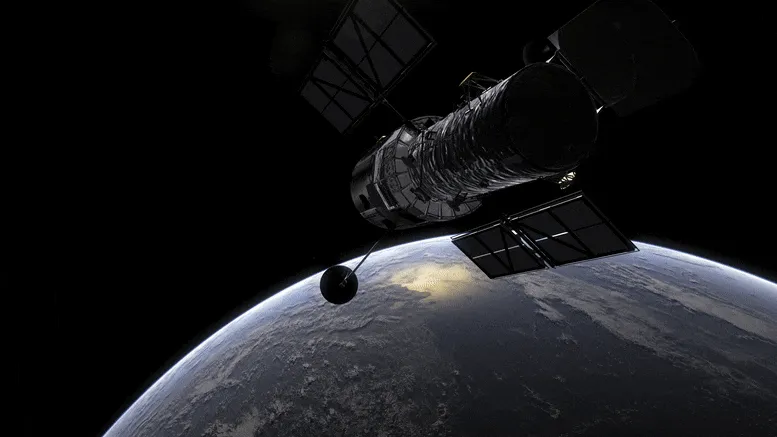
The next phase is already underway. As new sky surveys like NASA's upcoming Nancy Grace Roman Space Telescope and the Vera C. Rubin Observatory come online, astronomers are deploying machine learning and advanced statistics to sift through enormous datasets. The Hubble Space Telescope, now over 30 years old, continues to deliver discoveries that reshape our understanding of the universe's hidden architecture. What Li's team accomplished—coordinating observations across three different observatories to confirm something nearly invisible—hints at what's coming: a census of the universe's ghost galaxies, and with it, a deeper understanding of what dark matter actually is.