A tiny rotation between ultrathin magnetic layers has surprised physicists by creating magnetic patterns hundreds of times larger than expected. Researchers at the University of Edinburgh found that when atom-thin magnetic crystals are stacked with just a slight angular mismatch, they generate enormous topological structures that shouldn't exist according to conventional physics.
This discovery matters because it reveals a new way to engineer magnetic textures that could power the next generation of ultra-efficient computing. And it happened by accident — or rather, by noticing something odd in the data.
How a small twist creates outsized effects
Scientists have long known that stacking ultrathin crystals at a slight angle changes how they behave electronically. This technique, called moiré engineering, has become a standard way to design new quantum materials. The idea is simple: when two crystal grids overlap at an angle, they create an interference pattern (a moiré) that acts like a template, controlling where electrons go and how they interact.
We're a new kind of news feed.
Regular news is designed to drain you. We're a non-profit built to restore you. Every story we publish is scored for impact, progress, and hope.
Start Your News DetoxBut magnetism, it turns out, doesn't follow the same rulebook.
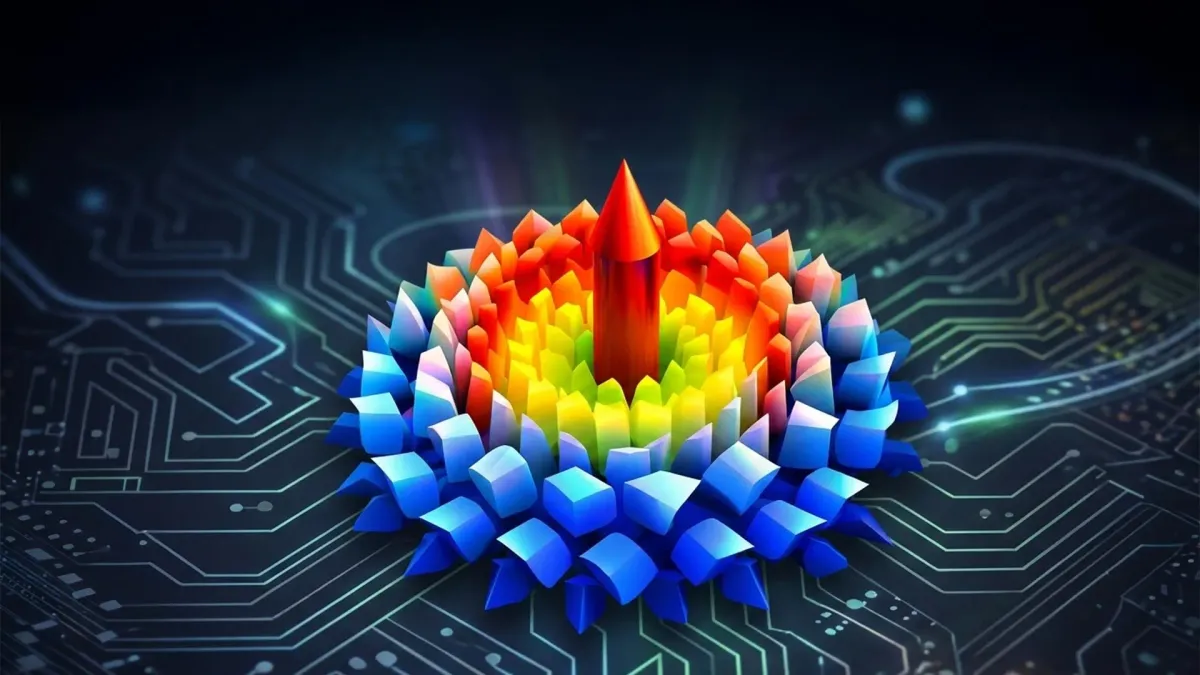
When the Edinburgh team examined twisted layers of chromium triiodide using a scanning magnetometry technique precise enough to map magnetic fields at the nanoscale, they found something counterintuitive. The magnetic patterns stretched across 300 nanometers — roughly ten times larger than the underlying moiré pattern. These weren't small, local effects. They were sprawling topological structures called skyrmions, and they appeared without any external force or special treatment.
What made it stranger: the effect didn't scale predictably. When researchers made the twist angle smaller, the moiré wavelength grew larger, as expected. But the magnetic textures did the opposite. They reached maximum size around 1.1 degrees of twist, then shrank and vanished above 2 degrees. Magnetism wasn't simply copying the template. It was responding to a delicate balance between competing quantum forces — exchange interactions, magnetic anisotropy, and something called Dzyaloshinskii-Moriya interactions — all subtly adjusted by the rotation angle.
Why this matters for computing
Skyrmions are magnetic vortices, tiny spinning patterns that have fascinated physicists for years because they're stable, robust, and can be moved with almost no energy. That last part is crucial. Most computing today wastes enormous amounts of energy shuffling data around. Skyrmions could change that.
The Edinburgh discovery suggests a remarkably simple way to create them: just twist the layers. No lithography. No heavy metals. No strong electric currents. Just geometry. "Twisting is not just an electronic knob, but a magnetic one," said Elton Santos, who led the modeling work. "We're seeing collective spin order self-organize on scales far larger than the moiré lattice."
Because these skyrmions are so large, they're easier to detect and manipulate than smaller versions. And because they're topologically protected — their stability comes from their shape, not from energy barriers — they could operate with minimal energy loss. That combination points toward a path forward for post-CMOS computing, the era after conventional silicon chips hit their limits.
The deeper insight here is that moiré physics operates across multiple scales simultaneously. A shift in atomic alignment can generate structures a thousand times larger. That's not just a curiosity. It's a new control knob for quantum engineering, one that's almost impossibly simple to turn.