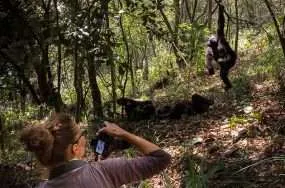
Humans, it turns out, are a complicated bunch. We can be the reason a species teeters on the brink, and also the reason it pulls back. For the gorillas of Cameroon's Dipikar Island, that duality was painfully clear. Poaching had made them wary, even fearful, of the bipedal creatures invading their space.
But new research from the African Journal of Ecology suggests something rather remarkable: even gorillas with a history of trauma can learn to distinguish between the bad apples (poachers) and the merely curious (researchers, tourists). And that trust, surprisingly, might just be their ticket to survival.

The Long Game of Trust
France Anougue from Concordia University, lead author of the study, points out that without the steady, non-threatening presence of people, these gorilla populations would be in serious trouble. It's a slow burn, this trust-building. In other parts of Africa, gorillas have warmed up to humans in a mere 28 months. But those areas hadn't seen the kind of heavy poaching that scarred Dipikar Island.
We're a new kind of news feed.
Regular news is designed to drain you. We're a non-profit built to restore you. Every story we publish is scored for impact, progress, and hope.
Start Your News DetoxSo, when scientists began working with a group of 12 gorillas in Cameroon back in 2011, there were no guarantees. They started by simply tracking the family — a silverback, several females, and a crew of youngsters — from a safe distance, just observing their daily grind.
Then came 2015. Researchers and local trackers decided it was time to get a bit closer. They'd try to catch the gorillas' attention with tongue clacks or finger snaps. Once noticed, they'd mimic gorilla feeding, acting as neutral as possible. Think of it as trying to convince a very large, powerful, and previously traumatized animal that you're just… there.
Initially, the gorillas were not impressed. Nearly 30% of their reactions were aggressive, and over 30% were pure fear. Curiosity? Indifference? Practically non-existent. Which, if you think about it, is a perfectly reasonable response to a species that has historically caused them immense grief.
But here's where the resilience kicks in. Over seven long years, things shifted. By 2022, fear and aggression had largely vanished. Instead, gorillas were showing curiosity more than 30% of the time, and a healthy dose of disinterest for another 30%. Anougue notes that even the younger gorillas picked up on this tolerance, suggesting it's a learned behavior, passed down through the group.
A Win-Win for Gorillas and Humans
This increased interaction with harmless humans, coupled with more active poaching patrols, had a tangible impact. Signs of poaching — like gunshots and abandoned campsites — dropped by roughly half between 2015 and 2022. While it's tough to isolate the exact cause-and-effect, it’s clear that a multi-pronged approach worked.

Anougue sees this as a testament to gorillas' ability to overcome past traumas. Their willingness to tolerate humans could significantly boost their survival odds. And, in a rather neat twist, it could also benefit local communities through ecotourism. Because protecting gorillas isn't just about biodiversity; it's about creating a sustainable future where both species can, if not exactly coexist, then at least co-tolerate. Which, for the gorillas of Dipikar Island, is a pretty massive step forward.