
Fifteen years after discovering MXene—a remarkably conductive two-dimensional material—researchers at Drexel University have figured out how to roll it into something even better: tiny, hollow tubes called nanoscrolls.
These scrolls are about 100 times thinner than a human hair, yet they conduct electricity more efficiently than their flat counterparts. The breakthrough opens practical doors for better batteries, wearable electronics, biosensors, and something more exotic: superconductivity at room temperature.
Why Shape Matters at the Nanoscale
The insight is almost obvious once you hear it. "It's like comparing steel sheets to metal pipes," says Yury Gogotsi, the Drexel engineer who led the work. "You need sheets to make car bodies, but to pump water or reinforce concrete, you need tubes."
We're a new kind of news feed.
Regular news is designed to drain you. We're a non-profit built to restore you. Every story we publish is scored for impact, progress, and hope.
Start Your News DetoxWhen MXene sheets lie flat, stacked on top of each other, they create a cramped space. Ions trying to move through—say, in a battery or water filter—have to navigate a maze of confined passages. Roll those sheets into scrolls, and you create open highways. Ions move through with far less resistance.
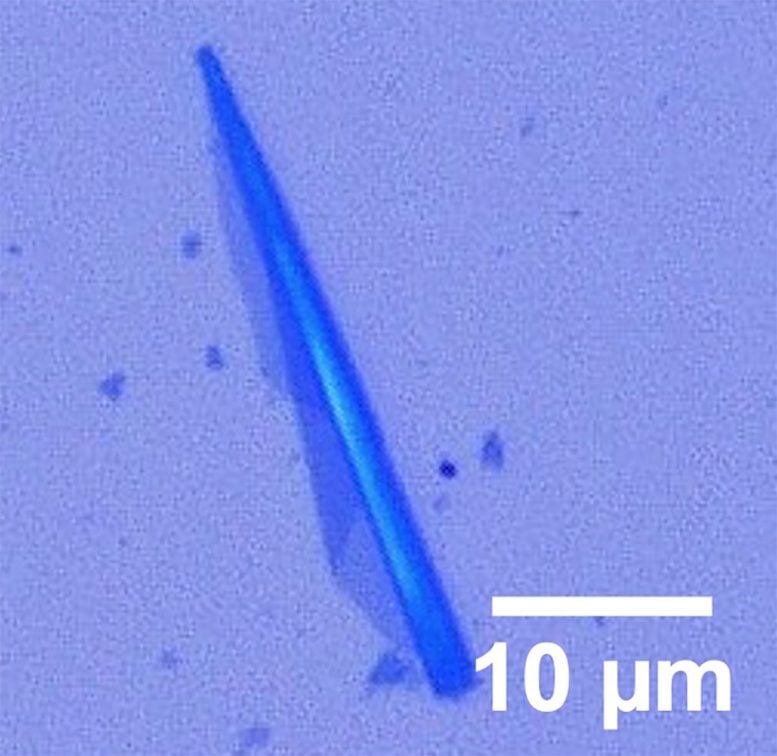
Teng Zhang, a postdoctoral researcher on the team, explains the physics: "By converting 2D nanosheets into 1D scrolls, we prevent this nano-confinement effect. The open, tubular geometry effectively creates 'highways' for rapid transport."
Graphene—the famous carbon nanomaterial—already has tube versions (carbon nanotubes), but they've been difficult to manufacture at scale and lack the chemical flexibility of MXenes. The Drexel team solved this by carefully controlling the chemical environment around MXene flakes, using water to create an imbalance in the surface structure. This asymmetry causes internal strain that makes the layers peel away and curl into tight scrolls.
The method works consistently. The researchers produced nanoscrolls from six different types of MXenes—including titanium carbide, niobium carbide, and vanadium carbide—and generated about 10 grams of material with tunable composition each time.
Sensing and Wearables Get a Boost
The tubular shape creates a second advantage: accessibility. In flat stacked structures, the most chemically active sites are buried between layers, hidden from the molecules they're supposed to detect. In scrolls, everything is exposed on the outer surface. This matters for biosensors that need to detect large molecules like proteins. It also opens possibilities for gas sensors and electrochemical capacitors.
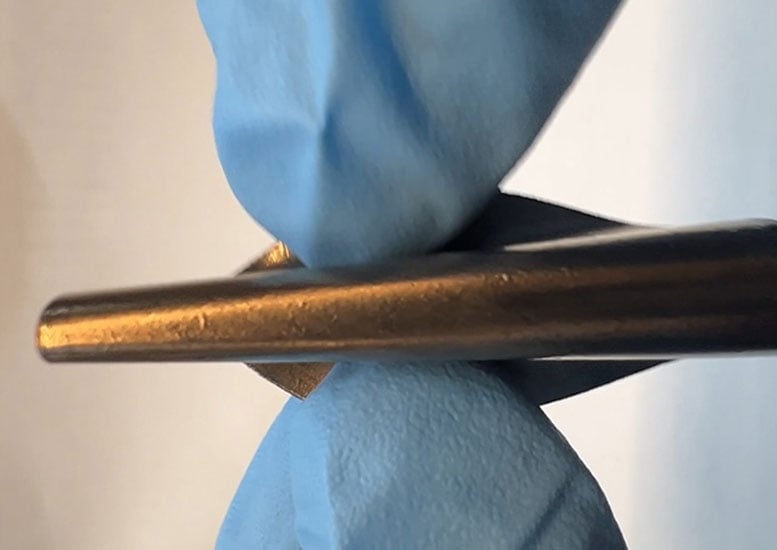
For wearable electronics, the scrolls offer something different: strength without sacrificing conductivity. They can reinforce soft polymers while keeping electrical signals flowing, even when the material bends and stretches. Their rigid, tubular shape means they embed securely in flexible fabrics rather than shifting around.
The team also discovered they can align the scrolls using an electric field—imagine arranging millions of tubes 100 times thinner than a hair to build a wire or stand upright like a brush. This opens a path to functional textiles that are both durable and conductive.
The Quantum Leap
The most striking finding came almost as a bonus. When the researchers rolled niobium carbide into scrolls, they observed something unexpected: the material became superconducting—able to conduct electricity with zero resistance—in flexible films at room temperature.
Previously, superconductivity in this class of materials only appeared in compressed powders and pellets, not in flexible films. The rolling process introduces lattice strain and curvature that flat sheets don't have, and something about that geometry stabilizes the superconducting state. The exact mechanism is still being explored, but the practical implication is clear: superconducting wires, coatings, and sensors that don't require the extreme cooling of traditional superconductors.
The team plans to investigate the quantum properties further and explore other phenomena the scrolling process might unlock. For now, they've moved a laboratory curiosity—a clever way to reshape nanomaterials—into territory where it could reshape how we store energy, sense molecules, and conduct electricity.