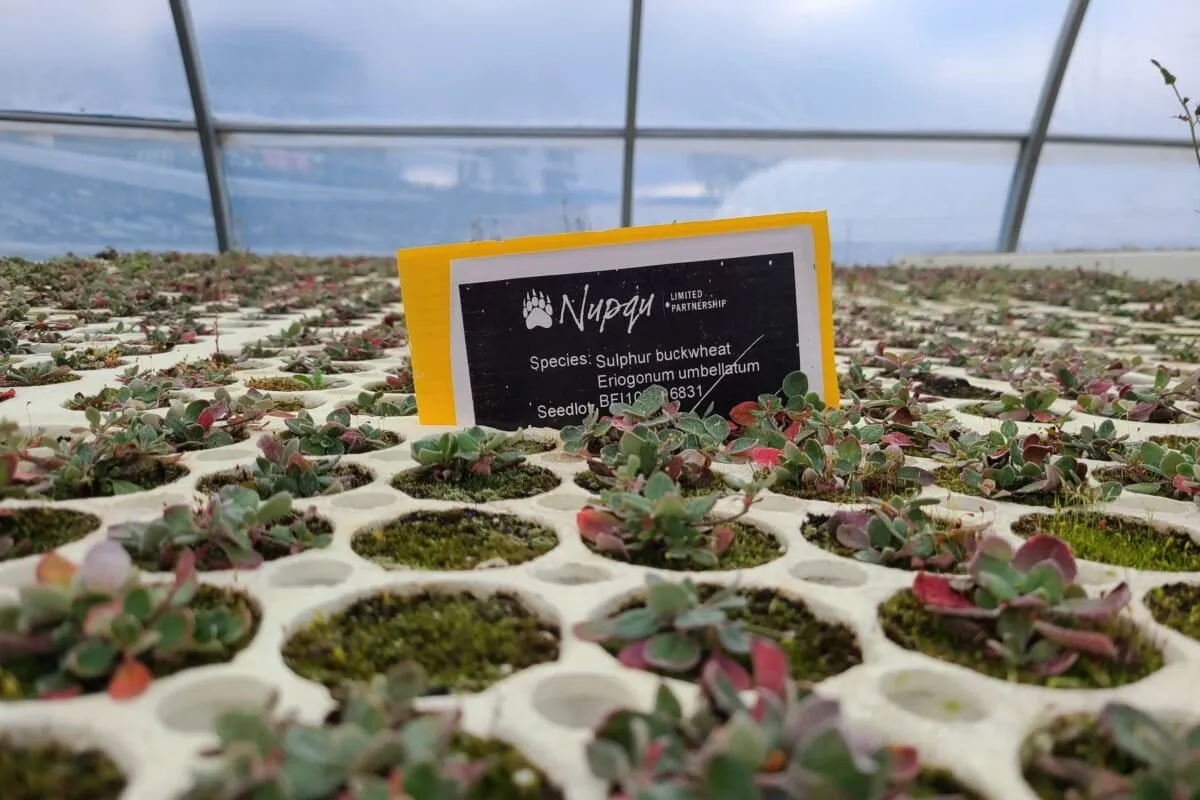
At the Nupqu Native Plant Nursery in British Columbia's Kootenay region, Melanie Redman holds a sulfur buckwheat seedling — a waxy-leafed plant that usually takes two to three years to grow from seed. This year, the nursery managed it in one.
That's not a small thing. Sulfur buckwheat is one of the most in-demand species for restoring heavily degraded land, but it's notoriously difficult to propagate. The breakthrough matters because it means more plants, faster, for the restoration work that Nupqu — which means "black bear" in Ktunaxa — is doing across its traditional territory.
Scaling up restoration
Nupqu is a wholly Ktunaxa-owned land and natural resource management company, jointly owned by the four Ktunaxa First Nations and the Ktunaxa Nation Council. Five years ago, it took over an existing native plant nursery on the ʔaq̓am reserve and has been building capacity ever since. Today, it cultivates more than 60 plant species — most grown from seeds collected across the Ktunaxa's traditional territory, which spans 70,000 square kilometers across the Kootenay region.
We're a new kind of news feed.
Regular news is designed to drain you. We're a non-profit built to restore you. Every story we publish is scored for impact, progress, and hope.
Start Your News DetoxNupqu calls itself the largest Indigenous-owned native plant nursery in Canada. That matters not just for scale, but for knowledge. The Ktunaxa have managed this landscape for thousands of years. They know which plants belong where, how they interact with the land, and what restoration actually looks like — not as an abstract environmental goal, but as a return to functional ecosystems that can sustain people and wildlife.
The work is already visible. Nupqu supplies plants for restoration projects across the region, helping to heal grasslands, forests, and alpine meadows that have been degraded by logging, mining, agriculture, and development. Each species is selected for its role in that particular ecosystem. The sulfur buckwheat, for instance, stabilizes high-altitude grasslands and provides food for pollinators.
What's happening at Nupqu reflects a broader shift: Indigenous-led conservation is increasingly recognized as more effective than top-down environmental management. The Ktunaxa aren't just growing plants — they're rebuilding the relationships between people and land that make ecosystems resilient. The faster they can propagate species like sulfur buckwheat, the faster that work can scale.