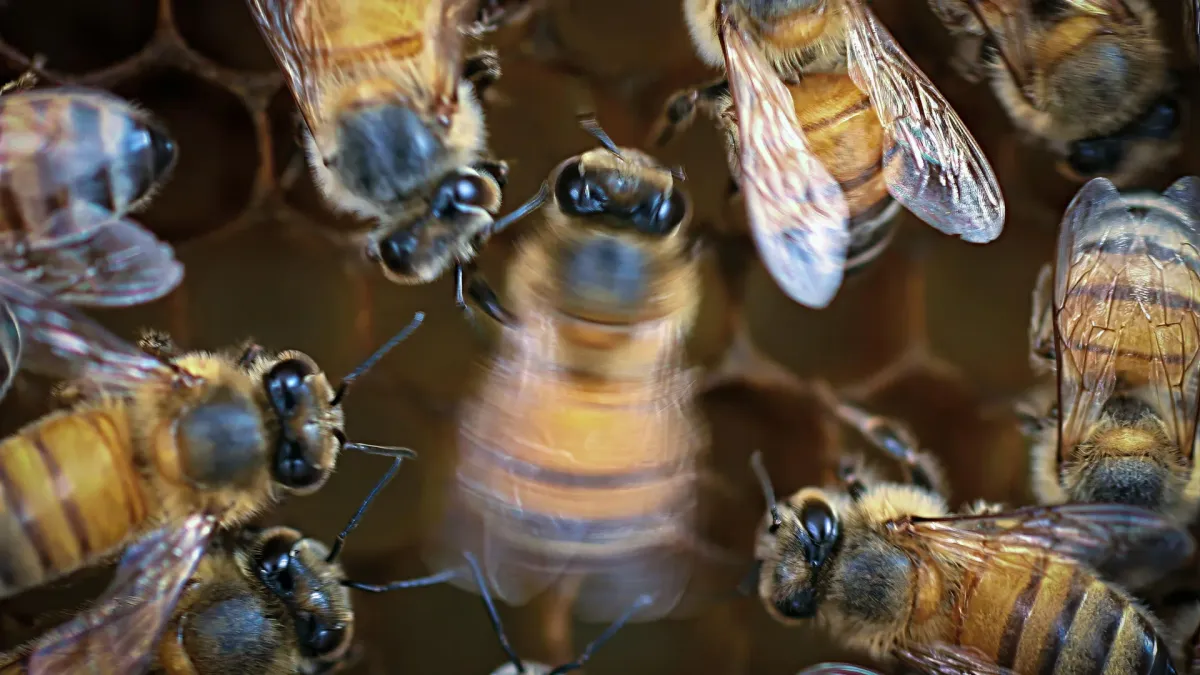
Honey bees adjust their famous waggle dance based on who is watching. Researchers found that when fewer bees pay attention, the dancer becomes less precise. This suggests the dance is a flexible performance, not just a fixed message.
How Bees Share Food Locations
When a bee finds a good food source, it returns to the hive. There, it performs a rapid, repeating waggle dance to share the location. Other bees watch as the dancer moves forward, shaking its abdomen, then circles back.
The dance's direction relative to the sun tells other bees where to go. The length of each movement signals the distance to the food. This system helps the colony find food efficiently.
We're a new kind of news feed.
Regular news is designed to drain you. We're a non-profit built to restore you. Every story we publish is scored for impact, progress, and hope.
Start Your News DetoxAudience Size Changes Dance Accuracy
Professor James Nieh from UC San Diego explains this behavior like a street performer. A large audience lets performers focus on their act. But a small crowd makes them work harder to attract interest.
Bees do something similar. If fewer hive mates are watching, the dancer moves around more to find followers. This extra movement makes it harder to keep the dance precise. As a result, the directions become less accurate.
Nieh noted that this is a "comparable tradeoff." When fewer bees follow, dancers move more, and the dance becomes less precise.
Experiments Show Social Feedback Matters
Nieh and his team worked with partners from the Chinese Academy of Sciences and Queen Mary University of London. They studied bees in controlled hives that mimicked natural conditions. They watched the "dance floor" where bees interact.
In one test, they changed the number of bees watching. In another, they kept the number steady but added young worker bees, who usually don't follow dances. In both cases, dancers were less precise when the audience was smaller or less engaged.
Ken Tan, a senior author of the study, said the waggle dance is often seen as a one-way transfer of information. However, their data shows that feedback from the audience shapes the signal. The dancer sends information and responds to social conditions.
How Bees Sense Their Audience
The study also looked at how bees know their audience size. Other bees often touch the dancer with their antennae and bodies. These physical touches likely help the dancer sense how many bees are nearby and how interested they are.
Lars Chittka from Queen Mary University of London pointed out that humans are not the only ones who perform differently for an audience. Bees dance better when they know someone is watching. When followers are few, dancers search for listeners, and their signals become less clear. This shows that communication is a deeply social act, even for insects.
Broader Implications for Animal Communication
These findings offer insights into how groups of animals share information. Many systems rely on signals that need to be repeated, received, and acted upon.
Nieh explained that the accuracy of a signal can depend on the availability of receivers, not just the sender's motivation. This kind of feedback may be important in animal societies, engineered swarms, and other systems where information quality changes with audience dynamics.
Deep Dive & References
The audience shapes the information content of the honey bee waggle dance - Proceedings of the National Academy of Sciences, 2026