Jacob Becraft tried to be an entrepreneur. Twice. He failed. Spectacularly, one might imagine, given his later description of ideas that "blew up in our faces." Most people would probably call it a day. But Becraft, then a graduate student, had a secret weapon: MIT Sandbox.
That secret weapon helped him co-found Strand Therapeutics, a company now valued at a cool $550 million. Their special mRNA drug has, in clinical trials, shrunk tumors in cancer patients who had literally run out of other options. So, not a bad "third swing at the plate," as Becraft put it.
The Sandbox Effect
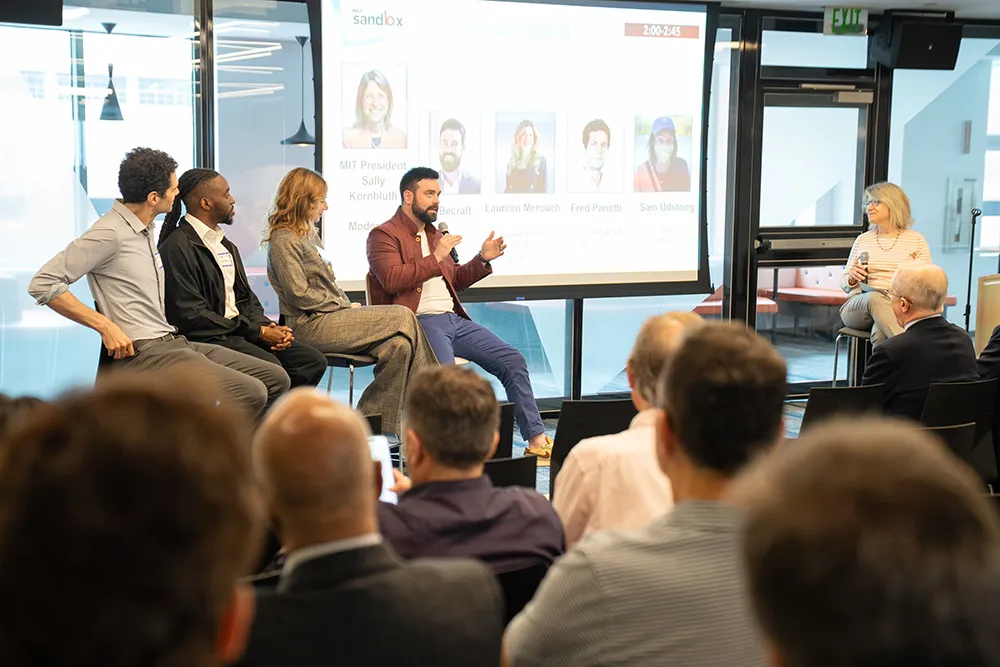
Stories like Becraft's were the main event at the 10-year anniversary of the MIT Sandbox Innovation Fund Program. Imagine a room full of founders, alumni, mentors, and university bigwigs, all celebrating a decade of giving students permission to fail fast, learn faster, and then, you know, change the world.
We're a new kind of news feed.
Regular news is designed to drain you. We're a non-profit built to restore you. Every story we publish is scored for impact, progress, and hope.
Start Your News DetoxFor Strand, Sandbox coughed up the cash for Becraft and his co-founder, Tasuku Kitada, to travel, do market research, and rub elbows with experts. This wasn't just pocket money; it was the fuel for building a company and convincing investors their vision wasn't just a pipe dream.
So, how does this magic sandbox work? Launched in 2016 by Ian Waitz (then dean, now MIT's VP for research), Sandbox is open to all MIT students. Undergrads, PhDs – doesn't matter. Teams snag between $500 and $5,000 to kick things off, get paired with two mentors, and hooked up with a network of advisors. If things are looking promising, they can apply for up to $25,000 more. All of this, by the way, is funded entirely by alumni, corporate sponsors, and investors. No strings attached, no ownership taken.
Jinane Abounadi, Sandbox's founding executive director, calls it a "home." A place where students can "explore, seriously test assumptions, talk to customers, build prototypes, fail, pivot, learn, and grow." Because apparently, that's where the good stuff happens.
From Kitchen Tables to Global Reach
Take Samuel Udotong, co-founder of Fireflies.ai. That initial Sandbox funding? It allowed him to take the terrifying leap of moving to San Francisco to build his company. Without it, he says, money would have been an "insurmountable barrier."
Fred Parietti, CEO of Multiply Labs, was literally building early prototypes on his kitchen table. Small funding, he admits, but "not zero." That belief, that chance to build something, was the game-changer. Multiply Labs now has over 60 employees, has raised $36 million, and supplies robotics to pharmaceutical giants like AstraZeneca. From a kitchen table. Let that sink in.
Over the past decade, MIT Sandbox has supported more than 4,000 teams and 8,000 participants. They've handed out over $11 million in funding. The result? 475 companies launched in more than 30 countries, collectively raising a mind-boggling $8.7 billion in venture funding. To put that in perspective, nine out of 10 winners of MIT's prestigious $100K Entrepreneurship Competition got their start in Sandbox.
But beyond the jaw-dropping numbers, the real win, according to Dean Paula T. Hammond, is seeing students transform. They gain confidence, refine their ideas, and start to see themselves not just as students, but as actual creators of impact. Which, if you think about it, is a pretty good return on investment.