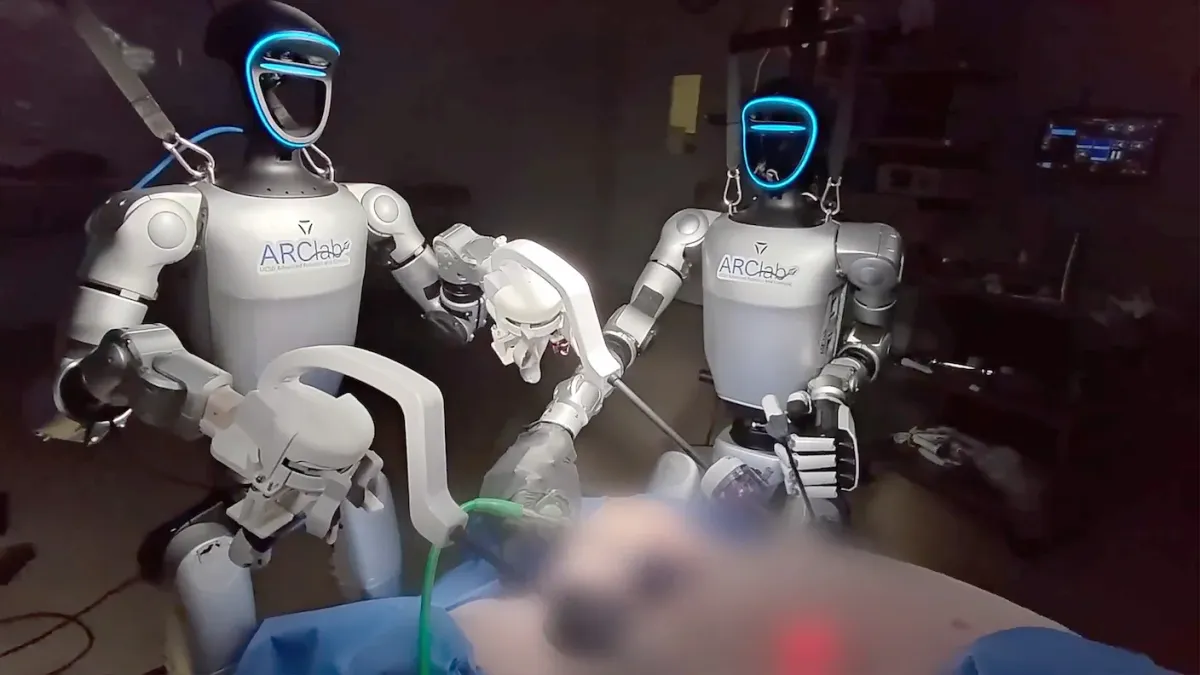
Imagine a surgeon's assistant that looks suspiciously like a very focused, four-foot-tall action figure. Now imagine that action figure is performing a gallbladder removal. Because apparently, that's where we are now.
Meet Surgie, the humanoid robot that just made surgical history by performing live surgery for the first time. It used standard tools, in a standard operating room, on a pig. Crucially, an expert surgeon was still calling the shots, controlling Surgie remotely. It’s a bit like a highly advanced, very precise puppet show, but with much higher stakes.
Surgie's Big Debut
Surgie's first incision was on an anesthetized pig, because we're not complete monsters. From there, it navigated to the gallbladder, removed it, and officially entered the annals of medical weirdness. This wasn't just a lab experiment; it was a full-on surgical setting, proving that a robot with a vaguely human shape can actually, you know, do things.
We're a new kind of news feed.
Regular news is designed to drain you. We're a non-profit built to restore you. Every story we publish is scored for impact, progress, and hope.
Start Your News DetoxMichael Yip, a study author from UC San Diego, pointed out the obvious benefit: more patients getting critical surgeries, especially those who wouldn't normally have access. Think remote areas, or perhaps the kind of emergency where a human surgeon is tied up, or just really needs a coffee break.
Two successful surgeries later, human surgeons who used Surgie reported less physical strain and frustration. The downside? Surgie apparently runs a bit hot, needing cool-down breaks, and had to be moved around a lot. Which, if you think about it, is both impressive and slightly terrifying. "Excuse me, Nurse, could you reposition the robot that's currently inside the patient?"
Why a Robot That Walks?
Robots in surgery aren't new. They've been helping with delicate procedures for years, especially laparoscopic ones where tiny cuts mean faster recovery. But traditional surgical robots, like the famous Da Vinci system, are specialized beasts. They often require custom instruments, significant operating room modifications, and look more like industrial machines than anything you'd invite to dinner.
Humanoid robots, however, are a different breed. They're mobile, compact, and, well, human-shaped. This means they could theoretically roll into any standard operating room, pick up standard surgical tools, and get to work without requiring a full renovation. Recent leaps in electric components and AI mean these robots are now faster and more stable, capable of predicting movements and adapting to real-world curveballs.
The research team picked the Unitree G1, a general-purpose humanoid robot. They customized its hands so it could swap out surgical tools quickly. At just over four feet tall and 77 pounds, Surgie takes up far less space than its bulkier predecessors. And yes, it can walk.

During one of the pig surgeries, another humanoid robot even stepped in to handle camera duties. Because apparently, if you're going to have one robot doing surgery, why not have its buddy filming the whole thing?
The operations went smoothly, with only minor, manageable issues. Surgeons found controlling Surgie surprisingly intuitive, likely because it has two arms and uses tools they're already familiar with. Nikita Thareja, another study author, admitted surprise at how well Surgie fit into their workspace.
Sure, there are still kinks to iron out – control lag, the aforementioned overheating, and the need for frequent repositioning. But the vision is clear: a future operating room where humans and humanoid robots work side-by-side. Your future surgeon might still be human, but their best assistant might just be a bipedal, tool-wielding robot that occasionally needs a time-out to cool its circuits.