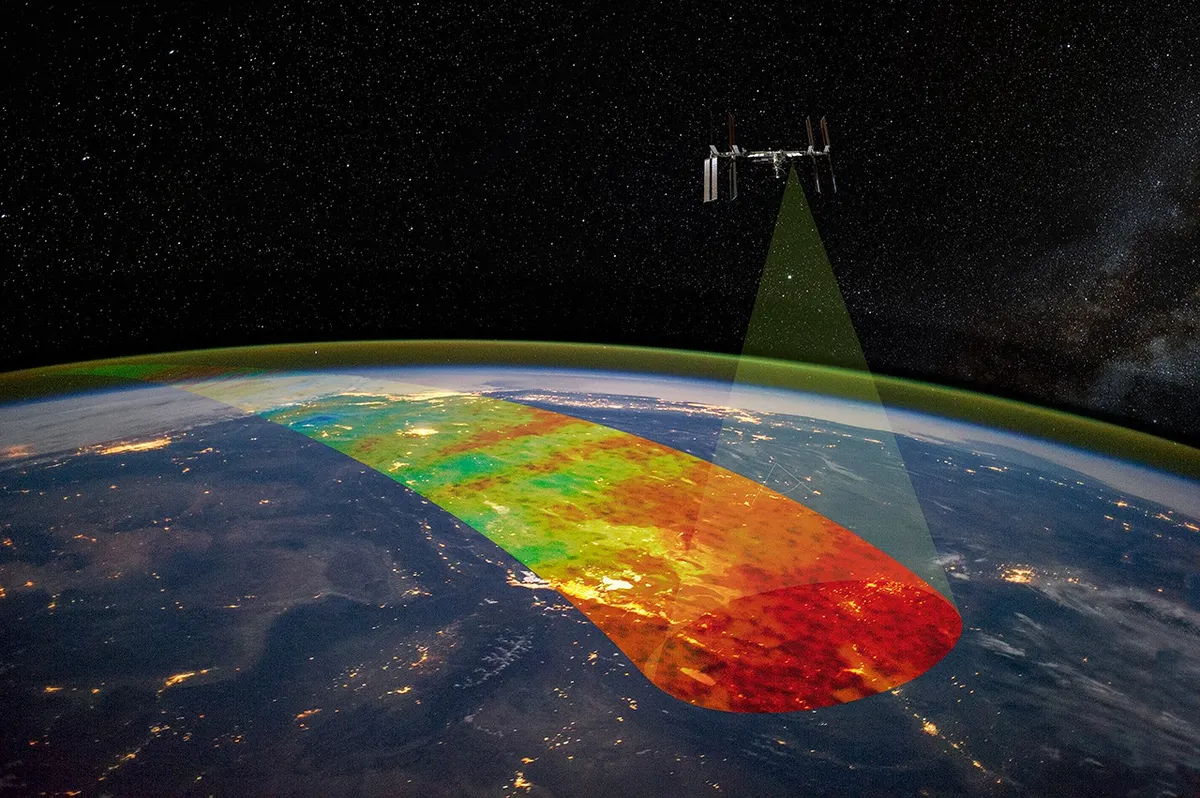
Well, that's a wrap. After a stellar 30 months — outlasting its planned two-year gig — NASA's Atmospheric Waves Experiment (AWE) instrument on the International Space Station officially powered down on May 21. Its mission? To prove that what happens down here in Earth's atmosphere doesn't always stay down here.
AWE was basically an orbital detective, looking for atmospheric gravity waves. Think of these as giant ripples in the sky, kicked off by everything from strong winds over mountains to severe weather like tornadoes and hurricanes. AWE spotted them by looking at colorful bands of light in our atmosphere called airglow. Because apparently, even the sky gets a neon glow-up.
NASA's Heliophysics Division bankrolled this whole affair, aiming to understand how these ripples climb all the way into space and start messing with space weather. Which, if you're not keeping track, can seriously disrupt satellites and communication signals. Because who needs reliable GPS when you can have an atmospheric ripple party?
We're a new kind of news feed.
Regular news is designed to drain you. We're a non-profit built to restore you. Every story we publish is scored for impact, progress, and hope.
Start Your News DetoxJoe Westlake, director of NASA's Heliophysics Division, put it rather poetically: AWE showed our atmosphere is like a "living, breathing ocean in the sky." For the first time, scientists could literally see how Earth's weather events send invisible ripples up, up, and away, shaping the space weather that impacts our entire orbital economy. Your phone signal's reliability? Blame a hurricane.
The Rippling Revelations
During its time circling the planet, AWE was a busy bee, snapping four infrared images every second. That's over 80 million nighttime images, which is when airglow decides to make an appearance. It caught gravity waves from some truly dramatic events, including a tornado outbreak in the central U.S. in May 2024 and Hurricane Helene making a rather unwelcome visit to Florida's Gulf Coast in September 2024.
Ludger Scherliess, AWE's lead investigator from Utah State University, confirmed they saw "wave signatures linked to major Earth events." Translation: a massive storm on Earth can send a measurable thump into the upper atmosphere. And apparently, different storms have different thumps.
Take, for instance, a thunderstorm in north Texas on May 26, 2024. Its waves were smaller and more irregular, showing a distinct north-to-south asymmetry compared to other storms in the same area earlier that month. Because even atmospheric ripples like to be unique.
Why does this matter? These waves change the density of plasma – an electrically charged gas – in Earth's upper atmosphere. And those changes can scramble radio signals between satellites and the ground, turning your navigation and communication systems into a confused mess. A recent study, armed with AWE data, pinpointed that gravity waves with smaller horizontal wavelengths (30 to 300 kilometers) are the biggest troublemakers. Conveniently, AWE was designed to measure exactly those.
What Happens After the Power Down?
With its data collection complete, AWE was powered off. Its spot on the space station will soon be taken by CLARREO Pathfinder, a new experiment aiming to measure sunlight reflected by Earth and the Moon with almost absurd accuracy. It's like the space station is always getting a new tenant, each with a cooler, more precise job.
Canadarm2, the space station's robotic arm, will gently remove AWE. Then, it'll hitch a ride on a SpaceX Dragon cargo spacecraft, destined for a fiery, dramatic re-entry into Earth's atmosphere. A fitting end for an instrument that spent its life studying atmospheric drama.
All of AWE's 80 million-plus observations will be released to the public for ongoing research. Scherliess noted that both professional scientists and curious citizen scientists will get to dig through the data. Some of it's already available, including interactive online visualizations on Utah State University's website. You can literally watch AWE's observations "painted" onto a globe or map as the space station orbits. Because who doesn't want to see a hurricane's atmospheric ripple from space?