Tiny galaxies orbiting the Milky Way might hold clues to big mysteries about the universe. These "ultra-faint dwarf galaxies" are among the smallest known galaxies. Scientists have long thought they were ancient leftovers from the early cosmos.
New simulations from the Oskar Klein Centre and the LYRA collaboration show these dim galaxies could reveal how conditions in the young universe decided which galaxies grew and which never formed stars.
Simulating the Smallest Galaxies
The study, published in Monthly Notices of the Royal Astronomical Society (MNRAS), was led by Azadeh Fattahi. She is an Associate Professor at the Oskar Klein Centre (OKC). Collaborators from Durham University and the University of Hawaii also worked on the project.
We're a new kind of news feed.
Regular news is designed to drain you. We're a non-profit built to restore you. Every story we publish is scored for impact, progress, and hope.
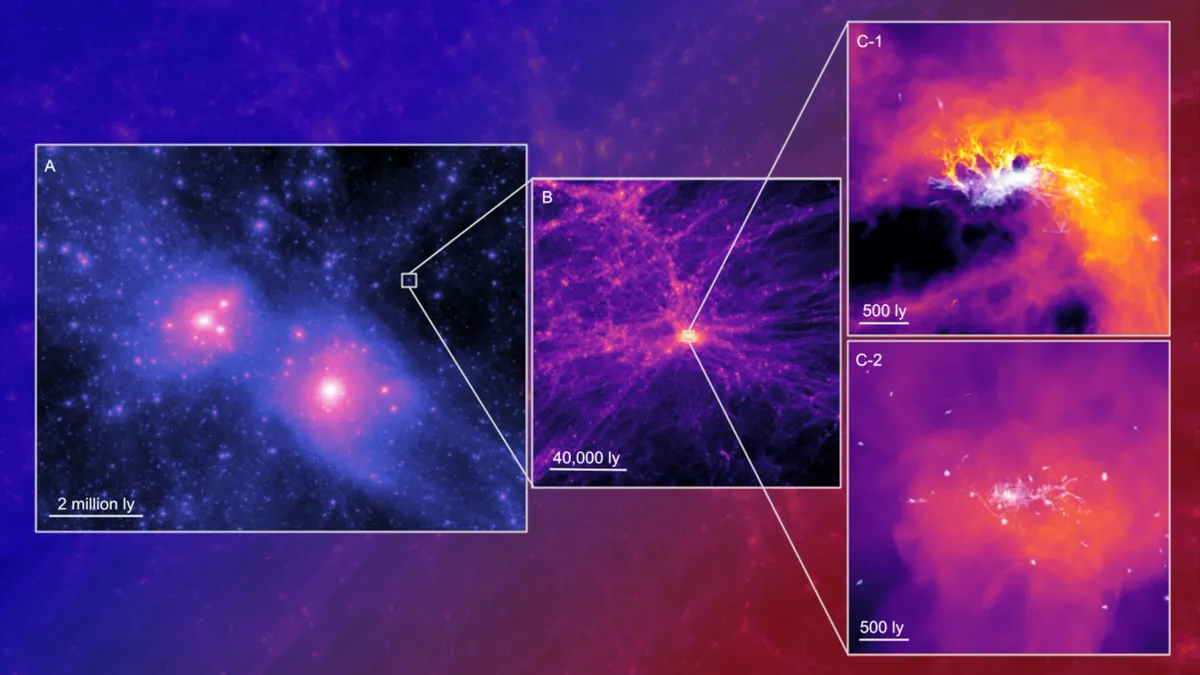
Start Your News DetoxFattahi explained that their new simulations are "brand-new" and focus on the faintest galaxies. They offer "unprecedented resolution" and are the largest sample of such galaxies ever simulated at this level of detail.
Dwarf galaxies are much smaller than the Milky Way. They form inside small dark matter halos, which are predicted by standard models of the universe. The faintest ones are very fragile. They challenge what scientists understand about how galaxies form and about dark matter.
"The smallest galaxies are called ultra-faint dwarf galaxies," Fattahi said. "They are a million times less massive than the Milky Way or even smaller." Their tiny size makes them very hard to model and simulate.

The new simulations give researchers a much clearer view of how these galaxies formed over cosmic history. Shaun Brown, who led the study, compared it to plants. "The way they grow is sensitive to the weather conditions," he said. "The properties of faint dwarf galaxies today can tell us a lot about the conditions, or weather, of the Universe at a much earlier time."
A Window to the Early Universe
These simulations are important because they do more than just recreate faint dwarf galaxies. They suggest these nearby objects can reveal information about the universe's earliest "climate." The team tested how different ideas about early radiation affected whether small dark matter halos could form stars.
Brown explained that they studied two different ideas about the early universe, when it was less than 500 million years old. They wanted to see how these ideas affected the small galaxies today, 13 billion years later.
The results showed a strong effect on the smallest galaxies. "We found that these small ultra-faint galaxies are very sensitive to these changes," Brown added. "More massive galaxies, like our Milky Way, don’t really care." For the smallest galaxies, early conditions could decide if they became visible galaxies or remained starless dark matter halos.
This sensitivity could help scientists test ideas about early-universe physics with future observations. "Excitingly, in the near future we will have data from the Vera C. Rubin Observatory," Fattahi said. This observatory will find many more ultra-faint dwarfs around the Milky Way.
Astronomers hope the Vera C. Rubin Observatory will find almost all of the Milky Way’s satellite galaxies. These discoveries might offer insights into conditions that existed shortly after the Big Bang. "Our work suggests that these upcoming observations of the very local Universe will be able to constrain what the Universe at its infancy looked like," Fattahi noted. This is something scientists cannot directly see with other observations right now.
The findings also connect to recent discoveries from the James Webb Space Telescope (JWST). The JWST has found surprisingly massive and bright galaxies in the early universe. If distant galaxies are challenging current theories, nearby ultra-faint dwarf galaxies might offer another way to investigate that period.
Massive Simulations and Future Questions
Studying such faint galaxies required a lot of computing power. "Running these simulations is challenging, and extremely expensive in both time and computational resources," Fattahi said. The simulations took over six months to run and produced about 300 terabytes of data. This meant many old algorithms needed updates to handle the large amount of information.
Most of the work was done on COSMA 8, a supercomputer at Durham University. Fattahi’s team now plans to use these simulations to explore big questions about galaxy and structure formation. They want to find where the first stars in the universe might be and what ultra-faint dwarf galaxies can tell us about dark matter.
Deep Dive & References
LYRA ultra-faints: the emergence of faint dwarf galaxies in the presence of an early Lyman–Werner background - Monthly Notices of the Royal Astronomical Society, 2026