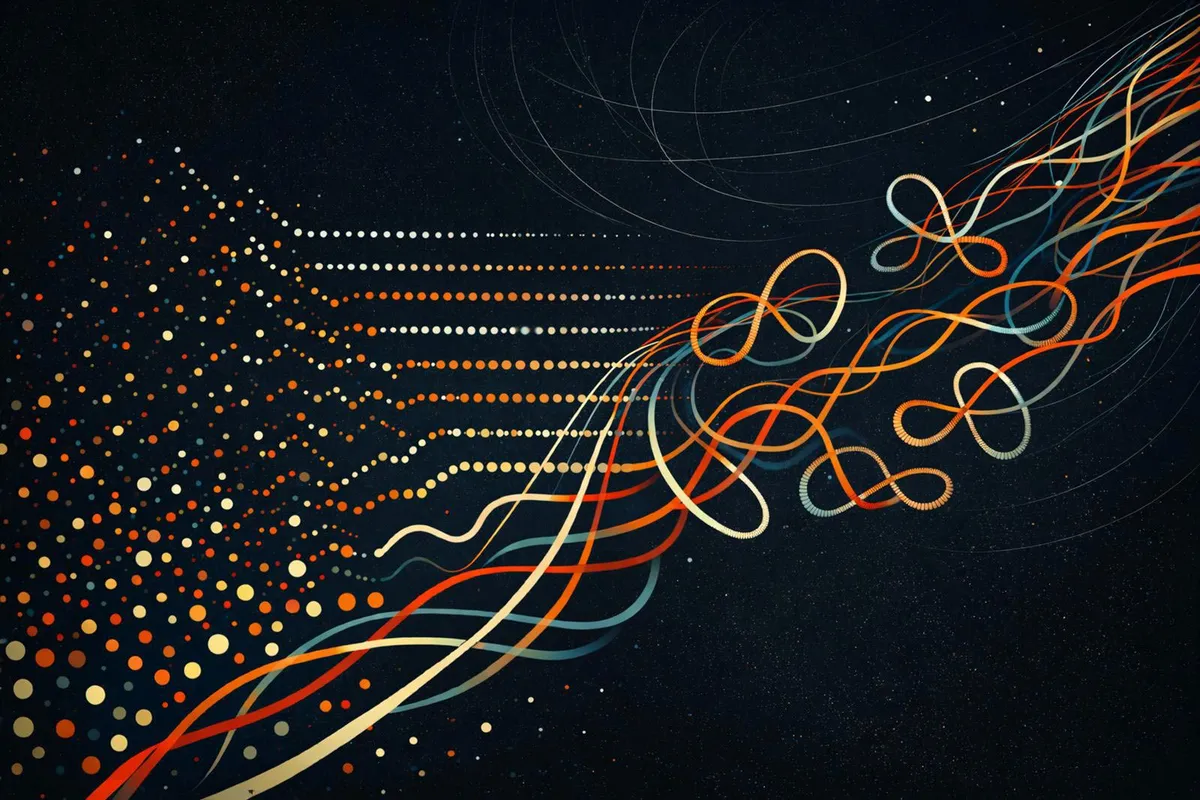
Imagine you're trying to figure out the universe's most fundamental building blocks. You've got atoms, then quarks, but what if you could go even smaller? String theory suggests that at the truly microscopic level, everything is made of tiny, vibrating strings. Think of them as cosmic guitar strings, each vibration creating a different particle.
This idea, born in the 1960s, was an attempt to mend a long-standing feud in physics: how to combine quantum mechanics (the rules for the tiny stuff) with general relativity (the rules for the really big stuff, like gravity). For decades, these two titans of physics just wouldn't play nice. Their math broke down spectacularly when forced together.
String theory offered a truce, replacing point-like particles with these microscopic strings. Different vibrations, different particles — even the elusive graviton, the theoretical particle that carries gravity. The catch? It also predicts at least ten dimensions, which is a lot more than the four we usually deal with. Oh, and to test it directly, you'd need a particle accelerator roughly the size of a galaxy. So, not exactly a weekend project.
We're a new kind of news feed.
Regular news is designed to drain you. We're a non-profit built to restore you. Every story we publish is scored for impact, progress, and hope.
Start Your News DetoxThe Accidental Discovery
Since building a galaxy-sized lab isn't in the budget, physicists have gotten clever. Enter the "bootstrap" method. Instead of starting with a grand theory, you begin with a few basic ideas about how nature should behave, then see what mathematical structures emerge. It's like solving a cosmic Sudoku.
A team from Caltech, NYU, and Institut de Fisica d’Altes Energies in Barcelona did just that. They started with minimal assumptions about how particles interact at super high energies. And then, like magic, key features of string theory just... appeared. "The strings just fell out," said Caltech professor Clifford Cheung. "We didn't start with any assumptions about strings at all. But then the solution contained the cornerstone signatures of strings." Which, if you think about it, is both impressive and slightly terrifying.
One of those signatures was the "string spectrum." Back in the late 1960s, physicist Gabriele Veneziano noticed a mathematical pattern describing an endless series of particles popping out of collider experiments. They appeared in an orderly fashion, like notes on a musical scale. Scientists later realized this was exactly what you'd expect from the harmonic vibrations of a string.
Another crucial piece was string theory's ability to fix a major headache in general relativity. When you try to calculate particle collisions at extremely high energies using general relativity, the numbers go to infinity. Meaningless. String theory, however, has a property called "ultrasoftness." At these extreme energies, interactions become smoother, less violent. The math behaves. The particles, apparently, "don't even want to scatter off one another, but rather pass freely." Because apparently that's where we are now: particles with feelings.
By simply assuming this "ultrasoft" behavior and another concept called "minimal zeros" (which limits how often scattering probabilities disappear), the team mathematically showed that the solutions had to reproduce string theory's main features. The infinite tower of particles, the interaction strengths — it all just clicked into place.
This isn't experimental proof, of course. But it's a powerful argument from pure mathematics. The universe, it seems, might just be humming a string theory tune, whether we were looking for it or not.