For the first time, researchers have sent secure quantum information over 100 kilometers without needing to trust the devices doing the sending. That might sound like a technical detail, but it's the kind of detail that separates "interesting lab experiment" from "actual infrastructure."
A team at the University of Science and Technology of China, led by Jianwei Pan, just published results in Nature and Science showing they've cracked one of quantum communication's biggest unsolved problems: how to send quantum information far enough to actually matter.
The Distance Problem
Quantum communication works by encoding information into particles of light called photons. The problem is that photons traveling through fiber optic cables get absorbed or scattered. After a few hundred meters, most of them are gone. This isn't just inconvenient—it's a fundamental barrier to building a quantum internet. You can't have a network if your signal dies after a few city blocks.
We're a new kind of news feed.
Regular news is designed to drain you. We're a non-profit built to restore you. Every story we publish is scored for impact, progress, and hope.
Start Your News DetoxFor years, the best secure quantum transmissions (called device-independent quantum key distribution, or DI-QKD) only worked over a few hundred meters. Useful for a single building, maybe a university campus. Not useful for connecting cities.
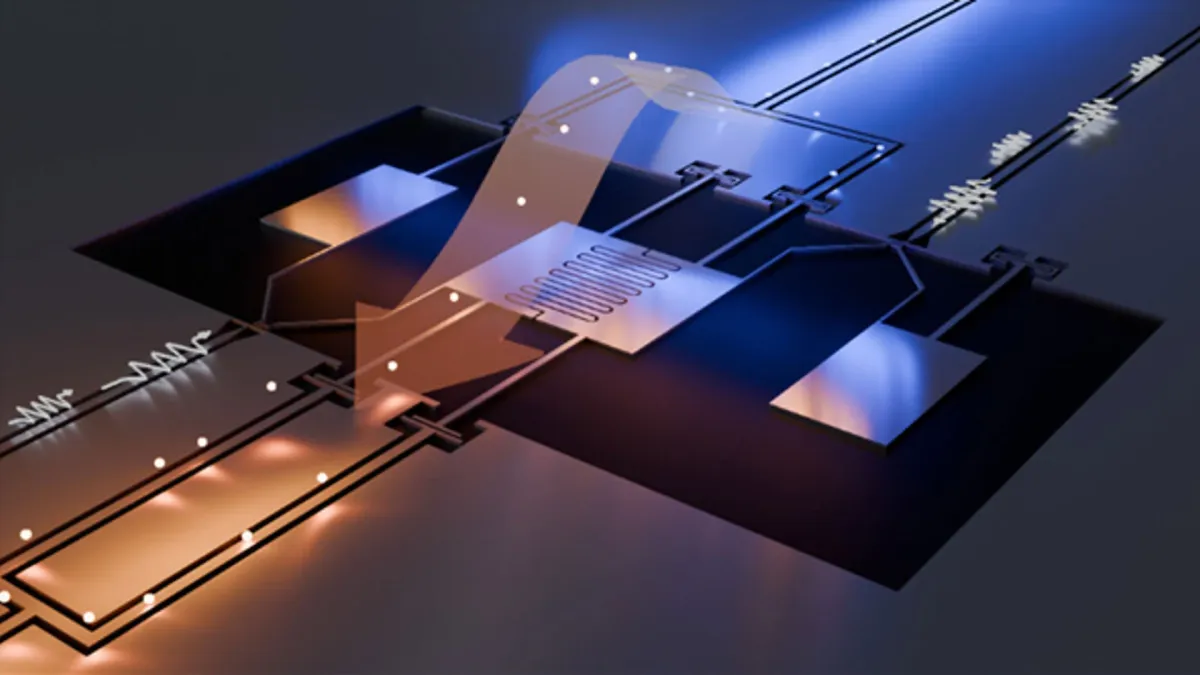
The Chinese team solved this using quantum repeaters—essentially relay stations that catch a quantum signal before it fades, refresh it, and send it onward. Think of it like a bucket brigade for quantum information. But building these relays requires something extremely difficult: creating and holding quantum entanglement (a state where two particles are mysteriously linked) between separate nodes long enough to pass the signal through.
How They Extended the Distance
The breakthrough was achieving what's called "memory-memory entanglement"—holding quantum information in atoms at two different locations, then linking those atoms through entanglement swapping. By stringing these nodes together, they could extend entanglement across much greater distances than direct transmission allows.
For the first time, they maintained this entanglement long enough for it to actually be useful for building scalable networks. Then, using this repeater system, they successfully performed secure quantum key distribution over 100 kilometers—roughly the distance between Boston and New York.
Jianwei Pan, one of the lead researchers, described quantum repeaters as the "building blocks" that will eventually link quantum computers together. In the next 10 to 15 years, he suggests, this could form the backbone of a quantum internet—a network that connects quantum computers, sensing devices, and classical networks with security guarantees that classical systems can't offer.
The 100-kilometer milestone matters because it proves the repeater concept actually works at distances relevant to real infrastructure. It's the difference between a proof of concept and a path toward deployment.
The next phase is scaling it up—making repeaters that can extend quantum networks across continents, not just between nearby cities. But for the first time, that path looks clear.