Imagine a laptop that never gets hot or a phone that holds its charge for days. Picture a computer memory chip that keeps data even when the power is off. These possibilities come from a special group of materials.
Researchers from the University of Ottawa and MIT have studied these materials for years. They recently published a detailed guide in the journal Newton.
How Magnetism and Topology Work Together
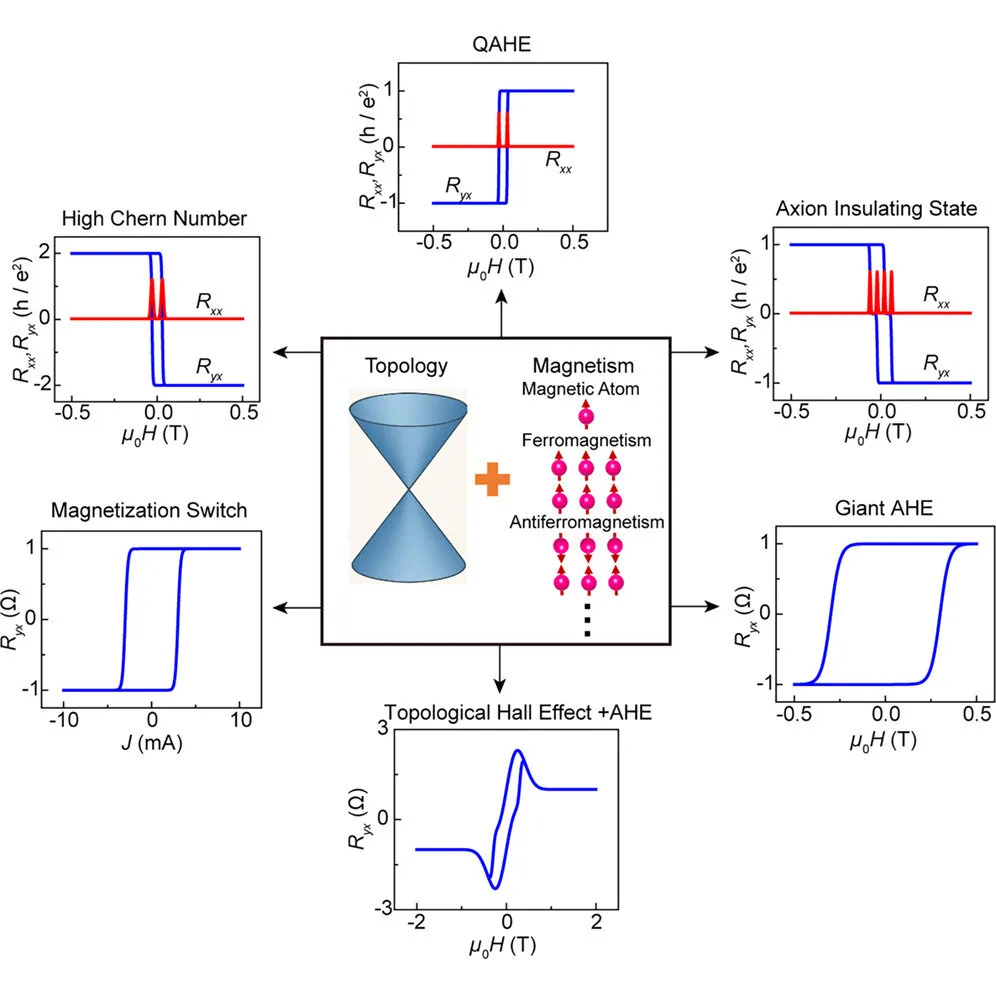
Magnetic topological materials combine magnetism and topology. Topology is a math field that studies shapes that cannot be changed into one another without tearing them. In these materials, this idea helps protect how electrons flow. This protection is something normal materials cannot offer.
We're a new kind of news feed.
Regular news is designed to drain you. We're a non-profit built to restore you. Every story we publish is scored for impact, progress, and hope.
Start Your News DetoxHang Chi, an Assistant Professor at uOttawa's Department of Physics, explained that these materials offer a unique platform. Magnetism and quantum physics work together in ways scientists are just starting to understand. He noted that their review brings together major advances and gives researchers a shared base to build upon.
The review covers over 20 years of global research. It gives the scientific community a common starting point.
Professor Chi and his co-authors, Dr. Peng Chen and Professor Jagadeesh S. Moodera of MIT, looked at four main families of these materials. They explained the quantum effects these materials produce. They also highlighted where the biggest chances for real-world technology lie.
Chasing Nearly Lossless Electric Current
One exciting effect is the "quantum anomalous Hall effect." In this state, electric current flows along the edges of a material with almost no energy loss. This happens without an external magnetic field. Achieving this reliably has been a long-term goal for the field.
Professor Chi is excited about how these materials can enable electric current or voltage-induced magnetization switching. He said their efficiency is much higher than traditional metals. This means devices can be faster, smaller, and use much less energy than current technology.
The Challenge of Room Temperature
Currently, these effects only appear when the materials are cooled to temperatures near absolute zero. The biggest challenge is getting these materials to work at room temperature.
The study suggests three ways forward. First, use powerful computers and AI to quickly check thousands of possible materials. Second, create new material combinations in thin layers. Third, discover entirely new families of magnetic topological materials.
Professor Chi added that while they are not there yet, they have a much clearer plan. He believes that by combining new ways to make materials, computer screening, and machine learning, room-temperature magnetic topological devices are possible.
Why This Could Change Computing
The way we build computers is reaching its limits. Chips are so packed that heat is a major barrier to making them faster. These new materials offer more than small improvements. They represent a completely different way to move and store information. This could lead to devices that are cooler, faster, and much more energy-efficient.
Beyond computing, these materials show early promise in AI hardware. These are circuits that process information like the human brain, not like a calculator. This is very important as AI data centers use a huge and growing amount of electricity.
Deep Dive & References
Progress and prospects of magnetic topological materials for spintronic applications - Newton, 2026