

Engineers at the University of Colorado have figured out how to trap light in impossibly small spaces—and keep it there long enough to actually do useful work. These "light racetracks" are so tiny they'd vanish into a speck of dust, yet they're poised to power a new generation of sensors that could detect everything from chemical traces to navigation signals.
The breakthrough hinges on something counterintuitive: curves. The team, led by doctoral student Bright Lu, borrowed a design principle from road engineering. Just as highways use smooth, gradual bends instead of sharp corners to keep vehicles stable at speed, these microresonators guide light along carefully engineered curves instead of right angles. Light, it turns out, behaves like a driver—it leaks away when forced through sharp turns.
"These racetrack curves minimize bending loss," says Won Park, the electrical engineering professor who co-advised the work. "Our design choice was a key innovation of this project." By reducing the light that escapes, photons can circle inside the device longer, building intensity. That intensity is what makes the whole system useful—it's where the sensing magic happens.
We're a new kind of news feed.
Regular news is designed to drain you. We're a non-profit built to restore you. Every story we publish is scored for impact, progress, and hope.
Start Your News Detox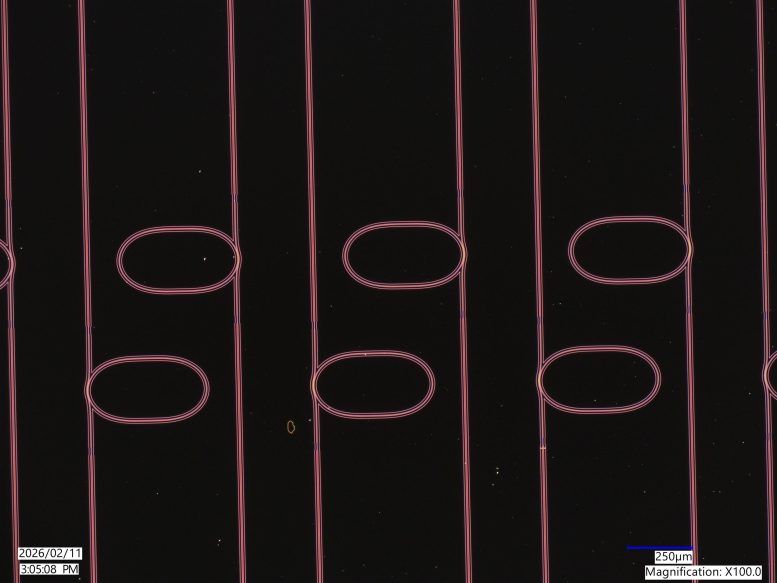
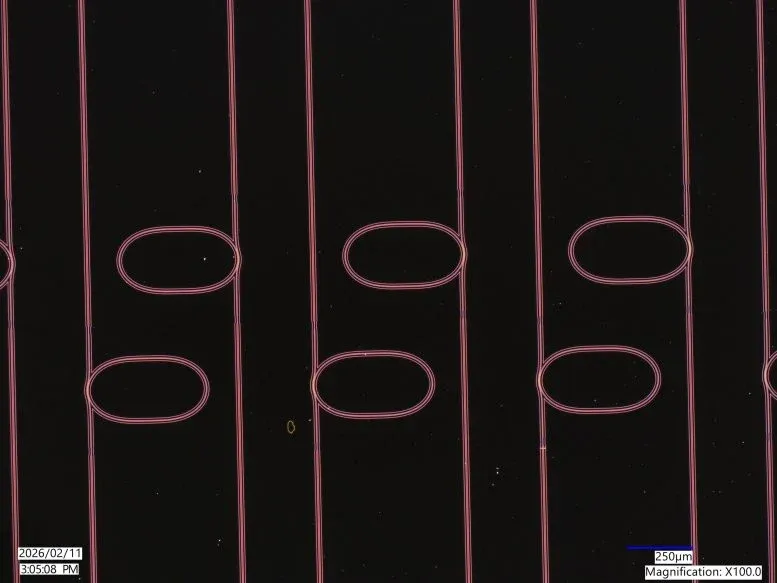
Building these devices meant working at scales that make a human hair look enormous. The team used electron beam lithography—a technique that sketches patterns using electrons instead of light, achieving precision at the sub-nanometer level. They chose chalcogenide glasses, specialized semiconductors that let intense light pass through with almost no loss. Even then, the material was finicky. "Chalcogenides are challenging to process, requiring careful optimization," Park notes.
Once fabricated in the university's clean room, the devices went through rigorous testing. Physics PhD student James Erikson aligned microscopic lasers with the waveguides, sending light through while watching for the telltale "dips" in the signal that reveal resonance. "When we saw the sharp resonances on this new device, we knew right away that we'd finally cracked the code," Erikson said. The team also had to track how much light was being absorbed—excessive heating can damage the device as laser power climbs.
The potential applications ripple outward. These microresonators could become the core of compact microlasers, ultra-sensitive chemical and biological detectors, and tools for quantum metrology. "Many photonic components from lasers, modulators, and detectors are being developed, and microresonators like ours will help tie all of those pieces together," Lu explains. The real goal is manufacturability—getting from lab prototype to something a company can mass-produce by the hundreds of thousands.
The research, published in Applied Physics Letters, represents some of the best-performing devices made from chalcogenides to date. What started as a geometry problem—how do you bend light without losing it—is opening a path toward sensors precise enough to detect what we couldn't before.





