A discovery that matters

Scientists Discover How To “Purify” Light, Paving the Way for Faster, More Secure Quantum Technology

48 min readSciTechDaily
Iowa City, Iowa, United States
Scientists Discover How To “Purify” Light, Paving the Way for Faster, More Secure Quantum Technology
75
...
0

Why it matters: this discovery could lead to faster, more secure quantum technologies that benefit society by enabling more efficient and reliable quantum computing and communication systems.

Futuristic Quantum Sensing Computer Data Technology

A new theoretical approach suggests that optical noise, once seen as a drawback, could be turned into a tool for producing purer streams of quantum light. Credit: Shutterstock

Researchers have uncovered a method to purify a photon stream that is central to quantum circuitry.

University of Iowa scientists have identified a new way to “purify” photons, a development that could improve both the efficiency and security of optical quantum technologies.

The team focused on two persistent problems that stand in the way of producing a reliable stream of single photons, which are essential for photonic quantum computers and secure communication systems. The first issue, known as laser scatter, arises when a laser is aimed at an atom to trigger the release of a photon, the basic unit of light. Although this method successfully generates photons, it can also produce extra, unwanted ones. These additional photons reduce the efficiency of the optical system, similar to how stray electrical currents interfere with electronic circuits.

A second complication comes from the way atoms occasionally respond to laser light. In uncommon cases, an atom releases more than one photon at the same time. When this happens, the precision of the optical circuit suffers because the extra photons disrupt the intended orderly flow of single photons.

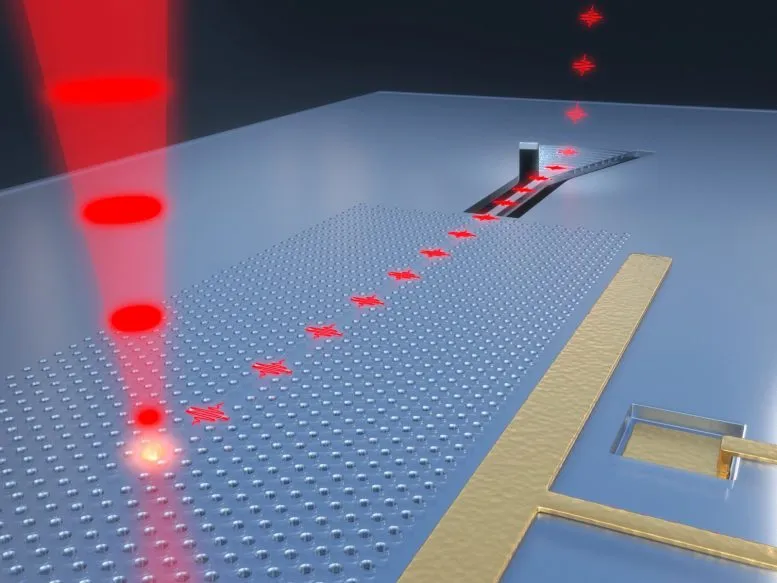
Consistent Single Photon Stream

University of Iowa researchers have modeled how to minimize interference to yield a consistent single photon stream (shown here in this image), an advance that could make quantum computing and communications more reliable and more secure. Credit: Ravitej Uppu lab, University of Iowa

Turning Noise Into a Tool

In the study, Matthew Nelson, a graduate student in the Department of Physics and Astronomy, discovered that when an atom emits multiple photons, the resulting color along the wavelength spectrum and the shape of the light wave closely match those produced by the laser itself. According to the researchers, this similarity makes it possible to adjust the two light sources so that they interfere with one another and effectively cancel out the unwanted photons.

Ravitej Uppu

Ravitej Uppu, University of Iowa. Credit: University of Iowa

“We have shown that stray laser scatter, typically considered a nuisance, can be harnessed to cancel out unwanted, multi-photon emission,” says Ravitej Uppu, assistant professor in the Department of Physics and Astronomy and the study’s corresponding author. “This theoretical breakthrough could turn a long-standing problem into a powerful new tool for advancing quantum technologies.”

Why Single Photons Matter

In photonic computing, light is used to carry out operations faster or more efficiently than with electronics. Today’s computers use bits — streams of electrical or optical pulses representing ones or zeroes. Quantum computers, on the other hand, use qubits, which are typically subatomic particles, such as photons. A growing number of startup companies believe photonic systems will be central to advances in quantum computing.

The single-photon line is important to that advance, in large part because it is orderly, controllable, and easier to scale up. Think about it like herding elementary school students single file through the cafeteria lunch line, rather than as a jumbled group. That tidy photonic line also lessens the chances of information being hacked or eavesdropped upon, much like a conversation shared between two students in a single-file line is less likely to be heard by the entire group.

Engineering a Purer Stream

“If we can control exactly how the laser beam shines on an atom — the angle at which it’s coming, the shape of the beam, and so on — you can actually make it cancel out all the additional photons that the atom likes to emit,” Uppu explains. “We would be left with a stream that is actually very pure.”

The research theoretically eliminates two barriers to accelerating photonic, or light-based, circuitry. Removing these obstacles could help usher in more advanced quantum computers and more secure communication networks. The next step is to test these ideas, which the researchers plan to do soon.

Reference: “Noise-assisted purification of a single-photon source” by Ravitej Uppu and Matthew D. Nelson, 24 December 2025, Optica Quantum.

DOI: 10.1364/OPTICAQ.565878

The Office of the Under Secretary of Defense for Research and Engineering, part of the U.S. Department of Defense, funded the research. The researchers also earned a seed grant from the University of Iowa Office of the Vice President for Research, through the P3 program, that helped initiate the research.

Never miss a breakthrough: Join the SciTechDaily newsletter.

Follow us on Google and Google News.

Brightcast Impact Score (BIS)

75/100Groundbreaking

This article describes a new scientific discovery that could lead to faster and more secure quantum technology. The discovery of a method to 'purify' light could enable significant advancements in quantum computing and communication, which have the potential for wide-ranging positive impacts. The article presents this as a constructive solution with measurable progress, aligning with Brightcast's mission to highlight positive stories.

Hope Impact25/33

Emotional uplift and inspirational potential

Reach Scale25/33

Potential audience impact and shareability

Verification25/33

Source credibility and content accuracy

Significant positive development

Comments(0)

Join the conversation and share your perspective.

Sign In to Comment
Loading comments...

Get weekly positive news in your inbox

No spam. Unsubscribe anytime. Join thousands who start their week with hope.

More stories that restore faith in humanity