

Water molecules carry hidden signatures in their atoms—and scientists have just figured out how to read them across the entire globe.
Hydrogen and oxygen atoms naturally occur in heavier forms called isotopes. When water evaporates from an ocean, condenses into clouds, or falls as rain, the balance of these isotopes shifts in predictable ways. It's like each droplet carries a passport stamped with everywhere it's been. By reading these atomic patterns, researchers can now trace water's journey across continents and oceans in ways that were impossible before.
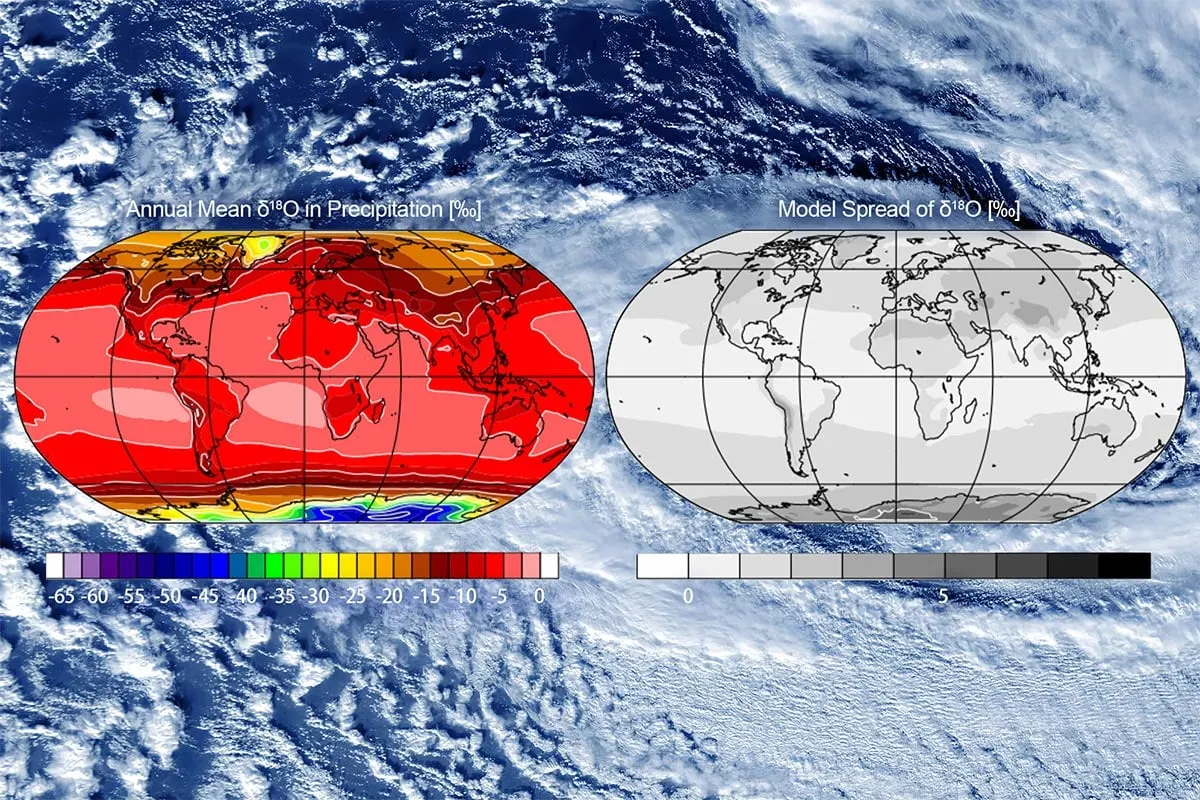
The breakthrough came from an unusual approach: instead of relying on a single climate model, researchers at the University of Tokyo combined eight different models that track water isotopes, feeding them 45 years of wind and temperature data from 1979 to 2023. When the models worked together as an ensemble, something remarkable happened. The combined results matched real-world observations far better than any single model could achieve on its own.
We're a new kind of news feed.
Regular news is designed to drain you. We're a non-profit built to restore you. Every story we publish is scored for impact, progress, and hope.
Start Your News Detox"We are delighted that our ensemble mean values capture the isotope patterns observed in global precipitation, vapor, snow, and satellite data much more successfully than any of the individual models," said Professor Kei Yoshimura, one of the study's senior authors. The research was published in the Journal of Geophysical Research: Atmospheres in February 2025.
Why This Matters for Weather and Climate
Water isotopes are like a translator between what we observe and what's actually happening in the atmosphere. When isotope ratios shift, they reveal changes in moisture transport, where air is converging, and how large-scale weather systems are moving. This matters because those systems—El Niño, the North Atlantic Oscillation, the Southern Annular Mode—shape whether a region gets drought or flood, and they influence weather patterns for billions of people across multiple years.
The ensemble analysis revealed something crucial: atmospheric water vapor has been rising steadily over the past 30 years in lockstep with global temperatures. That connection isn't just academic. It means the water cycle itself is intensifying, which feeds into storms, alters precipitation patterns, and changes how water moves from ocean to atmosphere to land.
Previously, individual climate models would sometimes disagree wildly about how water isotopes behaved, making it hard to trust any single prediction. The ensemble approach solved that by letting researchers see which patterns appeared consistently across multiple independent models—a signal strong enough to cut through the noise.
"Ensembles offer a nuanced modeling approach that reduces divergence between individual models," explained Dr. Hayoung Bong, who worked on the project at Tokyo's Institute of Industrial Science and now works at NASA's Goddard Institute for Space Studies. "This allows us to separate the effects of how each model represents water cycle processes from differences arising from individual model structures."
This is the first time researchers have combined multiple isotope-enabled climate models into a single framework like this. The result is a clearer picture of how Earth's water cycle actually operates—and a stronger foundation for predicting how it will respond as the planet continues to warm.





