A new holographic data storage method uses light in three dimensions to store much more information. This technique could help meet the world's growing need for data storage.
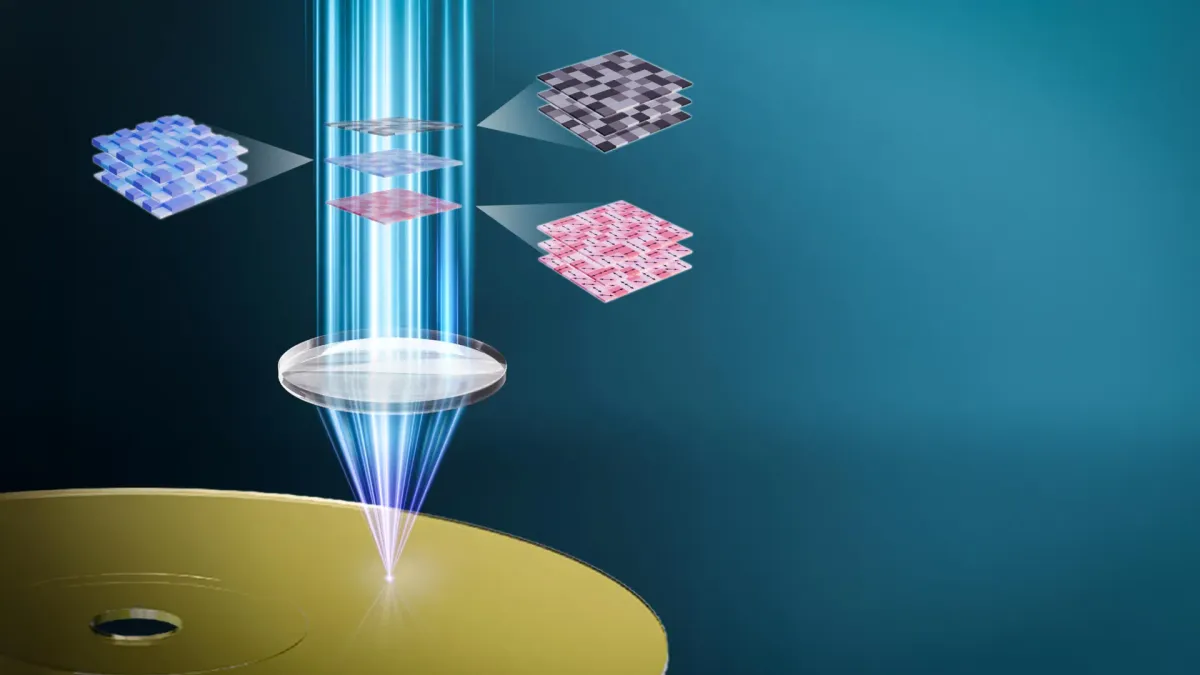
Traditional storage saves data on flat surfaces. This new method, however, embeds information throughout a material using laser light. This creates many overlapping light patterns in the same space. This greatly increases storage capacity and speeds up data transfer.
Using Light's Properties for More Data
Light has three main properties: amplitude, phase, and polarization. Researchers combined all three to record and retrieve data.
We're a new kind of news feed.
Regular news is designed to drain you. We're a non-profit built to restore you. Every story we publish is scored for impact, progress, and hope.
Start Your News Detox"In conventional holographic data storage, data encoding typically uses one light dimension such as amplitude or phase alone," said Xiaodi Tan, the research team leader from Fujian Normal University in China. "We used a deep learning architecture to enable the use of polarization as an independent information dimension."
This new technique not only stores more data but also makes it easier to get back. The research was published in Optica.
Tan believes this multidimensional storage could lead to smaller data centers and more efficient large-scale storage. It could also improve data processing, transmission, and security.
AI Helps Decode Light Data
In holographic storage, information is saved as image-like data pages made by laser light patterns. Converting digital data into these pages is called encoding. Decoding turns them back into usable information.
Combining light's properties to carry more data has been hard. The team refined a method called tensor-based polarization holography. This method keeps the light's polarization state during reconstruction, making it a reliable way to store extra information.
The team then created a 3D encoding strategy. They adjusted the intensity and phase of two perpendicular polarization states. They also used a double-phase hologram technique. This allowed a single device to encode amplitude, phase, and polarization together.
Decoding this combined information is tricky because standard sensors only measure light intensity (amplitude). They cannot directly detect phase or polarization. To solve this, researchers used tensor-polarization holography theory and a convolutional neural network. This AI model recovers all three types of data from light patterns.
The neural network learns from two images: one with a vertical polarizer and one without. By analyzing these, the model identifies patterns linked to amplitude, phase, and polarization. This allows it to reconstruct all three at once, increasing storage density and data speed.
The Future of Data Storage
The researchers built a system to record and reconstruct the encoded light within a special material. Tests showed that intensity images could be analyzed to find amplitude, phase, and polarization. These were then fed into the neural network for full 3D reconstruction.
"Our results showed that multidimensional joint encoding substantially increased the information carried by a single holographic data page," Tan said. "Neural network synchronous decoding reduced the need for complex measurements, supporting more efficient readout. This could enable high-capacity, high-throughput holographic data storage."
The system is still in the research stage. Future work will focus on increasing encoding capacity and improving the stability of recording materials. They also plan to combine this method with other techniques to store multiple pages and channels of data at once. Better integration between hardware and decoding algorithms will be key for faster, more reliable data retrieval.