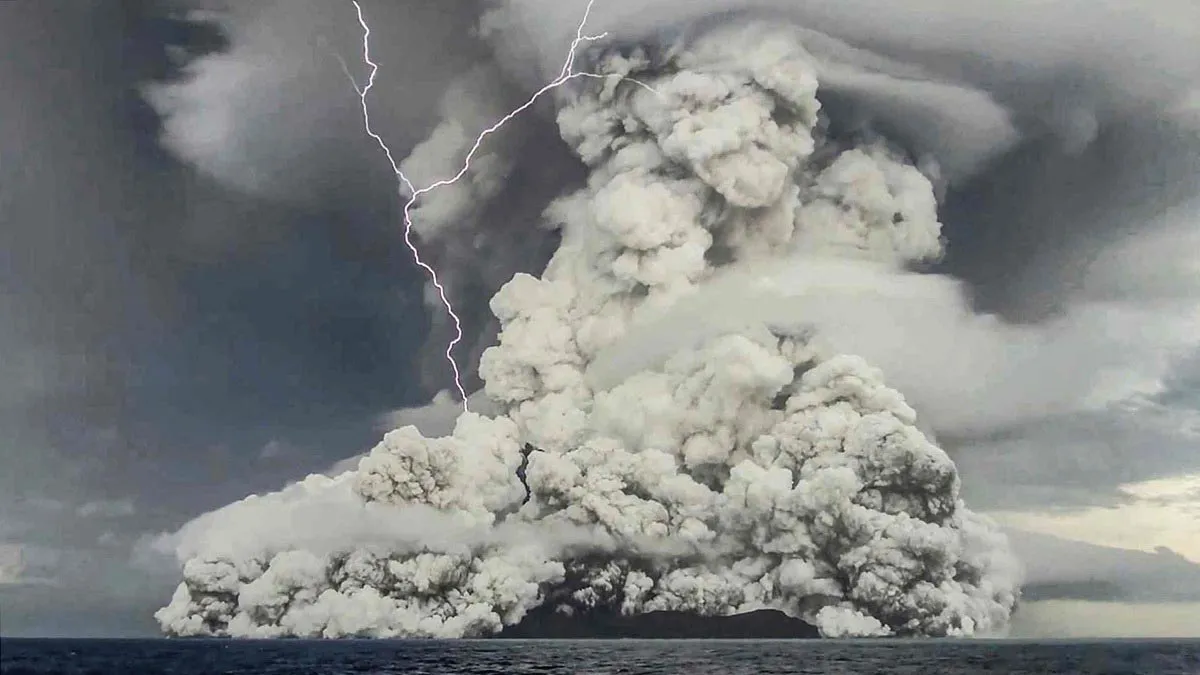
Turns out, some volcanoes are just trying to help. Back in January 2022, the Hunga Tonga–Hunga Ha’apai volcano in the South Pacific decided to make a dramatic entrance. It erupted with the force of a thousand suns (give or take), sending a plume of water and ash miles into the sky.
But here's the kicker: Scientists now say this explosive event didn't just cause a ruckus; it actually removed methane pollution from the atmosphere. Because apparently, that's where we are now — looking to volcanoes for climate solutions.
After the eruption, researchers peered at satellite data and noticed something odd in the volcanic cloud: unusually high amounts of formaldehyde. Now, formaldehyde isn't exactly a party trick, but it is a temporary chemical that forms when methane breaks down. Which meant, quite simply, methane was being destroyed high above Earth.
We're a new kind of news feed.
Regular news is designed to drain you. We're a non-profit built to restore you. Every story we publish is scored for impact, progress, and hope.
Start Your News DetoxDr. Maarten van Herpen, a lead author on the study, noted that the formaldehyde cloud was a record-breaker. It hung around for ten days, drifting all the way to South America. Considering formaldehyde usually vanishes in a few hours, this was a clear signal that methane was continuously getting obliterated for over a week straight.
"Volcanoes are known to release methane during eruptions," Dr. van Herpen explained, "But we didn't know until now that volcanic ash can also help clean up this pollution." Talk about an unexpected talent.
How a Volcano Became a Methane Scrubber
So, how did a giant underwater explosion turn into an air purifier? Scientists think the eruption kicked off a chemical process they only just discovered last year. Picture this: Sahara Desert dust meets sea salt over the Atlantic, creating tiny particles called iron salt aerosols. When sunlight hits these, they produce chlorine atoms, which then go to town on methane, breaking it down.
Professor Matthew Johnson, who worked on both discoveries, said it was genuinely surprising to see this exact process unfold in a volcanic plume way up in the stratosphere, where conditions are wildly different. But the Tonga eruption blasted a colossal amount of salty seawater and volcanic ash right into that high-altitude playground. The theory is that sunlight hitting this unique mix created highly reactive chlorine, which then helped destroy the methane the volcano itself had spewed out. The formaldehyde? That was just the smoking gun, confirming the methane's demise.
They estimate the eruption released around 300 gigagrams of methane (roughly the annual emissions of over two million cows). But get this: the plume also removed about 900 megagrams of methane every single day. That's the daily methane emissions of another two million cows. Let that satisfying number sink in.
Why Methane is the Climate's 'Emergency Brake'
Methane is a bit of a climate villain, responsible for about a third of global warming. It's a heat-trapping champion, about 80 times more potent than CO2 over a 20-year span. Good news, though: it only sticks around for about a decade, unlike CO2 which can linger for centuries.
Because of its relatively short lifespan, cutting methane emissions now could act as an "emergency brake" for climate change, potentially slowing warming within the next decade and reducing the risk of hitting irreversible tipping points. Of course, CO2 still needs to be tackled for long-term stability, but methane offers a quicker win.
This unexpected volcanic cleanup could inspire new technologies to speed up methane removal. Dr. Jos de Laat, a senior author, noted that proving methane has been removed is usually tricky. But this study, using the TROPOMI instrument on the European Space Agency’s Sentinel-5P satellite, shows that satellite tracking can confirm it.
"It's an obvious idea for industry to try to copy this natural event," Matthew Johnson concluded. But, as always, it needs to be proven safe and effective. Imagine: giant, artificial volcanoes that just... clean the air. Which, if you think about it, is both impressive and slightly terrifying. This discovery might even force scientists to update how they calculate the global methane budget, because it turns out, dust can be a surprisingly good cleaner.