

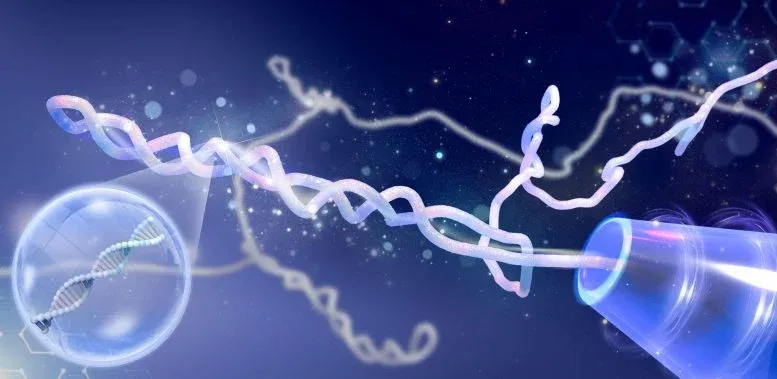
For forty years, scientists watching DNA slide through nanopores thought they were seeing knots forming. The electrical signals seemed clear enough. But a new study in Physical Review X reveals the real story is far stranger—and more useful.
What researchers actually captured were plectonemes: DNA coiling around itself in tight spirals, the way a phone cord wraps when you twist it. The difference matters more than it sounds.
Why the twist changes everything
When DNA moves through a nanopore—a tiny hole used to read genetic material—water flowing inside the pore creates a spinning force on the helical strand. This torque travels outward to the DNA waiting outside, causing it to wind up like a spring. Unlike true knots, which get yanked tight and vanish quickly, these twisted structures persist and grow, leaving a long, distinctive fingerprint in the electrical signal.
We're a new kind of news feed.
Regular news is designed to drain you. We're a non-profit built to restore you. Every story we publish is scored for impact, progress, and hope.
Start Your News Detox"As DNA is pulled through the nanopore, the ionic flow inside twists the strand, accumulating torque and winding it into plectonemes," explains Dr Fei Zheng from Cambridge's Cavendish Laboratory, who led the work. "This hidden twisting structure has a distinctive, long-lasting fingerprint in the electrical signal, unlike the more transient signature of knots."
The team proved their theory by engineering DNA with intentional breaks at precise points. These "nicked" molecules couldn't transmit the twisting force—and plectoneme formation nearly vanished. It was the kind of elegant confirmation that makes a hypothesis click into place.
What this unlocks
The practical payoff is already visible. Because knots and plectonemes leave different electrical signatures—one quick, one lingering—nanopores can now tell them apart. That means scientists can detect not just whether DNA is tangled, but how it's tangled, which carries information about damage and integrity.
Inside cells, plectonemes and knots happen constantly as enzymes manage the genome. Understanding these structures better could reveal how cells organize and protect their DNA. For diagnostics, the ability to sense these twist patterns might enable earlier detection of DNA damage linked to disease—turning a nanopore into something closer to a molecular stethoscope.
"Knots pass through quickly, just like a quick bump, whereas plectonemes linger and create extended signals," says Prof Ulrich Keyser, co-author of the study. "This offers a path to richer, more nuanced readouts of DNA organization and possibly damage."
What started as a correction to forty years of interpretation has become a blueprint for a new generation of DNA sensors. Sometimes the most useful discoveries come not from finding something new, but from finally seeing what was always there.





