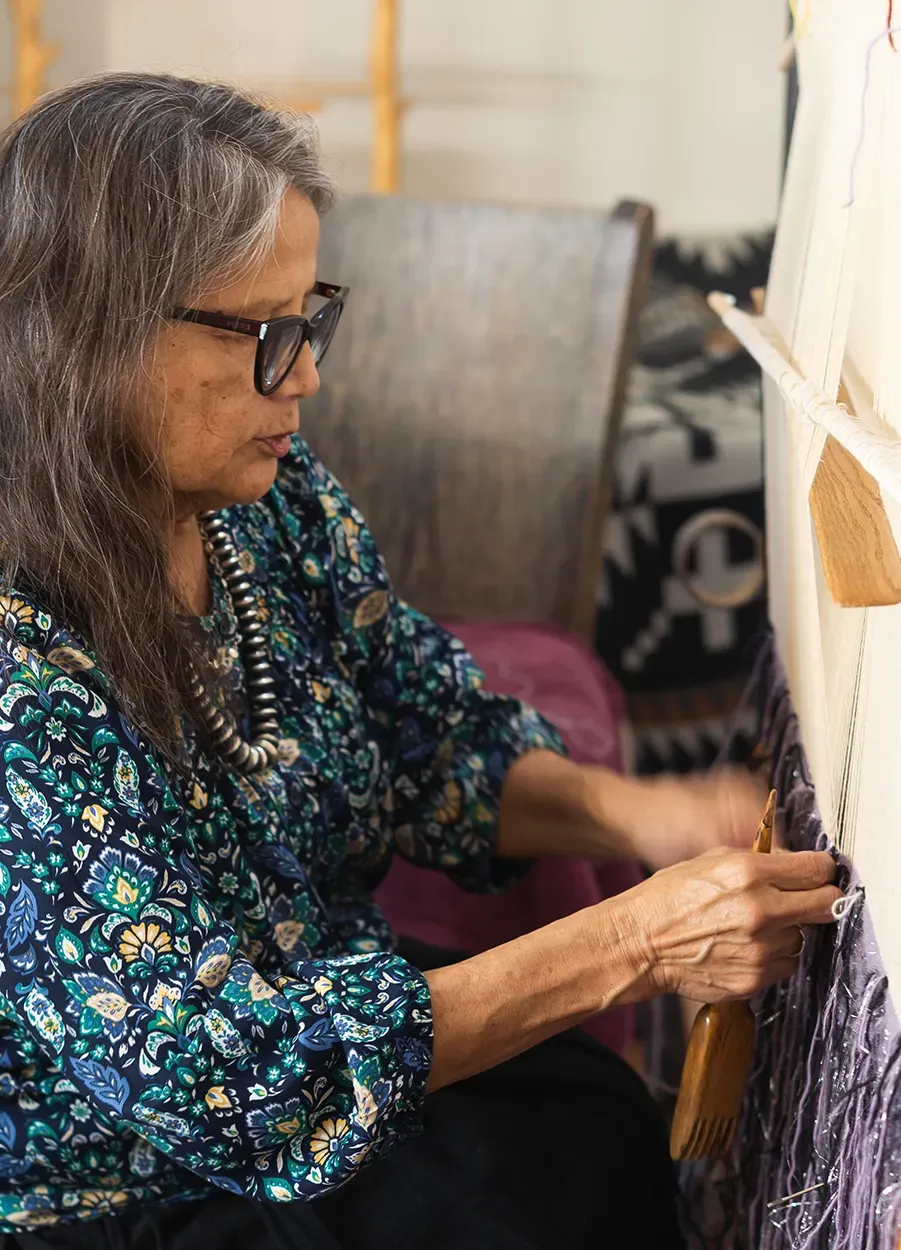
What happens when you take one of the oldest forms of information storage—weaving—and smash it right into the newest: computing? For Marilou Schultz, the answer is a mind-bending, visually stunning career that spans decades, culminating in her first major museum show at the Hessel Museum of Art.
Schultz, a Diné (Navajo) artist, has been exploring this connection since the 1960s. Her exhibition features about 55 of her works, alongside historical items that tell a story of tradition, innovation, and a whole lot of binary logic. Because, if you think about it, weaving's "over/under" is basically computing's "on/off." Both count. Both create patterns from their very structure. Even the word "text" comes from "textile." Let that sink in.
From Loom to Logic Gate
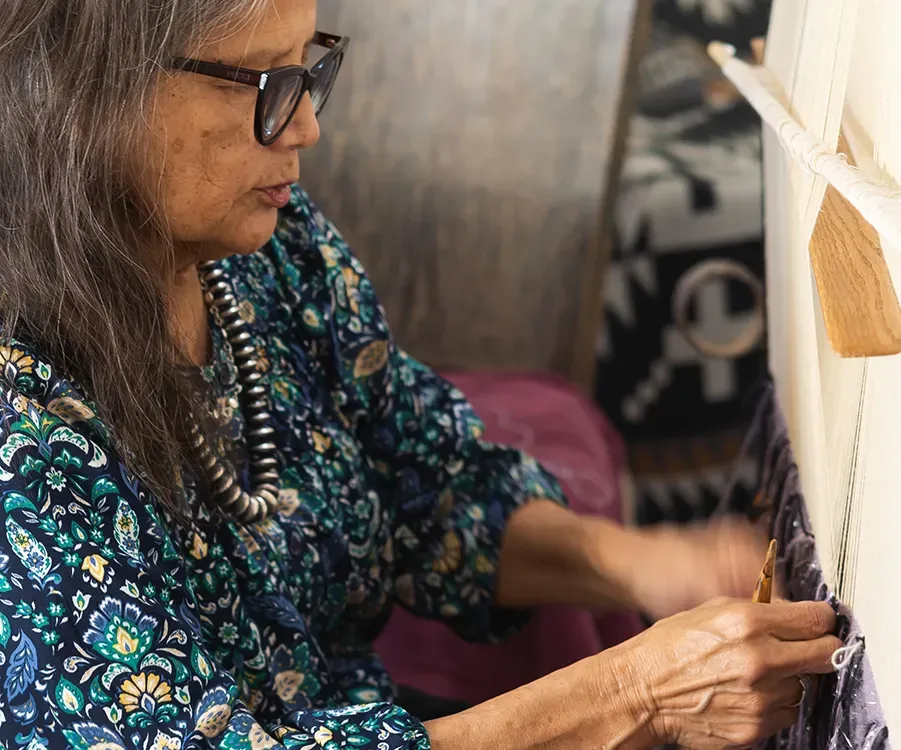
Schultz grew up in Leupp on the Navajo Nation, learning to weave at age five from her mother and grandmothers. "In Navajo, they say, you meet your elders, you connect with them through the loom," she explains. Later, as a math teacher, she wove for pleasure, experimenting with everything from plant dyes to yarn. While materials might change (like the reintroduction of Churro sheep to her family), the core techniques have remained remarkably consistent for generations.
We're a new kind of news feed.
Regular news is designed to drain you. We're a non-profit built to restore you. Every story we publish is scored for impact, progress, and hope.
Start Your News DetoxHer early work, like Untitled (late 1990s), already showed a playful defiance. She took an 1860s Navajo blanket design and split it into three panels, asking, "My thinking was that if fashion can change, why can’t Navajo wearing blankets?" Fair point. She even engineered a new loom to create three-dimensional, cylindrical shapes from traditional flat patterns, inspired by the spinning Earth. Which, if you think about it, is both impressive and slightly terrifying.
Then came 1995. An Intel employee, Louis Baca, found Schultz at the Heard Indian Market. Intel needed a weaver to create a design based on a microchip for a conference celebrating their 1993 Pentium chip. Schultz, always up for a challenge, said yes.
The project was… complicated. She used a raised-outline technique to make the geometric chip patterns pop. Her own mother, a lifelong weaver, was baffled. "That wasn’t no rug Marilou was weaving… But something that goes into the radio," she apparently said, convinced the tiny chip was a working radio part. She didn't get the concept of a chip, but never discouraged her daughter. Which is peak mom energy, if you ask us.
Schultz's Replica of a Chip (1994) was a hit. Engineering students at the conference immediately recognized the woven multiprocessor units and data caches. It took a while for the art world to catch up, but by 2017, the piece was shown at Documenta 14, one of the biggest art exhibitions in the world. Later, Schultz started weaving microchips less literally, incorporating Navajo subjects and myths—like the four cardinal directions or even the Navajo Spider Woman, who, according to lore, gave her family the gift of weaving.
The Unsung Weavers of Silicon Valley
Intel's choice of a Navajo weaver wasn't random. From 1965 to 1975, Fairchild (an Intel predecessor) had a plant on the Navajo Nation in Shiprock. Most of the workers? Navajo women. Their weaving skills were directly applied to creating integrated circuits for the Apollo Guidance Computer. Fairchild ads even bragged about the "nimble fingers" of these women. Because apparently that's where we are now.
Fast forward to today: Schultz is still pushing boundaries. She's collaborating with microelectronics hobbyists online, exchanging images, and modifying them with Diné cultural elements. Her recent work, Integrated Circuit Chip & AI Diné Weaving (2024), even uses metallic threads to create conductive networks, literally weaving hardware into her tapestries. She's got pieces in New York and Basel, with more coming.
It’s a fascinating tension: the rapid obsolescence of microchips (thanks, Moore's Law) versus the slow, intergenerational wisdom of Diné weaving. But Schultz's work reminds us that the "digital" world, based on "digits" or fingers, has always been about hands. It's an homage to the hands that built our virtual reality, often overlooked, and often belonging to women like her.
At 71, Schultz is retiring from teaching to weave full-time. Her next frontier? Adding music to her rugs. She imagines "the rug was talking to you through sounds." Because, as writer Sadie Plant once noted, "Before the loom, lungs were our first technology." And if that doesn't make you want to tell someone, we don't know what will.