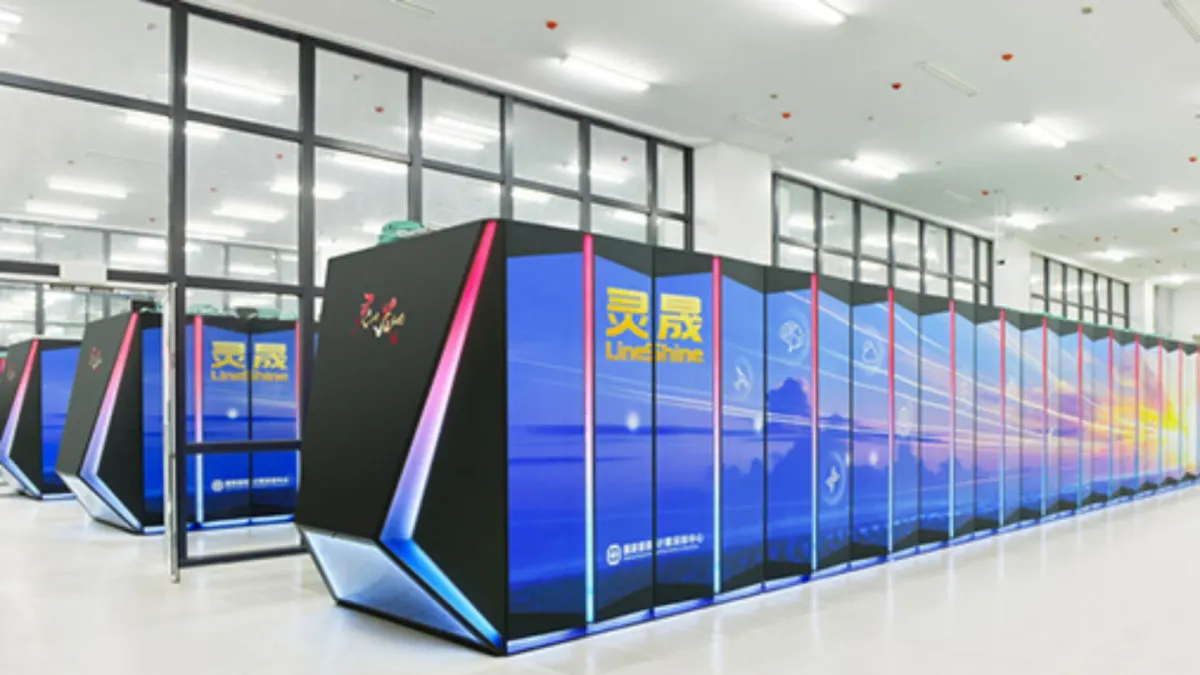
For the first time in nearly a decade, the world's most powerful supercomputer isn't American. Instead, a previously unlisted Chinese behemoth called LineShine just swooped in to claim the top spot, flexing some serious digital muscle.
Unveiled at the ISC 2026 conference in Hamburg, Germany, LineShine debuted at number one on the TOP500 list, a ranking that, let's be honest, sounds like something out of a sci-fi movie. It clocked in at a mind-bending 2.198 Exaflop/s on the High Performance Linpack (HPL) benchmark. To put that in perspective, it's the first system ever to push past two exaflops using only CPUs. Your laptop just shed a tear.

The Brains Behind the Brute Force
LineShine lives at the National Supercomputing Center in Shenzhen, built by the Shenzhen Cloud Computing Center. It runs on a custom Chinese processor and a platform called "LingKun." Because, of course, a supercomputer that powerful needs a name that sounds like a mythical beast.
We're a new kind of news feed.
Regular news is designed to drain you. We're a non-profit built to restore you. Every story we publish is scored for impact, progress, and hope.
Start Your News DetoxThis digital titan boasts 13.79 million cores across 304-core LX2 processors, all humming along at 1.55 GHz. They're connected by a special "LingQi" interconnect and run on Kylin OS. All that power sips about 42.2 megawatts, which, if you're keeping track, is a lot of juice. But it does so with an impressive efficiency of 52.07 Gigaflops/Watt.
What makes LineShine a bit of an anomaly is its reliance on CPUs. Many modern supercomputers, especially those geared for AI, lean heavily on GPUs. But LineShine decided to go old school and just be really good at it. Its arrival means there are now five exascale systems (those capable of over one exaflop/s) scattered across Asia, North America, and Europe. The global digital arms race is officially on.

The Rest of the Bragging Rights
While China's LineShine is currently wearing the crown, the next three spots on the list are still held by the United States. El Capitan, last year's champ at Lawrence Livermore National Laboratory, now sits in second with a still-staggering 1.89 Exaflop/s. Oak Ridge National Laboratory's Frontier is third, and Germany's Jupiter Booster rounds out the top five.
Supercomputers are the unsung heroes behind everything from predicting the weather (sometimes accurately) to developing new medicines and even simulating nuclear explosions. Their power is often seen as a barometer of a nation's tech prowess. China's latest win definitely raises a few eyebrows in the West, though whispers suggest new, even more powerful machines from the US and Europe might soon be ready to challenge the throne. Because apparently, just being really, really fast isn't fast enough.