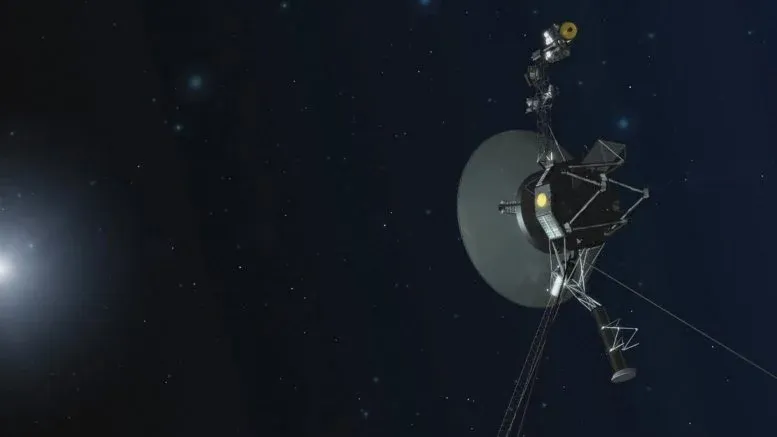
Turns out, even after 46 years and billions of miles, NASA engineers still have a few tricks up their sleeves. They've just pulled off a clever maneuver to keep the venerable Voyager 2 spacecraft chugging along, extending its scientific mission for at least another year.
The team at NASA's Jet Propulsion Laboratory (JPL) basically put Voyager 2 on a power diet. This gives the historic probe more time to send back data from the interstellar void, because apparently, it's not done exploring yet.
The Big Bang (of Power Saving)
The operation, rather dramatically dubbed the "Big Bang," involved simultaneously powering down several devices. These were then swapped out for alternatives that sip electricity rather than guzzle it. Crucially, the engineers also made sure Voyager 2 wouldn't freeze solid, because even in deep space, warmth is apparently non-negotiable for delicate electronics.
We're a new kind of news feed.
Regular news is designed to drain you. We're a non-profit built to restore you. Every story we publish is scored for impact, progress, and hope.
Start Your News DetoxVoyager 2, along with its twin Voyager 1, generates its own juice from radioisotope thermoelectric generators. Think of them as tiny, plutonium-powered ovens that convert heat from decaying plutonium into electricity. Which, if you think about it, is both impressive and slightly terrifying.
Here's the rub: every year, as the plutonium slowly dwindles, the available power drops by about four watts. After nearly half a century, these probes are running on fumes. So, the mission team has had to be ruthless, turning off anything deemed non-essential.
Since 2024, this power decline forced them to switch off two science instruments on each Voyager. Each spacecraft originally carried ten, with others having been shut down earlier after their planetary flybys were complete. The remaining ones are the real workhorses.
Without this "Big Bang" effort, another instrument on Voyager 2 would have gone dark before the end of 2026. Now, thanks to the newly salvaged power, the spacecraft's three remaining instruments can operate for at least one more year. Let that satisfying number sink in.
And because you can't have one twin without the other, the mission team plans to implement the same power-saving changes on Voyager 1 in the coming months. Voyager 1, for the record, is currently even farther from Earth than Voyager 2. Because apparently that's where we are now.