Islands are basically nature's petri dish for evolution. Keep a population isolated long enough, and suddenly you've got a whole new species doing its own thing, completely oblivious to its cousins across the water.
But what if the island is, well, huge? Big enough to have its own internal borders and distinct environments? Can evolution still play its greatest hits within a single landmass, or does it need that salty separation to really get creative?
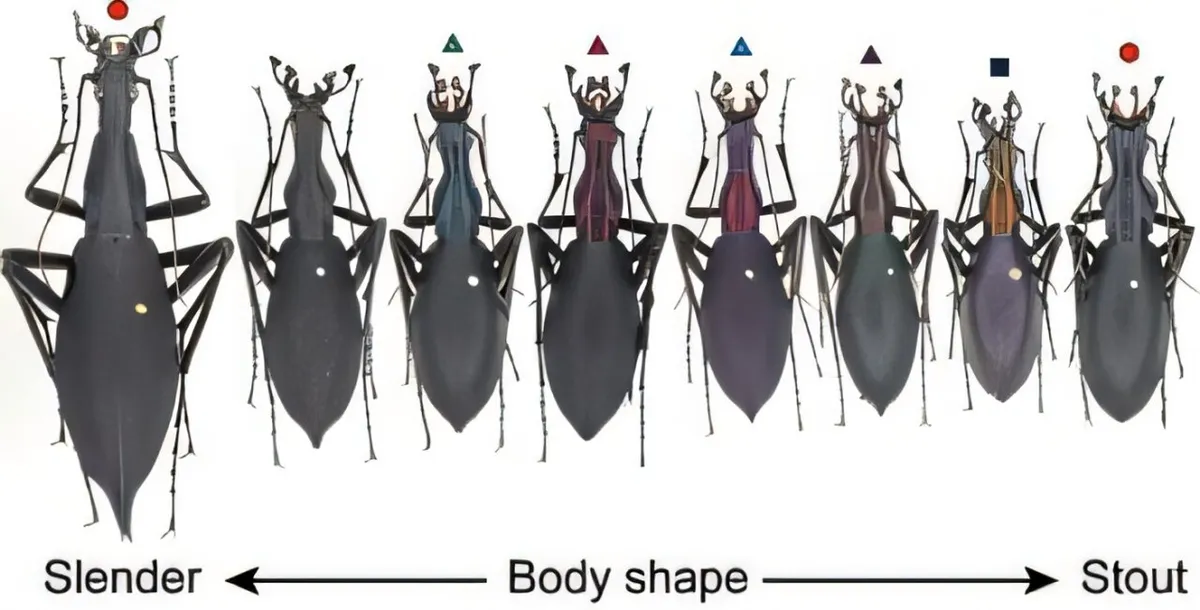
Enter the Carabus blaptoides beetle, a creature that apparently skipped leg day for its wings. These flightless gourmands are found all over Japan, and they've diversified into eight distinct subspecies. The key to their evolutionary glow-up? They can't fly. Their hind wings are basically vestigial nubs, forcing them to get around strictly on foot. This means populations don't exactly mix and mingle, making them perfect for observing how geography shapes destiny.
We're a new kind of news feed.
Regular news is designed to drain you. We're a non-profit built to restore you. Every story we publish is scored for impact, progress, and hope.
Start Your News DetoxThe Great Snail Divide
These beetles are snail-munching specialists, and their body shapes have evolved to match their preferred prey. Some are slender, sporting long, narrow heads and chests, perfectly designed for spelunking deep inside large snail shells. Others are stout, with short, wide heads and powerful jaws, built for crushing smaller, more compact shells. It's basically the difference between a surgical tool and a tiny, armored nutcracker.
For years, the thinking was that the local snail menu drove these specialized body types. A research team led by Associate Professor Junji Konuma from Toho University, along with Nobuaki Nagata and Professor Teiji Sota, decided to put that theory to the test. They gathered genetic data from 170 beetles across 70 locations and combined it with body shape data from 50 different populations.
The results? Published in the Biological Journal of the Linnean Society, their analysis confirmed that these distinct body shapes didn't just evolve between separate islands like Hokkaido and Sado. They also popped up within Honshu, Japan's largest island. Apparently, even on a single landmass, if you can't fly, distance and differing environments are enough to spark some serious evolutionary innovation.
Konuma noted that while adaptive changes are often discussed for oceanic islands, their findings suggest that even on large continental islands, limited travel for flightless animals means populations stay isolated enough to evolve their own unique flair. Because sometimes, the biggest barrier isn't an ocean, but just a really long walk.