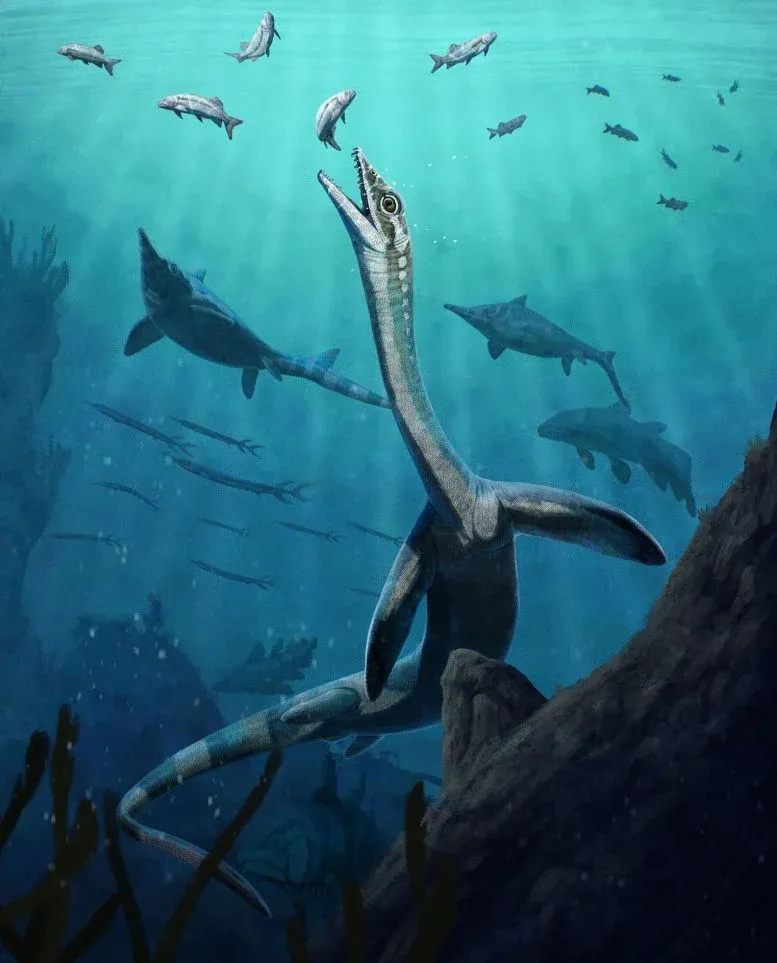
An international team of researchers has found a unique fossil in China. It's a 245-million-year-old marine reptile with its digestive system still preserved. This is the first time scientists have seen such detailed internal organs in a long-necked marine reptile from that era.
The fossil, almost complete, shows the stomach, liver, and intestines of Austronaga minuta. This small, long-necked reptile was an ancestor of land animals but had adapted well to ocean life.
Scientists from China, Europe, and the U.S., including Dr. Stephan Spiekman, used advanced methods to study the fossil. Their findings offer the first detailed look at the animal's skeleton and much of its digestive tract. This makes it the oldest known example of a mostly complete reptile digestive system. The research was published in Science Advances.
We're a new kind of news feed.
Regular news is designed to drain you. We're a non-profit built to restore you. Every story we publish is scored for impact, progress, and hope.
Start Your News DetoxAn Ancient Swimmer's Unique Body
During the Triassic period, many long-necked marine reptiles lived in the seas that once covered China. Austronaga minuta, at 60 centimeters long, had a very unusual body.
It had an extremely long neck and tail. The tail was its main power source for swimming, while its long, fin-like front limbs helped it steer. Its back limbs were much smaller and didn't help much with swimming.
This body shape is surprising because Austronaga was only distantly related to other marine reptiles like ichthyosaurs and giant mosasaurs, which developed similar swimming styles. Instead, Austronaga was closer to land-dwelling archosaurs, a group that includes dinosaurs and crocodiles.
Dr. Stephan Spiekman, a specialist in long-necked marine reptiles and co-author of the study, noted that archosaurs were the most diverse land reptiles during the dinosaur age. He explained that scientists thought their adaptation to sea life was limited. However, Austronaga shows that early archosaurs had already developed complex ways to live in the ocean, similar to other well-known marine reptiles.
Soft Tissues Reveal Ancient Organs
Researchers noticed a dark area between the fossil's ribs. Closer inspection showed it contained the remains of a digestive tract, mostly intact.
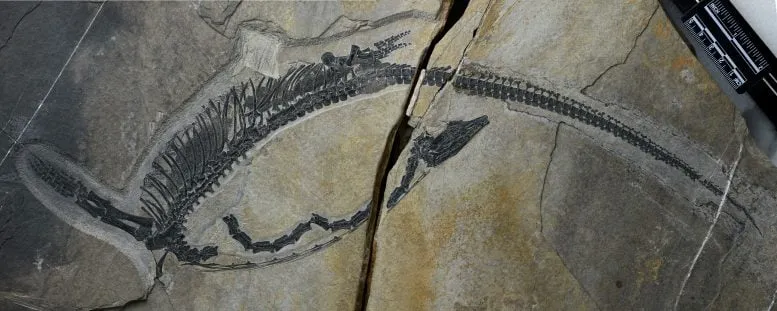
The scientists used methods like ultraviolet light photography and mass spectrometry to identify the individual organs.
Dr. Wei Wang, the lead author and a marine reptile expert, explained that despite Austronaga's specialized body, its internal organs seemed less modified. The preserved organs include a large, sac-like stomach, a reddish liver with traces of hemoglobin, and a long, simple tube for the small and large intestines. The digestive system was relatively simple. This fossil is the oldest known example of a mostly complete reptile digestive system.
Simple Stomachs in Early Archosaurs
Dr. Nick Fraser, another author of the study, pointed out that modern birds and crocodiles have a two-part stomach. However, Austronaga had only one stomach chamber. This suggests that early archosaur stomachs were simple and evolved later. He also noted that Austronaga had a short, uncomplicated digestive tract, much like today's fish-eating reptiles.
This research is part of a larger effort to understand the early history of modern reptile groups and their diversity in Triassic seas. Future discoveries could provide more clues about how marine reptiles are related to their land-based relatives. The fossil is currently housed in Beijing.
Deep Dive & References
Highly aquatic marine stem archosaur with soft tissue preservation - Science Advances, 2026