Imagine finding a missing piece of a puzzle, but the puzzle is Mars, and the piece is 2 billion years of its volcanic history. That's essentially what scientists just pulled off, all thanks to a rather unassuming rock found in Algeria.
This isn't just any space rock. It’s a Martian meteorite, dubbed Northwest Africa (NWA) 13441, and it’s unlike any other. Researchers at Boston College dated it to a rather precise 1.273 billion years ago. Why is that a big deal? Because it slots neatly into a massive, 1.8-billion-year blank space in the known record of Martian shergottites — the most common type of meteorite from the Red Planet.
“The characteristics of this meteorite were entirely surprising,” said Ethan Baxter, a professor at Boston College. Because apparently, Mars decided to keep some secrets until now.
We're a new kind of news feed.
Regular news is designed to drain you. We're a non-profit built to restore you. Every story we publish is scored for impact, progress, and hope.
Start Your News DetoxThe Planet's Hidden Depths
But wait, there's more. The meteorite's chemical makeup suggests it didn't just pop off the surface. It came from a deep, previously unsampled part of Mars. Think of it as a geological time capsule from the planet's interior, carrying a chemical signature that’s been chilling since the early days of the solar system.
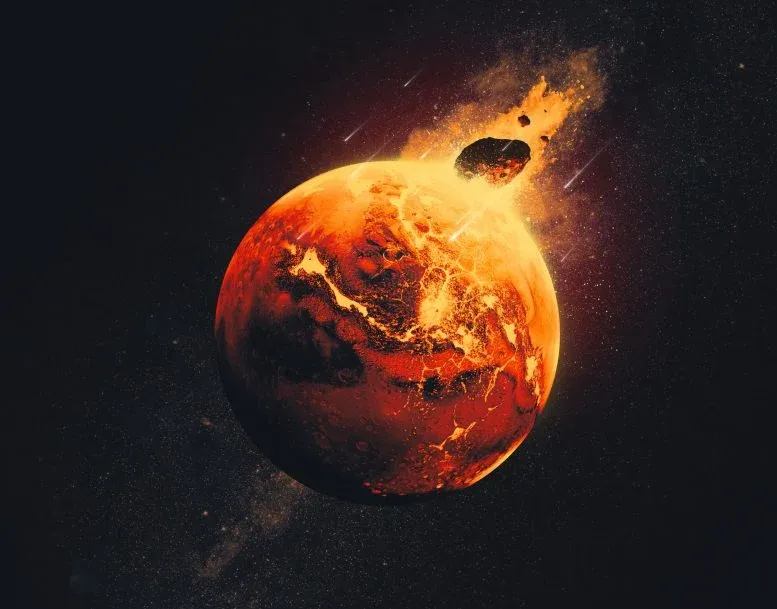
Since we can't exactly send a team of geologists to Mars with rock hammers (yet), these meteorites are our VIP passes to understanding the planet’s past. They get blasted off Mars by powerful impacts, hurtle through space, and then, if they’re lucky (or unlucky, depending on your perspective), survive a fiery entry into Earth’s atmosphere.
Only about 400 Martian meteorites have ever been found. And most of the shergottites among them are either younger than 600 million years or ancient, around 2.4 billion years old. NWA 13441 just waltzed in and filled that awkward, nearly 2-billion-year gap in the middle. “We dated this sample to be 1.273 billion years old, which fills a roughly 2 billion year gap,” explained lead author Dylan M. Seal. Let that satisfying number sink in.
Earth's Restless Cousin
What makes this particularly juicy is the meteorite's neodymium isotope composition. Without getting too bogged down in the atomic details, let's just say it's “chondritic.” This means it looks like the pristine, original material from the very formation of our solar system 4.56 billion years ago. No other shergottite has shown this particular chemical fingerprint, implying its magma came from a part of Mars's interior that has remained untouched for eons.
This highlights a major difference between our home planet and its rusty neighbor. Earth’s plate tectonics are constantly churning, melting, and recycling its crust, making ancient history hard to find. Mars, however, formed quickly and then mostly settled down under a stable outer shell. This allowed ancient chemical reservoirs to survive, essentially preserving geological memories that Earth has long since erased.
So, this little Algerian rock isn't just a curiosity; it's a direct line to how Mars (and potentially other planets) evolved billions of years ago. The team is still digging into NWA 13441, looking at other isotope systems to fully unravel how this unique sample fits into the grand, turbulent story of Mars. Because apparently, even planets have hidden depths waiting to be discovered.